


Sale
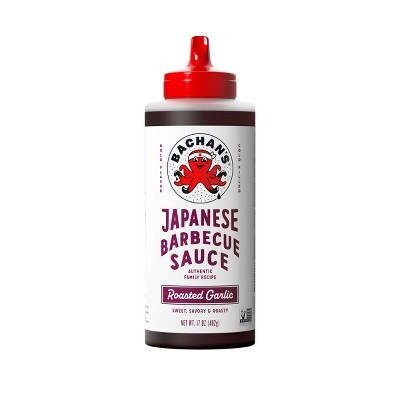
Roasted Garlic Japanese Bbq Sauce - 17Oz
Bachans
$7.99
$5.49
(No reviews yet)

Write a Review
Bachans
Roasted Garlic Japanese Bbq Sauce - 17Oz
Bachan's Roasted Garlic Japanese BBQ Sauce brings the bold umami depth of a classic Japanese-style tare — now layered with slow-roasted garlic and a touch of organic ginger — into one versatile bottle. Built on a Non-GMO soy sauce base with organic roasted garlic, organic mirin, organic rice vinegar, and organic toasted sesame oil, this is a carefully balanced sauce where every ingredient earns its place.
- Use it as a marinade, glaze, dipping sauce, or finishing drizzle — ideal on grilled chicken, salmon, roasted vegetables, rice bowls, noodles, and stir-fries
- Made with Non-GMO Project Verified soy sauce and multiple certified organic aromatics — roasted garlic, ginger, sesame oil, and rice vinegar are all organic-sourced
- No artificial preservatives, no high-fructose corn syrup, and no artificial flavors — suitable for households avoiding highly processed condiments
Bachan's Japanese BBQ Sauce has built a cult following among home cooks who want the layered complexity of a restaurant-quality tare without making it from scratch. The Roasted Garlic variety adds a deeper, caramelized garlic note to the brand's original umami-forward profile — a meaningful upgrade for anyone who reaches for garlic in nearly every savory application.
The 17 oz bottle contains a sauce built on Non-GMO Project Verified soy sauce (water, soybeans, wheat, salt) as its foundation, enriched with cane sugar, organic roasted garlic, organic garlic, mirin (water, rice, koji seed, sea salt), organic rice vinegar, tomato paste, organic ginger, sea salt, and organic toasted sesame oil. The double-garlic profile — both roasted and raw organic garlic — creates a sauce with genuine depth rather than a single flat note. Mirin and rice vinegar provide balanced sweet-acid contrast; sesame oil adds a toasted finish.
Bachan's is shelf-stable before opening. Store in a cool, dry place; refrigerate after opening. The sauce contains wheat (from the soy sauce base) and soy, making it unsuitable for those with gluten or soy allergies. Not vegan due to potential shared processing, and contains wheat — confirm label for your dietary needs.
Ingredients: Non-Gmo Soy Sauce (Water, Soybeans, Wheat, Salt), Cane Sugar, Organic Roasted Garlic, Organic Garlic, Mirin (Water, Rice, Koji Seed, Sea Salt), Organic Rice Vinegar, Tomato Paste, Organic Ginger, Green Onion, Sea Salt, And Organic Toasted Sesame Oil.
Common Questions
How does the roasted garlic version differ from Bachan's original Japanese BBQ Sauce in terms of actual flavor profile?
The Roasted Garlic variety uses two distinct forms of garlic — organic roasted garlic and organic garlic — which create layered flavor rather than a single sharp note. Roasting converts sharp allicin-driven pungency into sweeter, caramelized compounds like diallyl disulfide, which is why roasted garlic tastes mellower and more complex than raw. The raw organic garlic underneath still provides some brightness and bite, so the sauce lands somewhere between mellow-sweet and assertive rather than either extreme. The result is particularly useful for longer cooking applications like braises, slow-roasted meats, or sticky glazes where raw garlic can turn acrid — the roasted component holds up to heat without turning bitter.
What does Non-GMO Project Verified actually mean for the soy sauce in this product, and how does it differ from an organic certification?
Non-GMO Project Verified means the soybeans used in the soy sauce have been tested and confirmed to contain less than 0.9% GMO content, which is the threshold the Non-GMO Project uses for verification — it is an identity-preservation standard focused solely on genetic modification status. Organic certification, by contrast, prohibits GMOs as one requirement but also mandates no synthetic pesticides, no synthetic fertilizers, and specific soil management practices. The soy sauce itself is listed as Non-GMO Project Verified but not certified organic, while several other ingredients in this sauce — roasted garlic, garlic, rice vinegar, ginger, sesame oil — are individually labeled organic. The Organic certification on the product overall indicates those specified organic ingredients meet USDA National Organic Program standards, which are independently audited.
Does this sauce contain gluten, and is it safe for people with celiac disease or gluten sensitivity?
Yes, this sauce contains gluten. The soy sauce base is made from water, soybeans, wheat, and salt — traditional brewed soy sauce uses wheat as a fermentation substrate, and wheat-derived proteins remain in the finished sauce. This makes Bachan's Roasted Garlic Japanese BBQ Sauce unsuitable for anyone with celiac disease or a non-celiac gluten sensitivity. There is no gluten-free claim on this product, and wheat is listed as a named allergen in the ingredients. Anyone requiring a gluten-free soy-based sauce should look specifically for tamari, which is traditionally brewed without wheat, though individual tamari products should still be verified for cross-contact risk.
What savory dishes can I actually use this sauce in, and does the garlic-forward profile require any cooking adjustments?
Bachan's Roasted Garlic works well as a direct marinade for chicken thighs, pork shoulder, skirt steak, salmon, and tofu — the mirin and cane sugar in the formula promote caramelization quickly, so high-heat applications like grilling or broiling benefit from applying the sauce in the final 3-5 minutes rather than the entire cook to avoid burning. As a stir-fry sauce, it works as a one-ingredient addition — the soy, vinegar, and sesame oil are already balanced, so you do not need to build a separate sauce. It substitutes well for teriyaki sauce in rice bowls, noodle dishes, and sheet pan meals at a 1:1 ratio. The roasted garlic depth also makes it functional as a glaze for roasted vegetables like cauliflower, Brussels sprouts, and eggplant, where it reduces into a sticky, umami-rich coating during the last 10 minutes at high heat.
What role does mirin play in the sauce, and how does it interact with the other ingredients chemically?
Mirin is a sweet rice wine with a natural sugar content typically between 40-50% by weight, and in this formula it is made from water, rice, koji seed, and sea salt. Koji (Aspergillus oryzae) produces amylase enzymes during fermentation that break down rice starches into glucose and maltose, which is why mirin contributes a gentler, rounder sweetness than refined sugar alone. When combined with soy sauce in a heated application, mirin's sugars participate in the Maillard reaction — the same browning mechanism responsible for seared meat crust — which is why sauces containing mirin produce deep, lacquered glazes on proteins and vegetables. The rice vinegar in the formula counterbalances mirin's sweetness with acetic acid, preventing the sauce from reading as cloying. Together, the mirin-vinegar pair creates the characteristic sweet-tart tension that defines Japanese tare-style sauces.
Is this sauce appropriate for keto, paleo, or Whole30 diet protocols?
This sauce contains cane sugar and mirin, both of which contribute meaningful carbohydrates, making it incompatible with strict ketogenic macros — a typical serving of Japanese BBQ sauce in this style contains roughly 8-12 grams of sugar per tablespoon, which would consume a significant portion of a standard keto daily carbohydrate limit of 20-25 grams. For paleo adherents, the sauce is similarly problematic on two counts: soy is excluded from most paleo frameworks, and refined cane sugar is not considered paleo-compliant. Whole30 excludes both soy sauce and added sugars in any form, so this sauce does not meet that protocol either. For reduced-carb cooking where strict compliance is not required, using smaller quantities as a finishing glaze rather than a marinade limits total sugar intake while still delivering the flavor profile.
How should this sauce be stored after opening, and what is a reasonable shelf life once opened?
Before opening, Bachan's is shelf-stable and should be kept in a cool, dry place away from direct heat and sunlight. After opening, the sauce should be refrigerated promptly — the combination of soy sauce, vinegar, and sugar creates a moderately preserved environment, but refrigeration slows oxidation of the sesame oil and prevents any microbial growth. Bachan's recommends consuming the sauce within 3 months of opening for best quality, though the high salt and acid content means properly refrigerated sauce often remains safe and flavorful beyond that window. The organic sesame oil is the most oxidation-sensitive ingredient and is usually the first indicator of quality decline — if the sauce develops a stale or rancid aroma, that is the signal it has passed its peak.
The 17 oz bottle contains a sauce built on Non-GMO Project Verified soy sauce (water, soybeans, wheat, salt) as its foundation, enriched with cane sugar, organic roasted garlic, organic garlic, mirin (water, rice, koji seed, sea salt), organic rice vinegar, tomato paste, organic ginger, sea salt, and organic toasted sesame oil. The double-garlic profile — both roasted and raw organic garlic — creates a sauce with genuine depth rather than a single flat note. Mirin and rice vinegar provide balanced sweet-acid contrast; sesame oil adds a toasted finish.
Bachan's is shelf-stable before opening. Store in a cool, dry place; refrigerate after opening. The sauce contains wheat (from the soy sauce base) and soy, making it unsuitable for those with gluten or soy allergies. Not vegan due to potential shared processing, and contains wheat — confirm label for your dietary needs.
Ingredients: Non-Gmo Soy Sauce (Water, Soybeans, Wheat, Salt), Cane Sugar, Organic Roasted Garlic, Organic Garlic, Mirin (Water, Rice, Koji Seed, Sea Salt), Organic Rice Vinegar, Tomato Paste, Organic Ginger, Green Onion, Sea Salt, And Organic Toasted Sesame Oil.
Common Questions
How does the roasted garlic version differ from Bachan's original Japanese BBQ Sauce in terms of actual flavor profile?
The Roasted Garlic variety uses two distinct forms of garlic — organic roasted garlic and organic garlic — which create layered flavor rather than a single sharp note. Roasting converts sharp allicin-driven pungency into sweeter, caramelized compounds like diallyl disulfide, which is why roasted garlic tastes mellower and more complex than raw. The raw organic garlic underneath still provides some brightness and bite, so the sauce lands somewhere between mellow-sweet and assertive rather than either extreme. The result is particularly useful for longer cooking applications like braises, slow-roasted meats, or sticky glazes where raw garlic can turn acrid — the roasted component holds up to heat without turning bitter.
What does Non-GMO Project Verified actually mean for the soy sauce in this product, and how does it differ from an organic certification?
Non-GMO Project Verified means the soybeans used in the soy sauce have been tested and confirmed to contain less than 0.9% GMO content, which is the threshold the Non-GMO Project uses for verification — it is an identity-preservation standard focused solely on genetic modification status. Organic certification, by contrast, prohibits GMOs as one requirement but also mandates no synthetic pesticides, no synthetic fertilizers, and specific soil management practices. The soy sauce itself is listed as Non-GMO Project Verified but not certified organic, while several other ingredients in this sauce — roasted garlic, garlic, rice vinegar, ginger, sesame oil — are individually labeled organic. The Organic certification on the product overall indicates those specified organic ingredients meet USDA National Organic Program standards, which are independently audited.
Does this sauce contain gluten, and is it safe for people with celiac disease or gluten sensitivity?
Yes, this sauce contains gluten. The soy sauce base is made from water, soybeans, wheat, and salt — traditional brewed soy sauce uses wheat as a fermentation substrate, and wheat-derived proteins remain in the finished sauce. This makes Bachan's Roasted Garlic Japanese BBQ Sauce unsuitable for anyone with celiac disease or a non-celiac gluten sensitivity. There is no gluten-free claim on this product, and wheat is listed as a named allergen in the ingredients. Anyone requiring a gluten-free soy-based sauce should look specifically for tamari, which is traditionally brewed without wheat, though individual tamari products should still be verified for cross-contact risk.
What savory dishes can I actually use this sauce in, and does the garlic-forward profile require any cooking adjustments?
Bachan's Roasted Garlic works well as a direct marinade for chicken thighs, pork shoulder, skirt steak, salmon, and tofu — the mirin and cane sugar in the formula promote caramelization quickly, so high-heat applications like grilling or broiling benefit from applying the sauce in the final 3-5 minutes rather than the entire cook to avoid burning. As a stir-fry sauce, it works as a one-ingredient addition — the soy, vinegar, and sesame oil are already balanced, so you do not need to build a separate sauce. It substitutes well for teriyaki sauce in rice bowls, noodle dishes, and sheet pan meals at a 1:1 ratio. The roasted garlic depth also makes it functional as a glaze for roasted vegetables like cauliflower, Brussels sprouts, and eggplant, where it reduces into a sticky, umami-rich coating during the last 10 minutes at high heat.
What role does mirin play in the sauce, and how does it interact with the other ingredients chemically?
Mirin is a sweet rice wine with a natural sugar content typically between 40-50% by weight, and in this formula it is made from water, rice, koji seed, and sea salt. Koji (Aspergillus oryzae) produces amylase enzymes during fermentation that break down rice starches into glucose and maltose, which is why mirin contributes a gentler, rounder sweetness than refined sugar alone. When combined with soy sauce in a heated application, mirin's sugars participate in the Maillard reaction — the same browning mechanism responsible for seared meat crust — which is why sauces containing mirin produce deep, lacquered glazes on proteins and vegetables. The rice vinegar in the formula counterbalances mirin's sweetness with acetic acid, preventing the sauce from reading as cloying. Together, the mirin-vinegar pair creates the characteristic sweet-tart tension that defines Japanese tare-style sauces.
Is this sauce appropriate for keto, paleo, or Whole30 diet protocols?
This sauce contains cane sugar and mirin, both of which contribute meaningful carbohydrates, making it incompatible with strict ketogenic macros — a typical serving of Japanese BBQ sauce in this style contains roughly 8-12 grams of sugar per tablespoon, which would consume a significant portion of a standard keto daily carbohydrate limit of 20-25 grams. For paleo adherents, the sauce is similarly problematic on two counts: soy is excluded from most paleo frameworks, and refined cane sugar is not considered paleo-compliant. Whole30 excludes both soy sauce and added sugars in any form, so this sauce does not meet that protocol either. For reduced-carb cooking where strict compliance is not required, using smaller quantities as a finishing glaze rather than a marinade limits total sugar intake while still delivering the flavor profile.
How should this sauce be stored after opening, and what is a reasonable shelf life once opened?
Before opening, Bachan's is shelf-stable and should be kept in a cool, dry place away from direct heat and sunlight. After opening, the sauce should be refrigerated promptly — the combination of soy sauce, vinegar, and sugar creates a moderately preserved environment, but refrigeration slows oxidation of the sesame oil and prevents any microbial growth. Bachan's recommends consuming the sauce within 3 months of opening for best quality, though the high salt and acid content means properly refrigerated sauce often remains safe and flavorful beyond that window. The organic sesame oil is the most oxidation-sensitive ingredient and is usually the first indicator of quality decline — if the sauce develops a stale or rancid aroma, that is the signal it has passed its peak.
- __Storage_Location:
- Dry
- __Volume:
- 2500
- __Owner:
- TCFarm
- __badge:
- Non-GMO