


Berry Bliss Smoothie Cup - 7 oz
Live More Organics
$5.89
(No reviews yet)

Write a Review
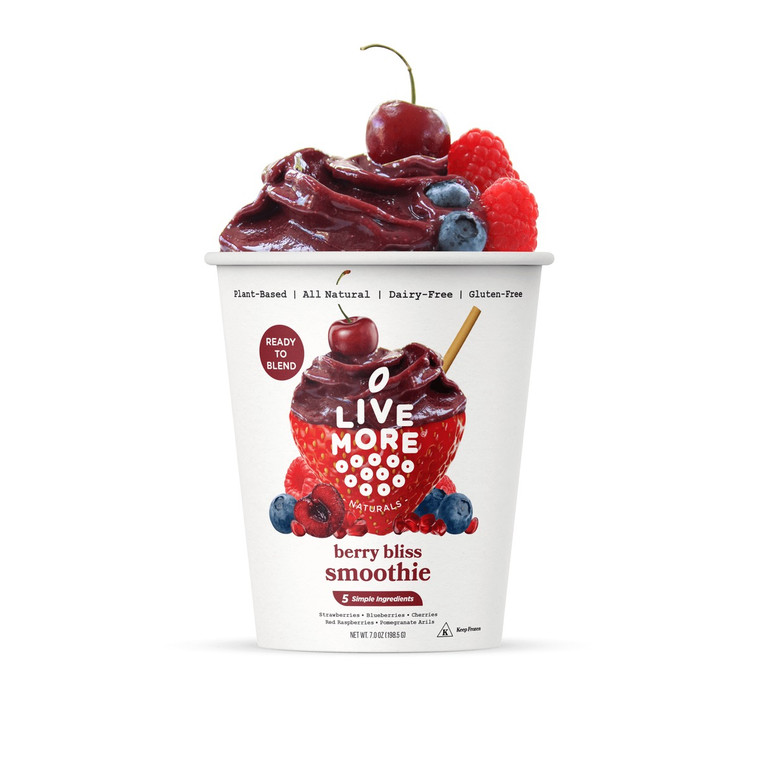
Live More Organics
Berry Bliss Smoothie Cup - 7 oz
Five whole fruits. Zero added sugar. One cup, one blend, one pour. LiveMore Organics' Berry Bliss Smoothie Cup packs strawberries, blueberries, cherries, raspberries, and pomegranate arils — all frozen at peak ripeness — into a single pre-portioned cup. Add your liquid of choice, blend, and you're done. No chopping, no measuring, no waste.
- Built for real mornings: pre-portioned at 198g per cup, the frozen fruit goes straight from cup to blender — fill to the line with water, juice, oat milk, or almond milk and blend. Pour it back into the cup and sip.
- 22% DV dietary fiber per serving from whole fruit (6g), with 301mg potassium and 0mg sodium — all from five recognizable fruits, nothing else.
- Certified Organic, 100% plant-based, gluten-free, dairy-free, and free of preservatives and added sugars — suitable for vegan, gluten-free, and whole-food plant-based lifestyles.
LiveMore Organics' Berry Bliss Smoothie Cup is a Certified Organic, pre-portioned blend of five whole fruits — strawberries, blueberries, cherries, raspberries, and pomegranate arils — frozen and ready to blend. It is not a pre-mixed smoothie and not a powder; it is exactly what it sounds like: real fruit in a cup with a fill line and a lid.
Each 198g cup delivers 120 calories, 6g of dietary fiber (22% DV), 2g of protein, 301mg of potassium (6% DV), and 17g of total sugars — every gram from the fruit itself, with 0g added sugars. There is no sodium, no cholesterol, and no fat worth mentioning (1g total, 0g saturated). The pomegranate arils are the standout here: a fruit that rarely makes it into grocery-store smoothie bags, they contribute anthocyanins and ellagitannins alongside the anthocyanin-rich blueberries and cherries and the vitamin C backbone of the strawberries and raspberries.
To use: pour the frozen fruit directly into your blender, fill the cup with your preferred liquid up to the marked line, blend until smooth, and pour back into the cup to drink. For a thicker result, use less liquid; for a lighter texture, add more. The cup doubles as your glass — no extra dishes.
One customer noted: the product is the fruit itself, not a pre-blended, ready-to-drink smoothie. If you're expecting a shake in a bottle, this isn't it. If you want whole certified-organic fruit, portioned and frozen for you, with nothing added, this is exactly that.
Customer perspective: the one published review flags a mismatch in expectation — the buyer's household initially thought it was a pre-mixed drink. Once they understood the format (fruit cup + your liquid + your blender), the result was described as a great smoothie. The honest note: you will need a blender, a liquid, and about two minutes.
Certified Organic, 100% plant-based, gluten-free, dairy-free, no added sugars, no preservatives. Store frozen; use directly from freezer.
Ingredients: Strawberries, Blueberries, Cherries, Raspberries, and Pomegranate Arils.
Common Questions
How does the fiber and sugar content in Berry Bliss compare to a typical store-bought smoothie drink?
Most bottled smoothie drinks on the market contain 2g or less of dietary fiber per serving while delivering 25–40g of total sugars, often with a portion of those coming from added sweeteners like cane juice or fruit concentrate. Berry Bliss provides 6g of dietary fiber (22% of the daily value) and 17g of total sugars in a 198g serving, with every gram of sugar coming directly from the five whole fruits — strawberries, blueberries, cherries, raspberries, and pomegranate arils — and 0g added sugars. Dietary fiber at that level meaningfully slows glucose absorption compared to a juice or pre-blended bottled drink where fruit solids have been strained or processed out. The difference comes down to format: this is frozen whole fruit, not a pre-processed beverage.
What makes pomegranate arils nutritionally significant, and why are they unusual in a frozen smoothie product?
Pomegranate arils contain two classes of polyphenols that are rarely found together in a single ingredient: anthocyanins, which give the fruit its deep red color and have been studied for anti-inflammatory activity, and ellagitannins — specifically punicalagin — which the gut microbiome converts into urolithin A, a compound linked in peer-reviewed research to mitochondrial function and muscle cell health. Punicalagin is found in meaningful concentrations almost exclusively in pomegranate, making it genuinely distinct from the other berries in this blend. Whole pomegranate arils rarely appear in commercial frozen smoothie bags because the fruit is labor-intensive to process; most products use pomegranate juice powder or concentrate instead, which strips the fiber and alters the polyphenol profile. The arils in this cup are frozen whole, preserving the seed, juice sac, and associated fiber intact.
Does Berry Bliss fit a low-sugar or diabetic-friendly diet given that it contains 17g of sugars?
The 17g of sugars in this product are entirely intrinsic fruit sugars — fructose and glucose bound within intact fruit cells alongside 6g of dietary fiber. The glycemic impact of whole fruit is meaningfully lower than equivalent grams of sugar from juice or added sweeteners because the fiber slows gastric emptying and glucose absorption; this distinction is well-documented in research comparing whole fruit consumption to juice in glycemic response studies. That said, 17g of sugar from any source is not negligible for individuals managing blood glucose closely, and the appropriate portion size depends on an individual's specific dietary plan and medical guidance. Berry Bliss carries no added sugars and no artificial sweeteners, which makes it a cleaner choice within a moderate-carbohydrate framework, but it is not a keto-compatible food — the carbohydrate load (the full nutrition panel is not listed here but the sugar content alone places it above typical keto thresholds of 20–50g net carbs daily when combined with other foods). Paleo and whole-food plant-based diets accommodate this product without restriction.
What does the Certified Organic designation actually mean for this product, and how is it verified?
USDA Certified Organic status requires that all agricultural ingredients — in this case, all five fruits — be grown without synthetic pesticides, synthetic fertilizers, sewage sludge, genetic engineering, or ionizing radiation. The certification is issued not by the USDA directly but by a USDA-accredited third-party certifying agent, which conducts annual on-site inspections of farms and processing facilities and reviews audit trail documentation for each ingredient. For a multi-ingredient product like this, every fruit in the blend must individually qualify; a product cannot be labeled Certified Organic if even one ingredient is conventional. The certifying agent's name is required to appear on the packaging, which is the primary way a consumer can independently verify the claim — you can cross-reference that certifier against the USDA's public database of accredited certifying agents at ams.usda.gov. Berry Bliss also carries Gluten-Free and No Added Sugars certifications, each verified by separate third-party bodies with their own testing and audit protocols.
Can I use Berry Bliss as a base for recipes other than a plain blended smoothie?
Yes — because the product is simply frozen whole fruit with nothing added, it behaves in any recipe exactly as fresh or frozen fruit would. The blend works well as a base for smoothie bowls by using minimal liquid and blending to a thick, spoonable consistency, then topping with granola, seeds, or nut butter. The mix of strawberries, blueberries, cherries, and raspberries produces a strongly colored, tart-sweet puree that can be thawed and cooked down into a mixed-berry compote or coulis for use over pancakes, oatmeal, or yogurt — the pomegranate arils will largely dissolve into the sauce during cooking. Partially thawed, the fruit can also be folded into overnight oats or chia pudding without blending. The one adaptation to note for cooked applications is that the pomegranate arils have a slightly firmer texture than the berries when only partially thawed, so allowing full thaw before mixing produces a more uniform result.
How much liquid should I actually add, and does the type of liquid affect nutrition meaningfully?
The cup includes a marked fill line intended as a starting guide; in practice, the volume of liquid controls texture — less liquid produces a thick, bowl-style consistency, more produces a thinner drinkable smoothie. The liquid you choose does change the nutritional profile of the finished drink significantly. Unsweetened almond milk (approximately 30–40 calories per cup, 1g protein) keeps the calorie count close to the base 120 calories from the fruit. Whole dairy milk adds roughly 150 calories, 8g protein, and 8g fat per cup. Coconut water adds electrolytes — approximately 600mg potassium per cup — and about 45 calories of additional natural sugar. Orange juice would add another 110 calories and roughly 20g of sugar per cup, nearly doubling the total sugar load of the finished drink. Plain water adds nothing but volume and is a legitimate option if you want the flavor and nutrition of the fruit alone without any additional calories or macros.
Is there any prep required, or does the fruit go directly from the freezer into the blender?
The fruit goes directly from the freezer into the blender — no thawing is required or recommended, and the frozen state is what gives a blended smoothie its cold temperature and thick texture without needing ice. The only preparation step is adding your liquid of choice to the fill line marked on the cup before blending. Standard countertop blenders handle frozen fruit without difficulty; a high-powered blender (750 watts or above) will produce a smoother result in less time, particularly given the slightly denser texture of pomegranate arils compared to the berries. Total active time from freezer to finished smoothie is approximately 2 minutes. The cup itself is designed to double as the drinking vessel, so the process involves one cup and one blender jar with no additional glasses or bowls required unless you prefer to use one.
Each 198g cup delivers 120 calories, 6g of dietary fiber (22% DV), 2g of protein, 301mg of potassium (6% DV), and 17g of total sugars — every gram from the fruit itself, with 0g added sugars. There is no sodium, no cholesterol, and no fat worth mentioning (1g total, 0g saturated). The pomegranate arils are the standout here: a fruit that rarely makes it into grocery-store smoothie bags, they contribute anthocyanins and ellagitannins alongside the anthocyanin-rich blueberries and cherries and the vitamin C backbone of the strawberries and raspberries.
To use: pour the frozen fruit directly into your blender, fill the cup with your preferred liquid up to the marked line, blend until smooth, and pour back into the cup to drink. For a thicker result, use less liquid; for a lighter texture, add more. The cup doubles as your glass — no extra dishes.
One customer noted: the product is the fruit itself, not a pre-blended, ready-to-drink smoothie. If you're expecting a shake in a bottle, this isn't it. If you want whole certified-organic fruit, portioned and frozen for you, with nothing added, this is exactly that.
Customer perspective: the one published review flags a mismatch in expectation — the buyer's household initially thought it was a pre-mixed drink. Once they understood the format (fruit cup + your liquid + your blender), the result was described as a great smoothie. The honest note: you will need a blender, a liquid, and about two minutes.
- "Makes a great smoothie. But when you figure the time and the mess and the ingredients you want have to add is really worth it. My wife thinks so but me not so sure." — John, Verified Buyer
Certified Organic, 100% plant-based, gluten-free, dairy-free, no added sugars, no preservatives. Store frozen; use directly from freezer.
Ingredients: Strawberries, Blueberries, Cherries, Raspberries, and Pomegranate Arils.
Common Questions
How does the fiber and sugar content in Berry Bliss compare to a typical store-bought smoothie drink?
Most bottled smoothie drinks on the market contain 2g or less of dietary fiber per serving while delivering 25–40g of total sugars, often with a portion of those coming from added sweeteners like cane juice or fruit concentrate. Berry Bliss provides 6g of dietary fiber (22% of the daily value) and 17g of total sugars in a 198g serving, with every gram of sugar coming directly from the five whole fruits — strawberries, blueberries, cherries, raspberries, and pomegranate arils — and 0g added sugars. Dietary fiber at that level meaningfully slows glucose absorption compared to a juice or pre-blended bottled drink where fruit solids have been strained or processed out. The difference comes down to format: this is frozen whole fruit, not a pre-processed beverage.
What makes pomegranate arils nutritionally significant, and why are they unusual in a frozen smoothie product?
Pomegranate arils contain two classes of polyphenols that are rarely found together in a single ingredient: anthocyanins, which give the fruit its deep red color and have been studied for anti-inflammatory activity, and ellagitannins — specifically punicalagin — which the gut microbiome converts into urolithin A, a compound linked in peer-reviewed research to mitochondrial function and muscle cell health. Punicalagin is found in meaningful concentrations almost exclusively in pomegranate, making it genuinely distinct from the other berries in this blend. Whole pomegranate arils rarely appear in commercial frozen smoothie bags because the fruit is labor-intensive to process; most products use pomegranate juice powder or concentrate instead, which strips the fiber and alters the polyphenol profile. The arils in this cup are frozen whole, preserving the seed, juice sac, and associated fiber intact.
Does Berry Bliss fit a low-sugar or diabetic-friendly diet given that it contains 17g of sugars?
The 17g of sugars in this product are entirely intrinsic fruit sugars — fructose and glucose bound within intact fruit cells alongside 6g of dietary fiber. The glycemic impact of whole fruit is meaningfully lower than equivalent grams of sugar from juice or added sweeteners because the fiber slows gastric emptying and glucose absorption; this distinction is well-documented in research comparing whole fruit consumption to juice in glycemic response studies. That said, 17g of sugar from any source is not negligible for individuals managing blood glucose closely, and the appropriate portion size depends on an individual's specific dietary plan and medical guidance. Berry Bliss carries no added sugars and no artificial sweeteners, which makes it a cleaner choice within a moderate-carbohydrate framework, but it is not a keto-compatible food — the carbohydrate load (the full nutrition panel is not listed here but the sugar content alone places it above typical keto thresholds of 20–50g net carbs daily when combined with other foods). Paleo and whole-food plant-based diets accommodate this product without restriction.
What does the Certified Organic designation actually mean for this product, and how is it verified?
USDA Certified Organic status requires that all agricultural ingredients — in this case, all five fruits — be grown without synthetic pesticides, synthetic fertilizers, sewage sludge, genetic engineering, or ionizing radiation. The certification is issued not by the USDA directly but by a USDA-accredited third-party certifying agent, which conducts annual on-site inspections of farms and processing facilities and reviews audit trail documentation for each ingredient. For a multi-ingredient product like this, every fruit in the blend must individually qualify; a product cannot be labeled Certified Organic if even one ingredient is conventional. The certifying agent's name is required to appear on the packaging, which is the primary way a consumer can independently verify the claim — you can cross-reference that certifier against the USDA's public database of accredited certifying agents at ams.usda.gov. Berry Bliss also carries Gluten-Free and No Added Sugars certifications, each verified by separate third-party bodies with their own testing and audit protocols.
Can I use Berry Bliss as a base for recipes other than a plain blended smoothie?
Yes — because the product is simply frozen whole fruit with nothing added, it behaves in any recipe exactly as fresh or frozen fruit would. The blend works well as a base for smoothie bowls by using minimal liquid and blending to a thick, spoonable consistency, then topping with granola, seeds, or nut butter. The mix of strawberries, blueberries, cherries, and raspberries produces a strongly colored, tart-sweet puree that can be thawed and cooked down into a mixed-berry compote or coulis for use over pancakes, oatmeal, or yogurt — the pomegranate arils will largely dissolve into the sauce during cooking. Partially thawed, the fruit can also be folded into overnight oats or chia pudding without blending. The one adaptation to note for cooked applications is that the pomegranate arils have a slightly firmer texture than the berries when only partially thawed, so allowing full thaw before mixing produces a more uniform result.
How much liquid should I actually add, and does the type of liquid affect nutrition meaningfully?
The cup includes a marked fill line intended as a starting guide; in practice, the volume of liquid controls texture — less liquid produces a thick, bowl-style consistency, more produces a thinner drinkable smoothie. The liquid you choose does change the nutritional profile of the finished drink significantly. Unsweetened almond milk (approximately 30–40 calories per cup, 1g protein) keeps the calorie count close to the base 120 calories from the fruit. Whole dairy milk adds roughly 150 calories, 8g protein, and 8g fat per cup. Coconut water adds electrolytes — approximately 600mg potassium per cup — and about 45 calories of additional natural sugar. Orange juice would add another 110 calories and roughly 20g of sugar per cup, nearly doubling the total sugar load of the finished drink. Plain water adds nothing but volume and is a legitimate option if you want the flavor and nutrition of the fruit alone without any additional calories or macros.
Is there any prep required, or does the fruit go directly from the freezer into the blender?
The fruit goes directly from the freezer into the blender — no thawing is required or recommended, and the frozen state is what gives a blended smoothie its cold temperature and thick texture without needing ice. The only preparation step is adding your liquid of choice to the fill line marked on the cup before blending. Standard countertop blenders handle frozen fruit without difficulty; a high-powered blender (750 watts or above) will produce a smoother result in less time, particularly given the slightly denser texture of pomegranate arils compared to the berries. Total active time from freezer to finished smoothie is approximately 2 minutes. The cup itself is designed to double as the drinking vessel, so the process involves one cup and one blender jar with no additional glasses or bowls required unless you prefer to use one.
- __Storage_Location:
- Frozen
- __Volume:
- 400
- __Owner:
- TCFarm
- __badge:
- 100% Plant-Based