


Sale
Cowboy Hardwood Lump Charcoal - 8.8 lb
Cowboy Charcoal
$14.99
$11.99
(No reviews yet)

Write a Review
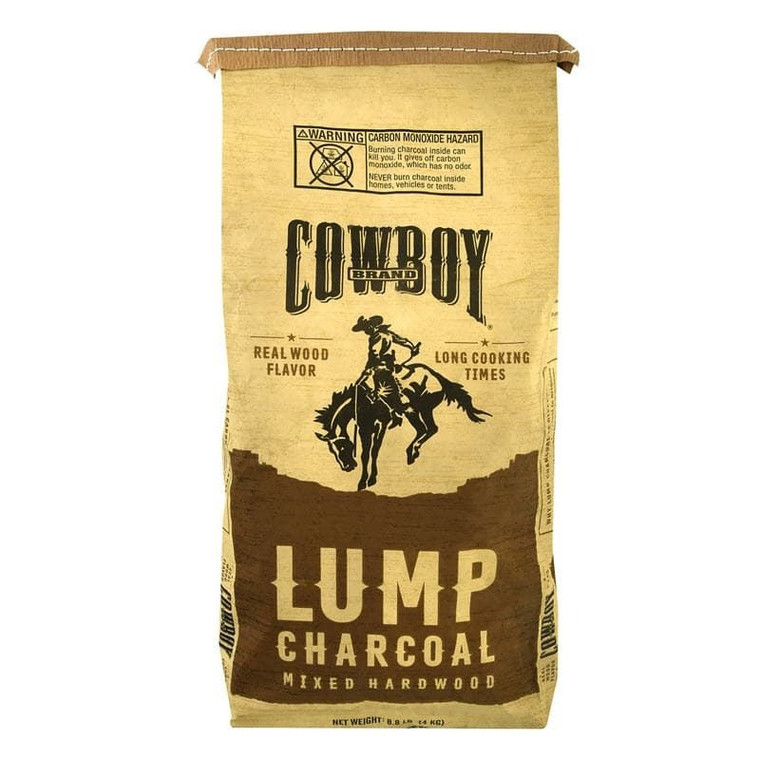
Cowboy Charcoal
Cowboy Hardwood Lump Charcoal - 8.8 lb
Real wood. No fillers. No lighter fluid needed. Cowboy Hardwood Lump Charcoal is made from kiln-dried southern hardwoods — no chemicals, no binders, no additives — and it shows in performance. It lights faster, burns hotter, and leaves significantly less ash than compressed briquets, which means more heat for your cook and less cleanup after.
- Versatile across every outdoor cooker: Works in kettle grills, barrel smokers, and kamado-style ceramic cookers like the Big Green Egg — anywhere authentic wood-fire heat matters.
- No fillers, no chemicals, no additives: Pure kiln-dried southern hardwood charcoal — no binders or accelerants that can off-gas into your food. Lights without lighter fluid.
- Named one of the 7 Best Lump Charcoals by The Spruce Eats (published by People, Inc.) — and backed by a competitive BBQ community that uses it to win.
Cowboy Hardwood Lump Charcoal starts with one material: superior-grade kiln-dried southern hardwoods. No fillers. No binding agents. No chemical accelerants. What you get is pure hardwood carbon that ignites faster than briquets, climbs to higher searing temperatures, and burns down to a fraction of the ash — which means better heat management during a long cook and a cleaner grate when you're done.
The format matters here. Lump charcoal's irregular chunk shape creates natural airflow channels in the fire bed, giving you more responsive temperature control than uniform compressed briquets — critical whether you're searing a steak at 700°F or holding a kamado at 225°F for a low-and-slow smoke. Because the wood is kiln-dried before carbonization, moisture content is consistent, so light-up behavior is predictable bag to bag.
Available in an 8.8 lb bag, sized right for the backyard griller who wants fresh charcoal for each cook rather than a bag sitting open between sessions. Compatible with all outdoor cooking appliances: classic kettle grills, barrel grills and offset smokers, and kamado-style ceramic cookers.
Shoppers on the brand's site who grill several times a week — including one verified competitive BBQ user from Oklahoma — cite consistent light-up performance and the clean wood-smoke flavor as reasons they stopped switching brands. Selected reviews:
Named one of the 7 Best Lump Charcoals by The Spruce Eats. Store in a cool, dry location; reseal the bag between uses to protect against moisture.
Ingredients: Hardwood Charcoal.
Common Questions
How does lump charcoal actually burn differently than briquets, and does the difference matter for cooking results?
Lump charcoal is pure carbonized wood, so it ignites roughly 30-50% faster than compressed briquets and reaches searing temperatures above 700°F more readily. Briquets are made from compressed charcoal dust, coal fines, and binders like cornstarch or sodium nitrate, which slow ignition and can contribute off-flavors during the first 10-15 minutes of a cook. The irregular chunk shape of lump creates natural air gaps in the fire bed, which lets you raise or drop temperature faster by adjusting airflow — a meaningful difference when you're trying to hold a kamado steady at 225°F for six hours. Lump also produces significantly less ash than briquets, which matters because ash buildup can choke airflow on long cooks and requires more frequent cleaning.
What does 'kiln-dried' mean for the wood, and why does it affect how the charcoal performs?
Kiln-drying removes most of the residual moisture from the wood before it's carbonized, typically bringing moisture content below 20% compared to air-dried wood that can sit at 30-50% depending on season and storage. Lower moisture at the start of carbonization means more of the wood converts to carbon rather than steam, which produces denser, more consistent pieces. From a practical standpoint, consistent moisture content means the charcoal lights predictably every time rather than behaving differently from bag to bag or between summer and winter storage conditions. It also means less popping and sparking during the initial light-up phase, since there's less trapped water vaporizing rapidly inside the chunks.
Is this charcoal safe to use in a kamado cooker like a Big Green Egg or Kamado Joe?
Yes, lump charcoal is actually the recommended fuel type for most ceramic kamado cookers, and multiple kamado manufacturers explicitly advise against using briquets as a primary fuel. The reason is airflow: kamados regulate temperature through very small adjustments to top and bottom vents, and the ash volume from briquets can overwhelm the bottom vent grate and disrupt that control. Lump's low ash output keeps the airflow channels open across a long cook, which is essential when holding temperatures between 225°F and 250°F for brisket or pork shoulder over 10-16 hours. The irregular chunk size of lump also settles into a natural bed with good air circulation rather than packing tightly the way uniform briquets can.
How much charcoal do you actually need for different cooking methods, and is an 8.8 lb bag enough for a full cook?
For a standard two-zone kettle setup doing burgers or steaks over 45-60 minutes, most cooks use roughly 2-3 lbs of lump charcoal, which means an 8.8 lb bag covers three to four typical grilling sessions. A long low-and-slow smoke on a kamado is more efficient than an open grill because ceramic retains heat — a full brisket cook at 225°F on a large kamado might use 4-6 lbs of lump total over 12 hours. On an offset smoker or barrel grill, fuel consumption is higher because there's no ceramic insulation, and you may go through most of an 8.8 lb bag for a single long cook. The 8.8 lb format is well-suited to cooks who grill frequently and want a fresh, sealed bag each session rather than managing moisture exposure in a partially used large bag.
Does the type of hardwood used in lump charcoal affect the flavor of the food?
Yes, though the effect is more subtle than adding wood chunks or chips as a secondary smoke source. Hardwoods like oak, hickory, and maple each have distinct lignin compositions, and lignin is the compound that breaks down during burning to produce smoke flavor compounds including guaiacol and syringol — the primary contributors to the characteristic wood-smoke taste. Southern hardwood blends, which typically include oak and hickory, tend to produce a mild to moderate smoke character compared to fruitwoods like apple or cherry, which burn cleaner with a lighter, slightly sweet note. Because charcoal is already fully carbonized, the smoke flavor it contributes is much less intense than raw wood, so the hardwood species matters most when you're cooking over direct heat at lower temperatures where some incomplete combustion is occurring. If you want a pronounced smoke flavor, most pitmasters add dedicated wood chunks directly to the lump bed rather than relying solely on the charcoal itself.
How should this charcoal be stored between uses to prevent it from becoming difficult to light?
Lump charcoal is hygroscopic, meaning it actively absorbs moisture from the surrounding air, and moisture absorption is the primary reason charcoal becomes slow to light or produces excessive smoke and sparking. Resealing the bag tightly after each use and storing it in a cool, dry location — a garage or shed rather than outdoors — will preserve light-up performance for several months. Avoid storing on concrete floors in humid climates, since concrete can wick ground moisture upward into the bag. If charcoal does absorb moisture, spreading it in the sun for a few hours before use will drive off surface moisture, though deeply saturated pieces may need to be discarded. The 8.8 lb bag size reduces this risk because you're more likely to use a bag within a few sessions rather than storing a large partially used bag for weeks.
What does it mean that The Spruce Eats named this one of the 7 Best Lump Charcoals, and how was that list determined?
The Spruce Eats is an established food and cooking publication that conducts hands-on product testing rather than relying solely on manufacturer claims or sponsored content. Their charcoal evaluations typically assess ignition time, maximum temperature reached, burn duration, ash volume, and the presence of off-flavors during the first phase of burning. Being included in a list of seven recommended products across the entire lump charcoal category represents a meaningful independent evaluation, not a paid placement. That said, any editorial list reflects testing conditions at a specific point in time, and factors like bag-to-bag consistency matter as much as single-session performance — which is where the verified buyer reviews from repeat users and competitive BBQ cooks provide complementary long-term signal.
The format matters here. Lump charcoal's irregular chunk shape creates natural airflow channels in the fire bed, giving you more responsive temperature control than uniform compressed briquets — critical whether you're searing a steak at 700°F or holding a kamado at 225°F for a low-and-slow smoke. Because the wood is kiln-dried before carbonization, moisture content is consistent, so light-up behavior is predictable bag to bag.
Available in an 8.8 lb bag, sized right for the backyard griller who wants fresh charcoal for each cook rather than a bag sitting open between sessions. Compatible with all outdoor cooking appliances: classic kettle grills, barrel grills and offset smokers, and kamado-style ceramic cookers.
Shoppers on the brand's site who grill several times a week — including one verified competitive BBQ user from Oklahoma — cite consistent light-up performance and the clean wood-smoke flavor as reasons they stopped switching brands. Selected reviews:
- "I have used this for a few years. Actually won competitions with it. Lights easy burns good and hot for a decent amount of time... Can't be beat." — Rosco, Verified Buyer
- "I cook on a bge all the time. I've tried a lot of different ones and the quality of this is good enough and cheap enough... it's gonna get harder to find." — Grille, Verified Buyer
- "I use it for all my outdoor cooking. Never lets me down." — Streatch, Verified Buyer
Named one of the 7 Best Lump Charcoals by The Spruce Eats. Store in a cool, dry location; reseal the bag between uses to protect against moisture.
Ingredients: Hardwood Charcoal.
Common Questions
How does lump charcoal actually burn differently than briquets, and does the difference matter for cooking results?
Lump charcoal is pure carbonized wood, so it ignites roughly 30-50% faster than compressed briquets and reaches searing temperatures above 700°F more readily. Briquets are made from compressed charcoal dust, coal fines, and binders like cornstarch or sodium nitrate, which slow ignition and can contribute off-flavors during the first 10-15 minutes of a cook. The irregular chunk shape of lump creates natural air gaps in the fire bed, which lets you raise or drop temperature faster by adjusting airflow — a meaningful difference when you're trying to hold a kamado steady at 225°F for six hours. Lump also produces significantly less ash than briquets, which matters because ash buildup can choke airflow on long cooks and requires more frequent cleaning.
What does 'kiln-dried' mean for the wood, and why does it affect how the charcoal performs?
Kiln-drying removes most of the residual moisture from the wood before it's carbonized, typically bringing moisture content below 20% compared to air-dried wood that can sit at 30-50% depending on season and storage. Lower moisture at the start of carbonization means more of the wood converts to carbon rather than steam, which produces denser, more consistent pieces. From a practical standpoint, consistent moisture content means the charcoal lights predictably every time rather than behaving differently from bag to bag or between summer and winter storage conditions. It also means less popping and sparking during the initial light-up phase, since there's less trapped water vaporizing rapidly inside the chunks.
Is this charcoal safe to use in a kamado cooker like a Big Green Egg or Kamado Joe?
Yes, lump charcoal is actually the recommended fuel type for most ceramic kamado cookers, and multiple kamado manufacturers explicitly advise against using briquets as a primary fuel. The reason is airflow: kamados regulate temperature through very small adjustments to top and bottom vents, and the ash volume from briquets can overwhelm the bottom vent grate and disrupt that control. Lump's low ash output keeps the airflow channels open across a long cook, which is essential when holding temperatures between 225°F and 250°F for brisket or pork shoulder over 10-16 hours. The irregular chunk size of lump also settles into a natural bed with good air circulation rather than packing tightly the way uniform briquets can.
How much charcoal do you actually need for different cooking methods, and is an 8.8 lb bag enough for a full cook?
For a standard two-zone kettle setup doing burgers or steaks over 45-60 minutes, most cooks use roughly 2-3 lbs of lump charcoal, which means an 8.8 lb bag covers three to four typical grilling sessions. A long low-and-slow smoke on a kamado is more efficient than an open grill because ceramic retains heat — a full brisket cook at 225°F on a large kamado might use 4-6 lbs of lump total over 12 hours. On an offset smoker or barrel grill, fuel consumption is higher because there's no ceramic insulation, and you may go through most of an 8.8 lb bag for a single long cook. The 8.8 lb format is well-suited to cooks who grill frequently and want a fresh, sealed bag each session rather than managing moisture exposure in a partially used large bag.
Does the type of hardwood used in lump charcoal affect the flavor of the food?
Yes, though the effect is more subtle than adding wood chunks or chips as a secondary smoke source. Hardwoods like oak, hickory, and maple each have distinct lignin compositions, and lignin is the compound that breaks down during burning to produce smoke flavor compounds including guaiacol and syringol — the primary contributors to the characteristic wood-smoke taste. Southern hardwood blends, which typically include oak and hickory, tend to produce a mild to moderate smoke character compared to fruitwoods like apple or cherry, which burn cleaner with a lighter, slightly sweet note. Because charcoal is already fully carbonized, the smoke flavor it contributes is much less intense than raw wood, so the hardwood species matters most when you're cooking over direct heat at lower temperatures where some incomplete combustion is occurring. If you want a pronounced smoke flavor, most pitmasters add dedicated wood chunks directly to the lump bed rather than relying solely on the charcoal itself.
How should this charcoal be stored between uses to prevent it from becoming difficult to light?
Lump charcoal is hygroscopic, meaning it actively absorbs moisture from the surrounding air, and moisture absorption is the primary reason charcoal becomes slow to light or produces excessive smoke and sparking. Resealing the bag tightly after each use and storing it in a cool, dry location — a garage or shed rather than outdoors — will preserve light-up performance for several months. Avoid storing on concrete floors in humid climates, since concrete can wick ground moisture upward into the bag. If charcoal does absorb moisture, spreading it in the sun for a few hours before use will drive off surface moisture, though deeply saturated pieces may need to be discarded. The 8.8 lb bag size reduces this risk because you're more likely to use a bag within a few sessions rather than storing a large partially used bag for weeks.
What does it mean that The Spruce Eats named this one of the 7 Best Lump Charcoals, and how was that list determined?
The Spruce Eats is an established food and cooking publication that conducts hands-on product testing rather than relying solely on manufacturer claims or sponsored content. Their charcoal evaluations typically assess ignition time, maximum temperature reached, burn duration, ash volume, and the presence of off-flavors during the first phase of burning. Being included in a list of seven recommended products across the entire lump charcoal category represents a meaningful independent evaluation, not a paid placement. That said, any editorial list reflects testing conditions at a specific point in time, and factors like bag-to-bag consistency matter as much as single-session performance — which is where the verified buyer reviews from repeat users and competitive BBQ cooks provide complementary long-term signal.
- __Storage_Location:
- Dry
- __Volume:
- 400
- __Owner:
- TCFarm
- __badge:
- Sale Valid for Deliveries Thru 7-15