


Sale
Puffed Millet Cereal - 6 oz
Arrowhead Mills
$3.79
$2.99
(No reviews yet)

Write a Review
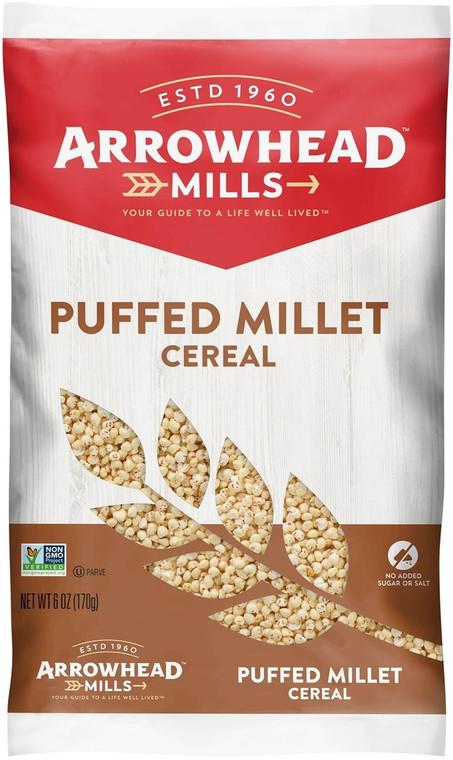
Arrowhead Mills
Puffed Millet Cereal - 6 oz
One of the world's oldest cultivated grains — still going strong after 6,000 years. Arrowhead Mills Puffed Millet is made from a single ancient grain that delivers a complete protein profile with naturally low fat, no added sugar, and no added salt. Light and airy with a mild, toasty character, it's the kind of cereal that works just as well crumbled into yogurt or plant-based milk as it does straight from the bag — and it's been Non-GMO Project Verified and Kosher Parve to back up every claim on the label.
- Wildly versatile: Use it as a hot cereal, cold cereal with milk, a crunchy yogurt topper, or a gluten-free addition to granola and trail mixes.
- Nutritionally notable: Millet is one of the few grains that provides a complete amino acid profile, making it a rare plant-based whole-grain protein source — with no added sugar or salt to muddy the picture.
- Broad diet compatibility: Non-GMO Project Verified, Kosher Parve, wheat-free, and free of added sugar and salt — suitable for gluten-sensitive, vegan, and clean-label lifestyles.
Arrowhead Mills has been milling whole grains since 1960, and their Puffed Millet Cereal is one of the clearest expressions of that mission: a single ancient grain, simply puffed, with nothing added and nothing hidden. Millet — nicknamed "The Little Giant" — has been a dietary staple across Asia and Africa since at least 4000 BC, valued precisely because it delivers outsized nutrition in a small, lightweight package.
Each 6 oz bag contains only one ingredient: whole grain millet, puffed into light, delicate rounds. The grain is naturally wheat-free and provides a complete protein — meaning it contains all essential amino acids — which is uncommon among cereal grains. Fat content is low, and with no added sugar or salt, the nutrition panel is as clean as the ingredient list. This is a pantry staple for households that read every label.
Arrowhead Mills Puffed Millet is Non-GMO Project Verified, meaning an independent third party has audited the supply chain and confirmed no genetically modified organisms were used at any stage. It is also certified Kosher Parve, making it suitable for both dairy and meat meals under kosher dietary law. The product contains no added sugar — verified by third-party certification, not just label copy.
Serve it as a cold cereal in plant-based or dairy milk, warm it into a creamy porridge with cinnamon and fruit, crumble it over yogurt for crunch, or use it as a base for homemade grain bars and energy bites. Its mild, slightly nutty flavor plays well with both sweet and savory preparations. Store in a cool, dry pantry; reseal the bag after opening to maintain crispness.
Ingredients: Whole Grain Millet.
Common Questions
How does puffed millet compare nutritionally to puffed rice or corn-based cereals?
Millet delivers a notably different nutrient profile than puffed rice or corn cereals. A roughly 30g serving of puffed millet provides approximately 7g of protein, 2g of fiber, and meaningful amounts of magnesium, phosphorus, and B vitamins — particularly niacin and folate — whereas puffed rice in the same serving size typically offers around 2g of protein and under 1g of fiber. Millet also contains iron at levels closer to wheat-based cereals than rice-based ones. Because puffed millet has no added sugar or sodium, its carbohydrate calories are purely from the grain itself, making the comparison to most commercial breakfast cereals — which average 10-15g of added sugar per serving — especially stark.
What does it mean that millet is a complete protein, and why is that unusual for a grain?
A complete protein contains all nine essential amino acids — the ones the human body cannot synthesize and must obtain from food. Most cereal grains are deficient in one or more essential amino acids; wheat, rice, and corn, for example, are all low in lysine. Millet is one of the few grains that provides a full essential amino acid spectrum in a single ingredient, which makes it particularly useful for plant-based diets that might otherwise need careful food combining. The specific amino acid profile includes meaningful levels of methionine, which is also limited in many legumes, so millet and legumes together create a very well-rounded protein source. This complete protein characteristic is part of why millet has been a nutritional cornerstone in regions of Asia and Africa for over 6,000 years.
Is puffed millet suitable for gluten-free diets, and what cross-contamination risks should I know about?
Millet is naturally gluten-free — it contains no gluten proteins and is botanically unrelated to wheat, barley, or rye. Arrowhead Mills Puffed Millet lists only one ingredient, whole grain millet, and carries no added grains or flavorings that would introduce gluten. However, the product does not carry a certified gluten-free seal on this particular item, which means individuals with celiac disease should note that manufacturing facilities may also process gluten-containing grains, creating a potential cross-contact risk. People with non-celiac gluten sensitivity who are less reactive to trace amounts generally tolerate puffed millet well. If you have celiac disease, it is worth contacting Arrowhead Mills directly to confirm current facility practices before relying on this product as a dietary staple.
How can I use puffed millet as a substitute in recipes that call for puffed rice or oats?
Puffed millet swaps in at a 1:1 volume ratio anywhere puffed rice is called for — Rice Krispies-style treats, homemade granola bars, and energy balls all work seamlessly, with the millet adding a slightly nuttier flavor. In no-bake energy bites bound with nut butter and honey, the puffed millet holds together slightly better than puffed rice because its surface texture is a bit more irregular, giving the binder more to grip. For porridge, use about 1/4 to 1/3 cup dry puffed millet per serving with roughly 3/4 cup liquid — it absorbs faster than rolled oats, reaching a creamy consistency in under 5 minutes on the stovetop. As a yogurt or smoothie bowl topper, it maintains its crunch for longer than granola clusters because the individual puffs are small enough to stay surface-dry rather than soaking in quickly. In savory applications, puffed millet can coat proteins or vegetables before baking as a lighter alternative to breadcrumbs.
What does the Non-GMO Project Verified seal actually confirm, and how rigorous is that process?
Non-GMO Project Verification is a third-party certification administered by the Non-GMO Project, a nonprofit organization with publicly available technical standards. To earn the seal, a product's entire supply chain — from seed to finished product — must be audited and tested to confirm that GMO content remains below 0.9%, which is the threshold set by the EU and adopted by the Non-GMO Project as its standard. For a single-ingredient product like puffed millet, this primarily means the millet seed source and any processing inputs are audited. The certification is renewed annually and requires ongoing testing, not a one-time approval. This is a meaningfully more verifiable claim than a brand simply stating 'non-GMO' on its own label with no external audit.
Does puffed millet fit into low-sugar or diabetic-friendly eating patterns?
Puffed millet has no added sugar — a claim backed by third-party certification in this product — so the only carbohydrates present are those naturally occurring in the grain itself. Whole grain millet has a glycemic index in the range of 54-71 depending on preparation method and variety, which places it in the low-to-moderate range compared to puffed rice (GI approximately 82) or corn flakes (GI approximately 81). The fiber content, approximately 2g per 30g serving, slows digestion slightly compared to refined-grain cereals. That said, puffed millet is not a low-carbohydrate food — a standard serving contains roughly 25-28g of total carbohydrates — so it would not fit strict ketogenic macros, which typically cap daily carbohydrates at 20-50g. For general low-sugar or moderate-carb eating patterns, particularly when paired with protein and fat, it is a reasonable whole-grain option.
What is Kosher Parve certification and why does it matter for this product?
Kosher Parve is a classification under Jewish dietary law (kashrut) indicating that a food contains neither meat nor dairy ingredients and was not processed on equipment shared with meat or dairy. Parve status is significant because kosher law prohibits mixing meat and dairy at the same meal, so a Parve-certified food can be served alongside either without restriction. For a product like puffed millet, Parve certification is verified by a recognized kosher certifying agency that inspects ingredients, facility, and equipment — it is not a self-declared label. Beyond its relevance to observant Jewish consumers, some people with dairy allergies or strict vegan diets also use Kosher Parve certification as a secondary signal that a product is dairy-free, since the kosher inspection process is thorough about detecting dairy traces.
Each 6 oz bag contains only one ingredient: whole grain millet, puffed into light, delicate rounds. The grain is naturally wheat-free and provides a complete protein — meaning it contains all essential amino acids — which is uncommon among cereal grains. Fat content is low, and with no added sugar or salt, the nutrition panel is as clean as the ingredient list. This is a pantry staple for households that read every label.
Arrowhead Mills Puffed Millet is Non-GMO Project Verified, meaning an independent third party has audited the supply chain and confirmed no genetically modified organisms were used at any stage. It is also certified Kosher Parve, making it suitable for both dairy and meat meals under kosher dietary law. The product contains no added sugar — verified by third-party certification, not just label copy.
Serve it as a cold cereal in plant-based or dairy milk, warm it into a creamy porridge with cinnamon and fruit, crumble it over yogurt for crunch, or use it as a base for homemade grain bars and energy bites. Its mild, slightly nutty flavor plays well with both sweet and savory preparations. Store in a cool, dry pantry; reseal the bag after opening to maintain crispness.
Ingredients: Whole Grain Millet.
Common Questions
How does puffed millet compare nutritionally to puffed rice or corn-based cereals?
Millet delivers a notably different nutrient profile than puffed rice or corn cereals. A roughly 30g serving of puffed millet provides approximately 7g of protein, 2g of fiber, and meaningful amounts of magnesium, phosphorus, and B vitamins — particularly niacin and folate — whereas puffed rice in the same serving size typically offers around 2g of protein and under 1g of fiber. Millet also contains iron at levels closer to wheat-based cereals than rice-based ones. Because puffed millet has no added sugar or sodium, its carbohydrate calories are purely from the grain itself, making the comparison to most commercial breakfast cereals — which average 10-15g of added sugar per serving — especially stark.
What does it mean that millet is a complete protein, and why is that unusual for a grain?
A complete protein contains all nine essential amino acids — the ones the human body cannot synthesize and must obtain from food. Most cereal grains are deficient in one or more essential amino acids; wheat, rice, and corn, for example, are all low in lysine. Millet is one of the few grains that provides a full essential amino acid spectrum in a single ingredient, which makes it particularly useful for plant-based diets that might otherwise need careful food combining. The specific amino acid profile includes meaningful levels of methionine, which is also limited in many legumes, so millet and legumes together create a very well-rounded protein source. This complete protein characteristic is part of why millet has been a nutritional cornerstone in regions of Asia and Africa for over 6,000 years.
Is puffed millet suitable for gluten-free diets, and what cross-contamination risks should I know about?
Millet is naturally gluten-free — it contains no gluten proteins and is botanically unrelated to wheat, barley, or rye. Arrowhead Mills Puffed Millet lists only one ingredient, whole grain millet, and carries no added grains or flavorings that would introduce gluten. However, the product does not carry a certified gluten-free seal on this particular item, which means individuals with celiac disease should note that manufacturing facilities may also process gluten-containing grains, creating a potential cross-contact risk. People with non-celiac gluten sensitivity who are less reactive to trace amounts generally tolerate puffed millet well. If you have celiac disease, it is worth contacting Arrowhead Mills directly to confirm current facility practices before relying on this product as a dietary staple.
How can I use puffed millet as a substitute in recipes that call for puffed rice or oats?
Puffed millet swaps in at a 1:1 volume ratio anywhere puffed rice is called for — Rice Krispies-style treats, homemade granola bars, and energy balls all work seamlessly, with the millet adding a slightly nuttier flavor. In no-bake energy bites bound with nut butter and honey, the puffed millet holds together slightly better than puffed rice because its surface texture is a bit more irregular, giving the binder more to grip. For porridge, use about 1/4 to 1/3 cup dry puffed millet per serving with roughly 3/4 cup liquid — it absorbs faster than rolled oats, reaching a creamy consistency in under 5 minutes on the stovetop. As a yogurt or smoothie bowl topper, it maintains its crunch for longer than granola clusters because the individual puffs are small enough to stay surface-dry rather than soaking in quickly. In savory applications, puffed millet can coat proteins or vegetables before baking as a lighter alternative to breadcrumbs.
What does the Non-GMO Project Verified seal actually confirm, and how rigorous is that process?
Non-GMO Project Verification is a third-party certification administered by the Non-GMO Project, a nonprofit organization with publicly available technical standards. To earn the seal, a product's entire supply chain — from seed to finished product — must be audited and tested to confirm that GMO content remains below 0.9%, which is the threshold set by the EU and adopted by the Non-GMO Project as its standard. For a single-ingredient product like puffed millet, this primarily means the millet seed source and any processing inputs are audited. The certification is renewed annually and requires ongoing testing, not a one-time approval. This is a meaningfully more verifiable claim than a brand simply stating 'non-GMO' on its own label with no external audit.
Does puffed millet fit into low-sugar or diabetic-friendly eating patterns?
Puffed millet has no added sugar — a claim backed by third-party certification in this product — so the only carbohydrates present are those naturally occurring in the grain itself. Whole grain millet has a glycemic index in the range of 54-71 depending on preparation method and variety, which places it in the low-to-moderate range compared to puffed rice (GI approximately 82) or corn flakes (GI approximately 81). The fiber content, approximately 2g per 30g serving, slows digestion slightly compared to refined-grain cereals. That said, puffed millet is not a low-carbohydrate food — a standard serving contains roughly 25-28g of total carbohydrates — so it would not fit strict ketogenic macros, which typically cap daily carbohydrates at 20-50g. For general low-sugar or moderate-carb eating patterns, particularly when paired with protein and fat, it is a reasonable whole-grain option.
What is Kosher Parve certification and why does it matter for this product?
Kosher Parve is a classification under Jewish dietary law (kashrut) indicating that a food contains neither meat nor dairy ingredients and was not processed on equipment shared with meat or dairy. Parve status is significant because kosher law prohibits mixing meat and dairy at the same meal, so a Parve-certified food can be served alongside either without restriction. For a product like puffed millet, Parve certification is verified by a recognized kosher certifying agency that inspects ingredients, facility, and equipment — it is not a self-declared label. Beyond its relevance to observant Jewish consumers, some people with dairy allergies or strict vegan diets also use Kosher Parve certification as a secondary signal that a product is dairy-free, since the kosher inspection process is thorough about detecting dairy traces.
- __Storage_Location:
- Dry
- __Volume:
- 400
- __Owner:
- TCFarm
- __badge:
- Sale Valid for Deliveries thru 6-24