


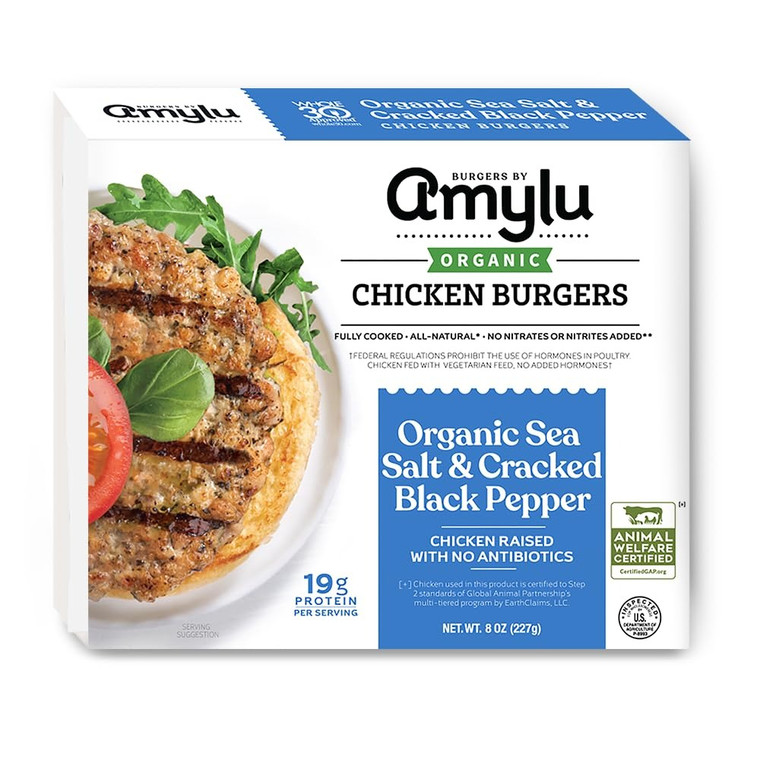
Salt & Black Pepper Chicken Burger - 8 oz
Amylu FoodsWrite a Review
Amylu Foods
Salt & Black Pepper Chicken Burger - 8 oz
Fully cooked, antibiotic-free chicken burgers seasoned with just sea salt and cracked black pepper — Amylu's organic version strips the formula down to what actually matters: responsibly raised chicken and two pantry spices, nothing more. Each burger delivers 19 grams of protein at 200 calories, making it one of the leanest fully cooked burger options on the market, and it's ready in minutes whether you're grilling, pan-searing, or slicing over a bowl.
- Versatile and fast: Fully cooked from the start — serve on a bun, in a lettuce wrap, sliced over a grain bowl, or meal-prepped in bulk. The classic salt-and-pepper profile pairs with virtually any cuisine direction.
- What makes it count: Raised with no antibiotics ever, certified Organic, with no nitrates, nitrites, or added fillers — the ingredient list is exactly what the flavor name says it is.
- Diet-compatible: Whole30 Approved, Paleo, Gluten-Free, Dairy-Free, and Pork-Free — fits cleanly into most protein-forward eating patterns without any label-reading anxiety.
Amylu's Organic Sea Salt & Cracked Black Pepper Chicken Burgers are the rare convenience product where the short ingredient list is the point. Raised with no antibiotics ever and certified Organic, the chicken itself is the star — seasoned with nothing but sea salt and cracked black pepper, so there's no flavor chemistry to second-guess and no label archaeology required.
Each 8 oz package contains fully cooked chicken burgers delivering 19g of protein and 170 calories per serving. "Fully cooked" here is a genuine convenience feature: there's no food safety guesswork, no thermometer required, and the path from freezer or fridge to plate is under 10 minutes. The lean chicken base keeps fat low while keeping protein density high — a macro profile that's genuinely hard to match among fully cooked burgers.
At the grocery store, most chicken burgers in the fully cooked, heat-and-eat category are made from conventionally raised poultry, contain sodium phosphates or flavor enhancers to compensate for leaner cuts, and are priced as commodity protein. Amylu's Organic SKU steps outside that category: the chickens are certified Organic (meaning verified feed, no antibiotics, no synthetic pesticides in the supply chain), and the seasoning is two ingredients. That's not a marketing claim — it's on the label.
The salt-and-pepper profile is intentionally neutral, which means these burgers adapt to whatever direction you're cooking. Serve on a toasted brioche bun with arugula and aioli, slice cold over a Whole30 salad, or warm and cube them into a stir-fry or grain bowl. Because the seasoning doesn't fight back, the burger works as a blank canvas across cuisines.
Certified Whole30 Approved, Paleo, Gluten-Free, Dairy-Free, and Pork-Free. No nitrates or nitrites added. Store refrigerated and use by the date on the package; fully cooked burgers can also be frozen for longer storage.
INGREDIENTS -
Common Questions
How do these chicken burgers compare nutritionally to a conventional beef or pork burger of the same size?
A standard 4 oz conventional beef burger (80/20 blend) delivers roughly 280 calories and 19-20g of protein alongside 22g of fat, of which 8-9g is saturated. These Amylu chicken burgers come in at 170 calories per serving with 19g of protein and significantly less fat, which puts the protein-to-calorie ratio well above most fully cooked beef or pork patty options. Conventional fully cooked chicken burgers in the same freezer aisle typically use mechanically separated chicken or added sodium phosphates to improve texture and moisture retention, ingredients you won't find on Amylu's label. For someone tracking macros, the lean chicken base here gets you equivalent protein at roughly 40% fewer calories than an 80/20 beef patty, which is a meaningful difference across multiple meals per week.
What does Certified Organic actually mean for the chicken in this product, and how do I verify the claim?
USDA Certified Organic for poultry requires third-party verification that the birds were raised on certified organic feed (no synthetic pesticides, no GMO crops), never given antibiotics or growth hormones, and had access to the outdoors. The certifying agency's name and certificate number must appear on the product label or be traceable through the USDA's organic integrity database at ams.usda.gov, where you can search by brand or operation. 'No antibiotics' on its own is a USDA Process Verified claim but doesn't guarantee feed standards or outdoor access — the Organic certification is the more rigorous and independently audited standard. If you want to confirm Amylu's specific certifying body, check the package for the USDA Organic seal alongside the certifier's name, then cross-reference that certificate on the USDA portal.
Do these burgers fit a Whole30, Paleo, or ketogenic diet, and what are the specific numbers that matter?
These burgers carry official Whole30 Approved and Paleo certifications, which means they've been reviewed against those programs' ingredient rules — no added sugar, no grains, no dairy, no legumes, and no carrageenan or sulfites. At 19g of protein and low fat per serving with effectively zero carbohydrates, the macro profile also fits standard ketogenic targets, where the goal is typically under 20-50g of net carbs per day and moderate-to-high protein. The only thing keto practitioners should confirm is total fat content relative to their personal fat targets, since a leaner protein source like this may need to be paired with added fat (avocado, olive oil, cheese if dairy is allowed) to hit ketogenic ratios. Carnivore dieters, who restrict to animal products only, will find the two-ingredient formulation — organic chicken, sea salt, cracked black pepper — compatible, as minimal plant-derived seasonings are generally accepted in most carnivore frameworks.
What role do nitrates and nitrites play in processed meat, and why does it matter that these burgers contain none?
Sodium nitrate and sodium nitrite are preservatives used in cured and processed meats primarily to inhibit Clostridium botulinum growth, extend shelf life, and produce the characteristic pink color in products like deli meat, hot dogs, and some sausages. The concern arises because under high heat, nitrites can react with amines in meat to form nitrosamines, a class of compounds classified as probable human carcinogens by the International Agency for Research on Cancer (IARC). 'No nitrates or nitrites added' on this label means neither sodium nitrate nor sodium nitrite was used as an intentional ingredient — it's a meaningful distinction from most shelf-stable or cured chicken products. It's worth noting that some 'no nitrates added' products use celery powder or celery juice, which is naturally high in nitrates and can convert to nitrite during processing; a clean label like Amylu's two-ingredient formulation avoids that substitution entirely.
Can I substitute these chicken burgers for beef or pork in specific recipes, and are there any cooking adjustments to know?
Because these burgers are fully cooked, the substitution logic flips compared to raw patties — you're reheating rather than cooking through, which means lower heat and shorter time are better to avoid drying out the lean chicken. In burgers and sandwiches, a direct swap for beef patties works well; the neutral salt-and-pepper seasoning won't clash with classic burger toppings, and brioche, potato, or pretzel buns all complement the mild flavor. For recipes that call for ground pork or beef crumbles — like tacos, pasta sauce, or shakshuka — slice or cube the burgers and add them in the final 2-3 minutes of cooking rather than browning from raw, since the leaner chicken will dry out faster than fattier meats under prolonged heat. In grain bowls or salads, these slice cleanly cold straight from the refrigerator, which beef patties rarely do, making them more versatile as a meal-prep protein.
What is the protein quality of chicken compared to beef, and does organic raising change the amino acid or fat profile?
Chicken breast and lean chicken patties provide a complete amino acid profile with a PDCAAS (Protein Digestibility Corrected Amino Acid Score) of approximately 0.91-1.0, meaning the protein is highly bioavailable and contains all nine essential amino acids in sufficient quantities — comparable to beef at similar scores. Organic raising practices do not meaningfully alter the amino acid composition of the muscle tissue, since protein structure is determined by the animal's genetics more than its feed. Where organic and pasture-influenced raising does make a modest difference is in fat composition: research published in journals including the British Journal of Nutrition has found that chickens with outdoor access and more varied diets can show modestly higher omega-3 fatty acid concentrations compared to conventionally confined birds, though the absolute omega-3 quantities in chicken are lower than in fatty fish regardless of raising method. For a lean chicken burger like this one, the fat quantity is relatively low overall, so the fat quality distinction is less impactful per serving than it would be in a fattier cut.
Why does the minimal two-ingredient seasoning matter, and what does it mean for people with food sensitivities?
Most fully cooked chicken burgers in the commercial category contain natural flavors, yeast extract, dextrose, or sodium phosphates — ingredients that are functional (they improve moisture retention, flavor intensity, and shelf stability) but require label translation for people avoiding specific compounds. Natural flavors, for example, is an FDA-defined category that can legally include hundreds of different substances derived from animal or plant sources, which creates ambiguity for people with allergies or dietary restrictions. A two-ingredient formulation — organic chicken, sea salt, cracked black pepper — eliminates that ambiguity entirely; there's nothing on the label that requires a follow-up question. For people managing gluten sensitivity, the Gluten-Free certification adds an audited layer of assurance beyond just 'no gluten-containing ingredients listed,' since cross-contamination during manufacturing is a separate concern that certification programs specifically test for.
- __Storage_Location:
- Frozen
- __Volume:
- 300
- __Owner:
- TCFarm
- __badge:
- Sale Valid for Deliveries thru 6-24