


3 Gallon Food Scraps Bag - 25 ct
World Centric
$2.99
(No reviews yet)

Write a Review
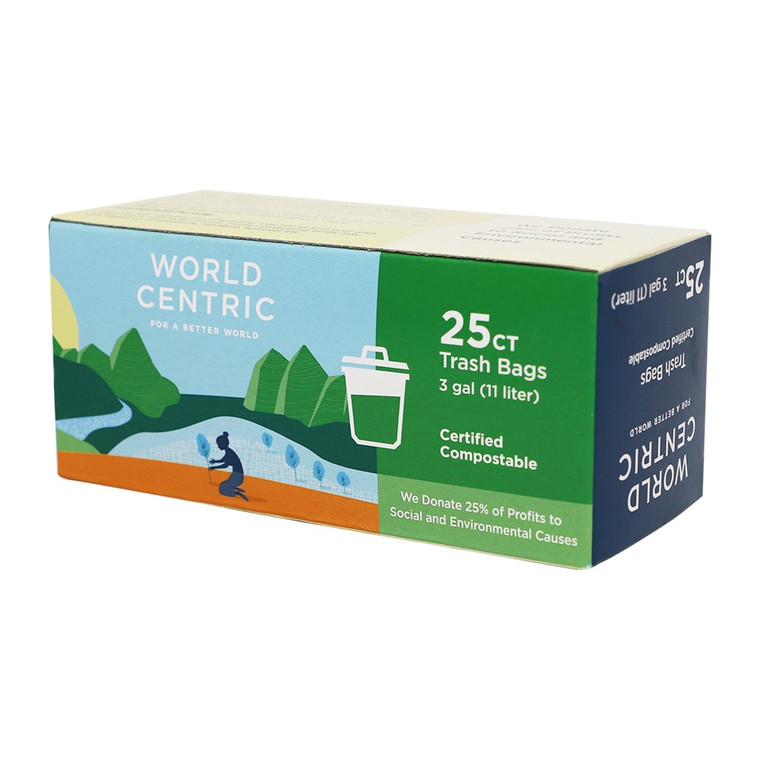
World Centric
3 Gallon Food Scraps Bag - 25 ct
World Centric's 3-gallon compostable bags are built from a blend of PBAT (a certified-biodegradable synthetic polymer) and corn starch — a combination that meets the BPI (Biodegradable Products Institute) certification standard for industrial composting. Unlike conventional plastic bin liners that persist in landfill for centuries, these break down alongside your food scraps in a certified compost facility, leaving no microplastic residue behind.
- Sized for kitchen compost bins: The 3-gallon format fits standard countertop and under-sink compost pails, making it easy to collect food scraps, paper towels, and other compostables without mess or odor transfer.
- Certified compostable — not just biodegradable: "Biodegradable" is an unregulated marketing term; World Centric's bags carry third-party BPI certification, meaning they've been independently tested to break down within a defined timeframe under industrial composting conditions.
- Shelf life and storage: Rated for a 12-month shelf life when stored away from heat, direct sunlight, and moisture — the material chemistry requires these conditions to prevent premature breakdown before use.
World Centric has been building a case for zero-waste living since 2004, and these 3-gallon compostable food scraps bags are one of the most practical tools in that mission. Each pack contains 25 bags made from a blend of PBAT (polybutylene adipate terephthalate) — a certified-biodegradable synthetic plastic — and corn starch. Together, these materials create a bag strong enough to handle wet food scraps, coffee grounds, and paper towels, while being fully accepted by industrial composting programs that reject conventional plastic liners.
The distinction between "compostable" and merely "biodegradable" matters here. Conventional plastic bags marketed as biodegradable often fragment into microplastics rather than breaking down into organic matter. World Centric's bags are BPI-certified — independently validated to disintegrate and biodegrade within the timeframe and conditions defined by ASTM D6400, the industry standard for compostable plastics. Most municipal and curbside composting programs that accept food scraps require BPI or equivalent certification before they'll allow bags in the green bin.
These bags are designed to line a standard 3-gallon kitchen compost pail — the most common countertop compost bin size. They handle the full range of compostable kitchen materials: fruit and vegetable scraps, eggshells, coffee grounds and filters, paper towels, and certified compostable serviceware. The liner system means your bin stays clean between washes, and the whole bag goes directly into your curbside compost cart or drop-off bin with no sorting required.
To preserve the material integrity, store bags away from heat sources, direct sunlight, and moisture. The expected shelf life under proper storage conditions is 12 months — after which the material may begin to degrade before use. Buy in quantities that match your household's turnover rate.
Note: These bags are designed for industrial composting facilities. Home backyard composting conditions (lower heat, less managed microbial activity) may not achieve full breakdown within the same timeframe. Check with your local composting program for acceptance criteria.
Ingredients: PBAT (Biodegradable Synthetic Plastic), Corn Starch.
Common Questions
What does BPI certification actually mean, and why does it matter for curbside compost programs?
BPI stands for Biodegradable Products Institute, and their certification means an independent lab has verified the bag meets ASTM D6400 — the standard requiring that a plastic product disintegrate by at least 90% within 84 days under industrial composting conditions (temperatures sustained around 130–140°F with managed microbial activity). This is a third-party verification process, not a self-declared claim. It matters for curbside programs because most municipal composting facilities have explicit policies rejecting any bag without BPI or equivalent certification, since non-certified bags — even those labeled 'biodegradable' — routinely contaminate the compost output with microplastic fragments. Many cities, including San Francisco, Seattle, and New York, publish approved bag lists that reference BPI certification as the baseline requirement. Without it, your entire bin load may be pulled from the compost stream and sent to landfill.
What is PBAT, and is it actually safe to put in a compost bin with food scraps?
PBAT is polybutylene adipate terephthalate, a synthetic polyester specifically engineered to be biodegradable under industrial composting conditions. Unlike conventional plastics (polyethylene, polypropylene), PBAT's molecular structure includes ester linkages that microorganisms can enzymatically break down, producing carbon dioxide, water, and biomass rather than persistent plastic fragments. It has been evaluated by the European Food Safety Authority and is considered safe for incidental food contact applications. When combined with corn starch in these bags, the corn starch accelerates initial breakdown and reduces the overall synthetic polymer content. The finished compost material from BPI-certified bags meets U.S. EPA standards for heavy metal limits, meaning the degraded material is safe to apply to soil.
Why won't these bags break down properly in a backyard compost pile?
ASTM D6400 certification is specifically calibrated to industrial composting conditions: sustained temperatures of 130–160°F, high microbial density, and controlled moisture and oxygen levels managed by facility operators. A typical backyard compost pile reaches 90–130°F at best, often cools significantly between turning cycles, and has far lower concentrations of the thermophilic microorganisms needed to enzymatically attack PBAT's polymer chains at a meaningful rate. Studies published in the journal Polymer Degradation and Stability have shown that compostable plastics in ambient-temperature soil or home compost environments can persist largely intact for over a year. This doesn't mean the bags are harmful in a home pile — they won't produce microplastics under those conditions — but full breakdown within a typical home composting timeframe is not guaranteed. If you home compost, the safest approach is to empty the bag contents into the pile and dispose of the bag through an industrial program.
How long can I store these bags before they start degrading on the shelf?
World Centric specifies a 12-month shelf life from manufacture date under proper storage conditions: away from direct sunlight, heat sources like stoves or radiators, and high-humidity environments. The corn starch component in particular absorbs ambient moisture, which can initiate premature breakdown of the material and cause bags to become brittle, sticky, or prone to tearing during use. If you open a roll and notice the bags feel tacky or tear unusually easily, that's a sign of moisture or heat exposure. For a household emptying a 3-gallon bin roughly twice a week, a 25-bag pack lasts about 12–13 weeks, which is well within the shelf-life window. Buying in very large bulk quantities makes less sense for compostable bags than it does for conventional products, precisely because of this degradation window.
What food scraps can actually go into these bags, and are there any materials that will cause them to fail?
These bags are designed to handle the full range of organics accepted by standard food scrap programs: raw and cooked fruit and vegetable scraps, eggshells, coffee grounds, paper coffee filters, paper towels, food-soiled paper napkins, and certified compostable serviceware like PLA cups and plates. The PBAT-corn starch blend provides adequate wet strength for normal kitchen scraps, but prolonged contact with liquids — for example, leaving a bag sitting in standing water or storing very wet scraps for more than 3–4 days — can accelerate breakdown and lead to bag failure before you reach your compost bin. Bones, large quantities of cooking oils, and meat scraps are often restricted by municipal programs regardless of bag type, so check your local program's accepted materials list. Sharp items like broken shells or skewers can puncture the bag; doubling the bag for those contents is a practical workaround.
How does a 3-gallon bag size compare to typical kitchen compost pail sizes, and will it fit other containers?
The 3-gallon size is the most common capacity for countertop compost pails sold in the U.S. — brands like OXO, Full Circle, and Bamboozle all produce countertop bins in the 0.8–1.0 gallon and 1.3–1.5 gallon range, but the standard under-counter or mid-size kitchen pail is typically 3 gallons (roughly 11 liters). A 3-gallon bag measures approximately 17 inches wide and 18–20 inches tall before folding, which fits a range of containers beyond dedicated compost pails: a standard 3-gallon plastic bucket, a small kitchen trash can, or a 1/3 hotel pan used in some commercial prep kitchens. For the bag to seat properly and not slip into the bin, the container's top opening should be 10–13 inches in diameter. If your bin is closer to 1.5 gallons, this bag will work with excess material folded over the rim.
How do compostable bags compare to conventional plastic liners in terms of environmental impact, and does the corn starch sourcing matter?
Conventional polyethylene bin liners persist in the environment for an estimated 400–1,000 years and do not biodegrade into organic matter under any realistic disposal condition — they fragment into microplastics. Compostable bags made to ASTM D6400 standards produce carbon dioxide, water, and humus-like organic material within 84 days at industrial facilities, with no persistent plastic residue. The corn starch component in these bags does carry an agricultural footprint — corn cultivation requires land, water, and in many cases nitrogen fertilizer — but lifecycle analyses published in journals including the International Journal of Life Cycle Assessment consistently show lower net greenhouse gas emissions and end-of-life environmental burden for certified compostable bags versus conventional plastic, particularly when the bags are actually processed through industrial composting rather than landfilled. World Centric does not specify the geographic origin or GMO status of its corn starch on the product label, which is worth noting if those factors are relevant to your purchasing criteria.
The distinction between "compostable" and merely "biodegradable" matters here. Conventional plastic bags marketed as biodegradable often fragment into microplastics rather than breaking down into organic matter. World Centric's bags are BPI-certified — independently validated to disintegrate and biodegrade within the timeframe and conditions defined by ASTM D6400, the industry standard for compostable plastics. Most municipal and curbside composting programs that accept food scraps require BPI or equivalent certification before they'll allow bags in the green bin.
These bags are designed to line a standard 3-gallon kitchen compost pail — the most common countertop compost bin size. They handle the full range of compostable kitchen materials: fruit and vegetable scraps, eggshells, coffee grounds and filters, paper towels, and certified compostable serviceware. The liner system means your bin stays clean between washes, and the whole bag goes directly into your curbside compost cart or drop-off bin with no sorting required.
To preserve the material integrity, store bags away from heat sources, direct sunlight, and moisture. The expected shelf life under proper storage conditions is 12 months — after which the material may begin to degrade before use. Buy in quantities that match your household's turnover rate.
Note: These bags are designed for industrial composting facilities. Home backyard composting conditions (lower heat, less managed microbial activity) may not achieve full breakdown within the same timeframe. Check with your local composting program for acceptance criteria.
Ingredients: PBAT (Biodegradable Synthetic Plastic), Corn Starch.
Common Questions
What does BPI certification actually mean, and why does it matter for curbside compost programs?
BPI stands for Biodegradable Products Institute, and their certification means an independent lab has verified the bag meets ASTM D6400 — the standard requiring that a plastic product disintegrate by at least 90% within 84 days under industrial composting conditions (temperatures sustained around 130–140°F with managed microbial activity). This is a third-party verification process, not a self-declared claim. It matters for curbside programs because most municipal composting facilities have explicit policies rejecting any bag without BPI or equivalent certification, since non-certified bags — even those labeled 'biodegradable' — routinely contaminate the compost output with microplastic fragments. Many cities, including San Francisco, Seattle, and New York, publish approved bag lists that reference BPI certification as the baseline requirement. Without it, your entire bin load may be pulled from the compost stream and sent to landfill.
What is PBAT, and is it actually safe to put in a compost bin with food scraps?
PBAT is polybutylene adipate terephthalate, a synthetic polyester specifically engineered to be biodegradable under industrial composting conditions. Unlike conventional plastics (polyethylene, polypropylene), PBAT's molecular structure includes ester linkages that microorganisms can enzymatically break down, producing carbon dioxide, water, and biomass rather than persistent plastic fragments. It has been evaluated by the European Food Safety Authority and is considered safe for incidental food contact applications. When combined with corn starch in these bags, the corn starch accelerates initial breakdown and reduces the overall synthetic polymer content. The finished compost material from BPI-certified bags meets U.S. EPA standards for heavy metal limits, meaning the degraded material is safe to apply to soil.
Why won't these bags break down properly in a backyard compost pile?
ASTM D6400 certification is specifically calibrated to industrial composting conditions: sustained temperatures of 130–160°F, high microbial density, and controlled moisture and oxygen levels managed by facility operators. A typical backyard compost pile reaches 90–130°F at best, often cools significantly between turning cycles, and has far lower concentrations of the thermophilic microorganisms needed to enzymatically attack PBAT's polymer chains at a meaningful rate. Studies published in the journal Polymer Degradation and Stability have shown that compostable plastics in ambient-temperature soil or home compost environments can persist largely intact for over a year. This doesn't mean the bags are harmful in a home pile — they won't produce microplastics under those conditions — but full breakdown within a typical home composting timeframe is not guaranteed. If you home compost, the safest approach is to empty the bag contents into the pile and dispose of the bag through an industrial program.
How long can I store these bags before they start degrading on the shelf?
World Centric specifies a 12-month shelf life from manufacture date under proper storage conditions: away from direct sunlight, heat sources like stoves or radiators, and high-humidity environments. The corn starch component in particular absorbs ambient moisture, which can initiate premature breakdown of the material and cause bags to become brittle, sticky, or prone to tearing during use. If you open a roll and notice the bags feel tacky or tear unusually easily, that's a sign of moisture or heat exposure. For a household emptying a 3-gallon bin roughly twice a week, a 25-bag pack lasts about 12–13 weeks, which is well within the shelf-life window. Buying in very large bulk quantities makes less sense for compostable bags than it does for conventional products, precisely because of this degradation window.
What food scraps can actually go into these bags, and are there any materials that will cause them to fail?
These bags are designed to handle the full range of organics accepted by standard food scrap programs: raw and cooked fruit and vegetable scraps, eggshells, coffee grounds, paper coffee filters, paper towels, food-soiled paper napkins, and certified compostable serviceware like PLA cups and plates. The PBAT-corn starch blend provides adequate wet strength for normal kitchen scraps, but prolonged contact with liquids — for example, leaving a bag sitting in standing water or storing very wet scraps for more than 3–4 days — can accelerate breakdown and lead to bag failure before you reach your compost bin. Bones, large quantities of cooking oils, and meat scraps are often restricted by municipal programs regardless of bag type, so check your local program's accepted materials list. Sharp items like broken shells or skewers can puncture the bag; doubling the bag for those contents is a practical workaround.
How does a 3-gallon bag size compare to typical kitchen compost pail sizes, and will it fit other containers?
The 3-gallon size is the most common capacity for countertop compost pails sold in the U.S. — brands like OXO, Full Circle, and Bamboozle all produce countertop bins in the 0.8–1.0 gallon and 1.3–1.5 gallon range, but the standard under-counter or mid-size kitchen pail is typically 3 gallons (roughly 11 liters). A 3-gallon bag measures approximately 17 inches wide and 18–20 inches tall before folding, which fits a range of containers beyond dedicated compost pails: a standard 3-gallon plastic bucket, a small kitchen trash can, or a 1/3 hotel pan used in some commercial prep kitchens. For the bag to seat properly and not slip into the bin, the container's top opening should be 10–13 inches in diameter. If your bin is closer to 1.5 gallons, this bag will work with excess material folded over the rim.
How do compostable bags compare to conventional plastic liners in terms of environmental impact, and does the corn starch sourcing matter?
Conventional polyethylene bin liners persist in the environment for an estimated 400–1,000 years and do not biodegrade into organic matter under any realistic disposal condition — they fragment into microplastics. Compostable bags made to ASTM D6400 standards produce carbon dioxide, water, and humus-like organic material within 84 days at industrial facilities, with no persistent plastic residue. The corn starch component in these bags does carry an agricultural footprint — corn cultivation requires land, water, and in many cases nitrogen fertilizer — but lifecycle analyses published in journals including the International Journal of Life Cycle Assessment consistently show lower net greenhouse gas emissions and end-of-life environmental burden for certified compostable bags versus conventional plastic, particularly when the bags are actually processed through industrial composting rather than landfilled. World Centric does not specify the geographic origin or GMO status of its corn starch on the product label, which is worth noting if those factors are relevant to your purchasing criteria.
- __Owner:
- TCFarm
- __Storage_Location:
- Dry
- __Volume:
- 400