


Sale
Almond Butter Bar - 2.3 oz
Perfect Foods
$3.49
$2.99
(No reviews yet)

Write a Review
Perfect Foods
Almond Butter Bar - 2.3 oz
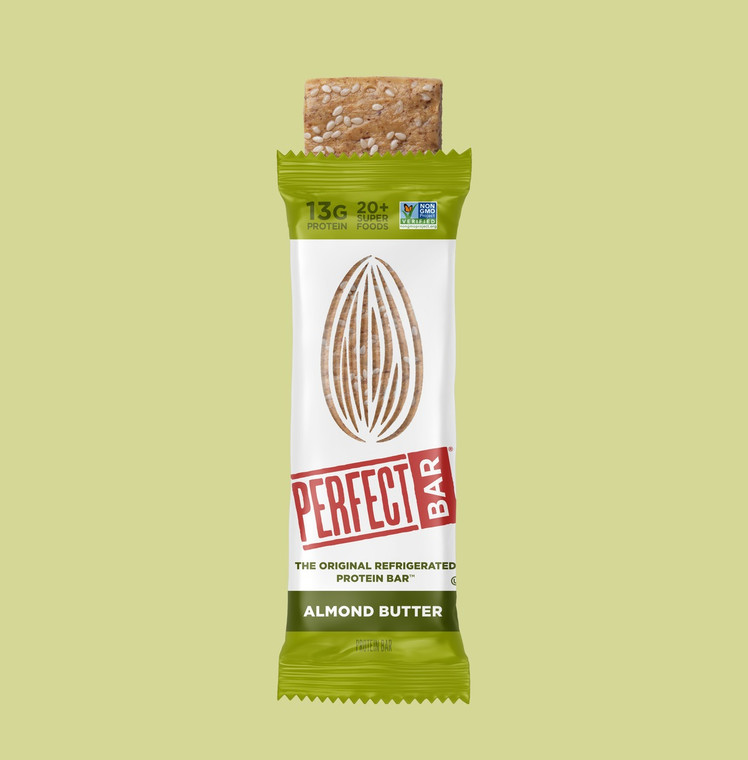
Real food protein — built from the fridge, not the lab. Perfect Bar's Almond Butter bar is a refrigerated whole-food protein bar made from freshly ground almond butter, organic honey, and a dense stack of 20+ dried superfood powders — kale, flax seed, rose hip, kelp, dulse, spinach, and more — bound together without chemical preservatives, emulsifiers, or artificial sweeteners. Each 65g bar delivers 13g of protein sourced entirely from whole foods: nut butter, dried whole egg powder, and nonfat dry milk. The reason it lives in the refrigerator case isn't a marketing gimmick — it's because real, minimally processed food without synthetic preservatives actually needs cold to stay fresh, the same way your fruits and vegetables do.
- Soft, cookie-dough texture with a rich almond butter flavor; works as a midday snack, pre-workout fuel, or a lunchbox addition that doesn't need an ice pack if consumed same-day
- 13g whole-food protein per bar (320 calories, 19g fat, 4g dietary fiber) from freshly ground nut butter, dried whole egg, and organic milk — no isolated soy protein or artificial protein blends; also an excellent source of Vitamin E (60% DV), Copper (45% DV), and Riboflavin (45% DV)
- Certified Organic, Gluten-Free, and Soy-Free; low glycemic index; suitable for gluten-free and soy-free lifestyles
Perfect Bar's Almond Butter bar starts with one foundational premise: real food belongs in the refrigerator. Built on freshly ground almond butter and organic honey — no artificial sweeteners, no stevia, no isolated protein concentrates — each bar packs 13g of whole-food protein into a soft, chewy 65g bar that tastes like cookie dough and fuels like a meal.
The ingredient list reads like a functional whole-food pantry: almond butter as the base (an excellent source of Vitamin E, Riboflavin, Magnesium, and Copper), organic honey as both binder and natural sweetener, dried whole egg powder and nonfat dry milk for complete protein, sesame seeds, almond pieces, and a broad blend of 20+ dried whole-food powders — kale, flax seed, rose hip, orange, lemon, papaya, tomato, apple, alfalfa, celery, kelp, dulse, carrot, and spinach. Protein-supporting oils round out the formula: organic olive oil, flax seed oil, sesame seed oil, and pumpkin seed oil.
Per bar (65g): 320 calories · 19g total fat · 13g protein · 25g total carbohydrate · 4g dietary fiber · 18g total sugars (12g added, from organic honey) · 45mg sodium · 430mg potassium. Vitamin E 60% DV · Copper 45% DV · Riboflavin 45% DV · Niacin 25% DV · Magnesium 25% DV · Calcium 15% DV.
This bar is sold refrigerated and should be kept cold for peak freshness and texture. Each box contains 8 full-size bars. Certified Organic, Gluten-Free, and Soy-Free. Contains almonds, milk, eggs, and sesame. Produced on equipment also handling peanuts and other tree nuts; may contain occasional nut shells.
Ingredients: Almond Butter, Honey*, Nonfat Dry Milk*, Almond Pieces, Dried Whole Egg Powder*, Rice Protein*, Sesame Seeds*, Dried Whole Food Powders (Kale*, Flax Seed*, Rose Hip*, Orange*, Lemon*, Papaya*, Tomato*, Apple*, Alfalfa*, Celery*, Kelp*, Dulse*, Carrot*, Spinach*), Olive Oil*, Flax Seed Oil*, Sesame Seed Oil*, Pumpkin Seed Oil*. *Organic
Common Questions
How does the protein in this bar compare to a conventional protein bar with isolated whey or soy protein?
Most conventional protein bars use isolated or concentrated proteins — whey isolate, soy protein isolate, or pea protein concentrate — which are stripped of the cofactors and fats that aid absorption. This bar sources its 13g of protein from whole-food forms: dried whole egg powder (a complete protein with all nine essential amino acids and a biological value of roughly 100), nonfat dry milk (complete protein with casein and whey fractions intact), rice protein, and the almond butter base itself. The practical difference is that whole-food protein matrices digest more slowly and carry fat-soluble nutrients like Vitamin E (60% DV per bar) that isolated powders do not. The tradeoff is a higher calorie count — 320 calories per 65g bar — compared to some isolate-based bars that push 20–25g protein for similar calories, so this bar is better framed as a meal replacement than a lean protein supplement.
What is the role of the dried whole-food powder blend, and is it present in meaningful amounts?
The blend includes 14 named whole-food powders — kale, flax seed, rose hip, orange, lemon, papaya, tomato, apple, alfalfa, celery, kelp, dulse, carrot, and spinach — and functions primarily as a micronutrient and phytonutrient matrix rather than a macronutrient source. Because these powders appear late in the ingredient list, each individual powder is present in small quantities, and no single powder delivers a clinically significant dose of any one compound on its own. Their value is in breadth: kelp and dulse contribute iodine and trace minerals difficult to find in most bar formats, rose hip is a concentrated source of Vitamin C, and flax seed adds lignans alongside its alpha-linolenic acid (ALA) content. The bar is transparent that these are functional additions, not the headline nutrient story — the 60% DV Vitamin E and 45% DV Copper come primarily from the almond butter base, not the powders.
Is this bar suitable for someone following a paleo diet, and how does it fit macronutrient-wise?
The bar is partially paleo-compatible but not strictly so. Paleo frameworks generally accept nuts, seeds, eggs, honey, and whole-food vegetables — all present here — but exclude dairy, and this bar contains nonfat dry milk as a protein source, which would disqualify it under strict paleo rules. For primal or paleo-adjacent approaches that allow dairy, the macros are workable: 19g fat, 13g protein, 25g carbohydrate, and 4g fiber (21g net carbs) per 65g bar. The 18g total sugars (12g added, all from organic honey) make it too high-carbohydrate for ketogenic protocols, which typically cap daily net carbs at 20–50g. It fits best as a between-meal option for active individuals on a whole-food or ancestral eating pattern who are not restricting carbohydrates.
What do the Certified Organic, Gluten-Free, and Soy-Free certifications actually verify, and who issues them?
USDA Certified Organic requires that ingredients marked with an asterisk — which here covers honey, nonfat dry milk, egg powder, rice protein, sesame seeds, and all 14 whole-food powders plus all four oils — be grown or raised without synthetic pesticides, synthetic fertilizers, or GMOs, and be verified by an accredited third-party certifier auditing the supply chain annually. The Gluten-Free certification (commonly issued by GFCO or NSF) requires testing to confirm gluten levels below 10–20 parts per million depending on the certifying body, providing a measurable threshold beyond just label claims. Soy-Free certification verifies the absence of soy-derived ingredients and typically includes allergen testing of the finished product. Note that none of these certifications address peanut or tree nut cross-contact — the facility disclaimer states shared equipment with peanuts and other tree nuts, which is a separate allergen risk not covered by these three certifications.
What are the omega-3 sources in this bar and how significant is their contribution?
There are three meaningful ALA (alpha-linolenic acid) omega-3 sources in the formula: flax seed oil, flax seed powder, and pumpkin seed oil. ALA is a plant-based omega-3 that the body must convert to EPA and DHA — the conversion rate in humans is typically less than 10% for EPA and under 1% for DHA, making these sources a supporting contribution rather than a replacement for marine-derived omega-3s. Sesame seed oil and olive oil are predominantly monounsaturated (oleic acid) and do not contribute meaningfully to omega-3 intake. The bar does not contain any direct EPA or DHA sources. For someone relying on this bar as an omega-3 delivery vehicle, the contribution is modest; its lipid profile is better characterized as a healthy monounsaturated and polyunsaturated fat mix anchored by the almond butter base, which is roughly 65% monounsaturated fat by weight.
Can this bar be used as a direct substitute for a meal, and what does its nutrient profile look like in that context?
At 320 calories, 13g protein, 19g fat, and 4g fiber per 65g bar, it meets the threshold most dietitians use for a light meal or substantial snack (roughly 300–400 calories with balanced macronutrients). The 430mg potassium per bar — about 9% of the 4,700mg daily adequate intake — is notably high for a bar format, as is the 60% DV Vitamin E from the almond base. Sodium is low at 45mg, which matters for those watching intake. Where it falls short as a standalone meal replacement is micronutrient breadth: it is not a complete multivitamin, and the whole-food powders, while diverse, are in small amounts. It functions best as a meal substitute in situations where whole-food access is limited — travel, long workouts, or skipped meals — rather than as a daily structured meal replacement in a clinical or weight-management context.
Does this bar contain any artificial sweeteners, sugar alcohols, or synthetic binders, and how is sweetness achieved?
The bar contains no artificial sweeteners, no stevia or monk fruit, and no sugar alcohols such as erythritol, maltitol, or xylitol — all of which are commonly used in lower-calorie protein bars to hit sweetness without added sugars. Sweetness comes entirely from organic honey, which accounts for all 12g of added sugars per bar (of the 18g total sugars). Honey also serves a functional role as a binder that gives the bar its characteristic soft, chewy texture without requiring gums, syrups, or emulsifiers. The result is a straightforward sugar profile that will appear on a continuous glucose monitor as a real sugar response — relevant for diabetics or those managing blood glucose — but with no digestive side effects associated with sugar alcohols like bloating or laxative effects that some consumers experience with conventional protein bars.
The ingredient list reads like a functional whole-food pantry: almond butter as the base (an excellent source of Vitamin E, Riboflavin, Magnesium, and Copper), organic honey as both binder and natural sweetener, dried whole egg powder and nonfat dry milk for complete protein, sesame seeds, almond pieces, and a broad blend of 20+ dried whole-food powders — kale, flax seed, rose hip, orange, lemon, papaya, tomato, apple, alfalfa, celery, kelp, dulse, carrot, and spinach. Protein-supporting oils round out the formula: organic olive oil, flax seed oil, sesame seed oil, and pumpkin seed oil.
Per bar (65g): 320 calories · 19g total fat · 13g protein · 25g total carbohydrate · 4g dietary fiber · 18g total sugars (12g added, from organic honey) · 45mg sodium · 430mg potassium. Vitamin E 60% DV · Copper 45% DV · Riboflavin 45% DV · Niacin 25% DV · Magnesium 25% DV · Calcium 15% DV.
This bar is sold refrigerated and should be kept cold for peak freshness and texture. Each box contains 8 full-size bars. Certified Organic, Gluten-Free, and Soy-Free. Contains almonds, milk, eggs, and sesame. Produced on equipment also handling peanuts and other tree nuts; may contain occasional nut shells.
Ingredients: Almond Butter, Honey*, Nonfat Dry Milk*, Almond Pieces, Dried Whole Egg Powder*, Rice Protein*, Sesame Seeds*, Dried Whole Food Powders (Kale*, Flax Seed*, Rose Hip*, Orange*, Lemon*, Papaya*, Tomato*, Apple*, Alfalfa*, Celery*, Kelp*, Dulse*, Carrot*, Spinach*), Olive Oil*, Flax Seed Oil*, Sesame Seed Oil*, Pumpkin Seed Oil*. *Organic
Common Questions
How does the protein in this bar compare to a conventional protein bar with isolated whey or soy protein?
Most conventional protein bars use isolated or concentrated proteins — whey isolate, soy protein isolate, or pea protein concentrate — which are stripped of the cofactors and fats that aid absorption. This bar sources its 13g of protein from whole-food forms: dried whole egg powder (a complete protein with all nine essential amino acids and a biological value of roughly 100), nonfat dry milk (complete protein with casein and whey fractions intact), rice protein, and the almond butter base itself. The practical difference is that whole-food protein matrices digest more slowly and carry fat-soluble nutrients like Vitamin E (60% DV per bar) that isolated powders do not. The tradeoff is a higher calorie count — 320 calories per 65g bar — compared to some isolate-based bars that push 20–25g protein for similar calories, so this bar is better framed as a meal replacement than a lean protein supplement.
What is the role of the dried whole-food powder blend, and is it present in meaningful amounts?
The blend includes 14 named whole-food powders — kale, flax seed, rose hip, orange, lemon, papaya, tomato, apple, alfalfa, celery, kelp, dulse, carrot, and spinach — and functions primarily as a micronutrient and phytonutrient matrix rather than a macronutrient source. Because these powders appear late in the ingredient list, each individual powder is present in small quantities, and no single powder delivers a clinically significant dose of any one compound on its own. Their value is in breadth: kelp and dulse contribute iodine and trace minerals difficult to find in most bar formats, rose hip is a concentrated source of Vitamin C, and flax seed adds lignans alongside its alpha-linolenic acid (ALA) content. The bar is transparent that these are functional additions, not the headline nutrient story — the 60% DV Vitamin E and 45% DV Copper come primarily from the almond butter base, not the powders.
Is this bar suitable for someone following a paleo diet, and how does it fit macronutrient-wise?
The bar is partially paleo-compatible but not strictly so. Paleo frameworks generally accept nuts, seeds, eggs, honey, and whole-food vegetables — all present here — but exclude dairy, and this bar contains nonfat dry milk as a protein source, which would disqualify it under strict paleo rules. For primal or paleo-adjacent approaches that allow dairy, the macros are workable: 19g fat, 13g protein, 25g carbohydrate, and 4g fiber (21g net carbs) per 65g bar. The 18g total sugars (12g added, all from organic honey) make it too high-carbohydrate for ketogenic protocols, which typically cap daily net carbs at 20–50g. It fits best as a between-meal option for active individuals on a whole-food or ancestral eating pattern who are not restricting carbohydrates.
What do the Certified Organic, Gluten-Free, and Soy-Free certifications actually verify, and who issues them?
USDA Certified Organic requires that ingredients marked with an asterisk — which here covers honey, nonfat dry milk, egg powder, rice protein, sesame seeds, and all 14 whole-food powders plus all four oils — be grown or raised without synthetic pesticides, synthetic fertilizers, or GMOs, and be verified by an accredited third-party certifier auditing the supply chain annually. The Gluten-Free certification (commonly issued by GFCO or NSF) requires testing to confirm gluten levels below 10–20 parts per million depending on the certifying body, providing a measurable threshold beyond just label claims. Soy-Free certification verifies the absence of soy-derived ingredients and typically includes allergen testing of the finished product. Note that none of these certifications address peanut or tree nut cross-contact — the facility disclaimer states shared equipment with peanuts and other tree nuts, which is a separate allergen risk not covered by these three certifications.
What are the omega-3 sources in this bar and how significant is their contribution?
There are three meaningful ALA (alpha-linolenic acid) omega-3 sources in the formula: flax seed oil, flax seed powder, and pumpkin seed oil. ALA is a plant-based omega-3 that the body must convert to EPA and DHA — the conversion rate in humans is typically less than 10% for EPA and under 1% for DHA, making these sources a supporting contribution rather than a replacement for marine-derived omega-3s. Sesame seed oil and olive oil are predominantly monounsaturated (oleic acid) and do not contribute meaningfully to omega-3 intake. The bar does not contain any direct EPA or DHA sources. For someone relying on this bar as an omega-3 delivery vehicle, the contribution is modest; its lipid profile is better characterized as a healthy monounsaturated and polyunsaturated fat mix anchored by the almond butter base, which is roughly 65% monounsaturated fat by weight.
Can this bar be used as a direct substitute for a meal, and what does its nutrient profile look like in that context?
At 320 calories, 13g protein, 19g fat, and 4g fiber per 65g bar, it meets the threshold most dietitians use for a light meal or substantial snack (roughly 300–400 calories with balanced macronutrients). The 430mg potassium per bar — about 9% of the 4,700mg daily adequate intake — is notably high for a bar format, as is the 60% DV Vitamin E from the almond base. Sodium is low at 45mg, which matters for those watching intake. Where it falls short as a standalone meal replacement is micronutrient breadth: it is not a complete multivitamin, and the whole-food powders, while diverse, are in small amounts. It functions best as a meal substitute in situations where whole-food access is limited — travel, long workouts, or skipped meals — rather than as a daily structured meal replacement in a clinical or weight-management context.
Does this bar contain any artificial sweeteners, sugar alcohols, or synthetic binders, and how is sweetness achieved?
The bar contains no artificial sweeteners, no stevia or monk fruit, and no sugar alcohols such as erythritol, maltitol, or xylitol — all of which are commonly used in lower-calorie protein bars to hit sweetness without added sugars. Sweetness comes entirely from organic honey, which accounts for all 12g of added sugars per bar (of the 18g total sugars). Honey also serves a functional role as a binder that gives the bar its characteristic soft, chewy texture without requiring gums, syrups, or emulsifiers. The result is a straightforward sugar profile that will appear on a continuous glucose monitor as a real sugar response — relevant for diabetics or those managing blood glucose — but with no digestive side effects associated with sugar alcohols like bloating or laxative effects that some consumers experience with conventional protein bars.
- __Storage_Location:
- Refrigerated
- __Volume:
- 400
- __Owner:
- TCFarm
- __badge:
- for delivery by 10/14