


Aloha Greens Smoothie Cup - 7.5 oz
Live More Organics
$5.89
(No reviews yet)

Write a Review
Live More Organics
Aloha Greens Smoothie Cup - 7.5 oz
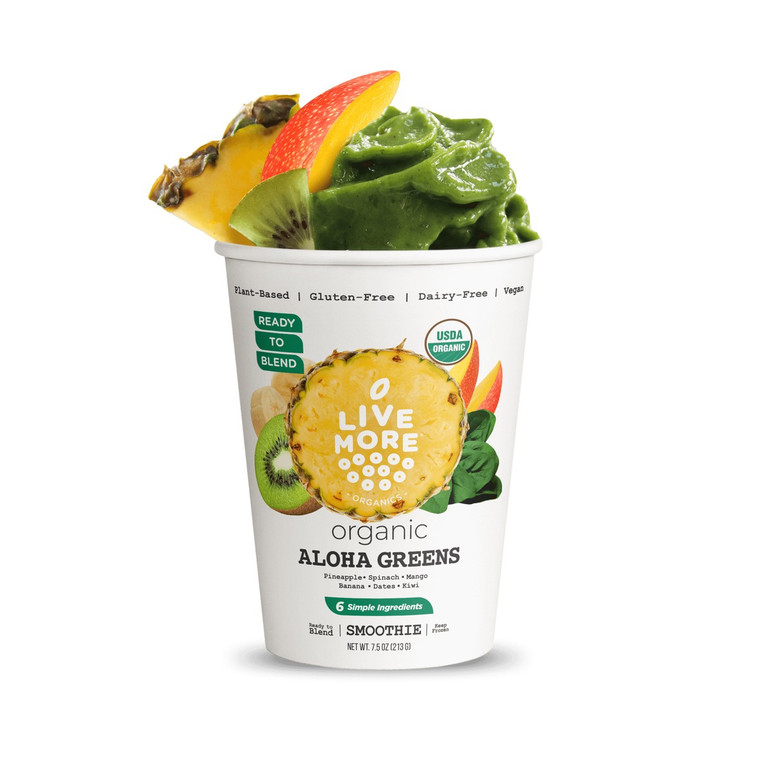
Six whole-food ingredients. Zero added sugar. One tropical smoothie cup ready to blend. LiveMore Organics' Aloha Greens packs pineapple, mango, kiwi, spinach, banana, and dates — and nothing else — into a single pre-portioned frozen cup. Every gram of sweetness comes from the fruit itself, not from a syrup or sweetener added after the fact.
- Blender-ready in under two minutes: pour your liquid of choice to the fill line, blend, and sip straight from the cup — a complete tropical-green smoothie with no prep, no measuring, and no waste.
- 570 mg potassium, 5g fiber, and 4g protein per serving from spinach, banana, and dates — nutrients delivered by whole fruit, not fortification.
- Certified Organic, 100% plant-based, gluten-free, dairy-free, and free of preservatives and added sugars — a smoothie that fits vegan, paleo-leaning, and clean-eating lifestyles alike.
LiveMore Organics built Aloha Greens around a simple premise: a smoothie should be made from fruit and greens, full stop. The result is a frozen smoothie cup whose entire ingredient list reads like a farmers' market haul — pineapple, spinach, mango, bananas, dates, and kiwi — with no fillers, no flavor concentrates, and no added sugars of any kind.
Each 213g cup delivers one ready-to-blend serving. The tropical fruit base — pineapple, mango, and kiwi — provides the tartness and Vitamin C load, while spinach adds iron and a deep-green nutrient profile without dominating the flavor. Banana and dates supply natural binding sweetness and 5g of dietary fiber per serving. Potassium clocks in at 569mg (12% DV), protein at 4g, and the entire cup lands at 170 calories with 0g added sugar — macros that are hard to replicate with most grocery-store smoothie blends, which routinely include fruit juice concentrates, cane sugar, or natural flavor additives to compensate for lower-quality fruit.
Preparation takes two minutes: remove the frozen cup from the freezer, pour your liquid of choice (oat milk, coconut water, kefir, or plain water) up to the fill line on the cup, blend until smooth, and pour back into the cup to sip. For a thicker consistency, use less liquid; for a lighter blend, add more. No portioning, no cleanup beyond the blender.
Shoppers who have tried Aloha Greens report a flavor that lands as genuinely fruity and satisfying. One verified buyer noted she mixed it with peach kefir and called it "totally delicious," adding that the organic, healthy profile is the reason she recommends it to others despite the premium price point.
Ingredients: Pineapple, Spinach, Mango, Bananas, Dates, and Kiwi.
Common Questions
How does the natural sugar in Aloha Greens compare to added sugars found in typical store-bought smoothie blends?
Aloha Greens contains 0g of added sugar — every gram of sweetness comes from the whole fruit and dates in the cup. Many grocery-store frozen smoothie blends include fruit juice concentrate, cane sugar, or honey, which can add 10–20g of added sugar per serving on top of the fruit's natural sugars. The distinction matters nutritionally because added sugars spike blood glucose faster and contribute empty calories, while the sugars in whole fruit arrive bundled with fiber (5g per serving here) that slows absorption. The American Heart Association recommends no more than 25g of added sugar per day for women and 36g for men, so a blend with 15g of added sugar uses up more than half that daily budget before breakfast.
What does spinach actually contribute nutritionally when blended into a fruit smoothie, and does freezing reduce those benefits?
Spinach is one of the more nutrient-dense leafy greens available, providing non-heme iron, folate, vitamin K, magnesium, and lutein per gram of calories. In a smoothie context, blending breaks down cell walls and can actually improve bioavailability of some carotenoids compared to eating whole raw leaves. Freezing spinach at or below 0°F preserves the majority of water-soluble vitamins — studies from the Institute of Food Research have found that frozen vegetables can retain as much or more vitamin C and folate than fresh produce stored for several days in a refrigerator. The one caveat is oxalate content in spinach, which can mildly inhibit iron absorption from the same meal; pairing with a vitamin C-rich liquid (like orange juice or coconut water) partially counteracts this. The tropical fruits in this blend — pineapple, mango, and kiwi — already supply a meaningful vitamin C load that helps on this front.
Is Aloha Greens suitable for people following a low-sugar or diabetic-friendly diet?
The cup has 0g added sugar, but it does contain naturally occurring sugars from pineapple, mango, banana, kiwi, and dates — fruits that sit in the moderate-to-high range on the glycemic index individually. The 5g of dietary fiber per serving helps moderate the glycemic response by slowing sugar absorption, but the overall carbohydrate load (driven largely by banana and dates) means this is not a low-carb product and would not fit a strict keto protocol, which typically caps net carbs at 20–50g per day. For people managing blood glucose who are not following a strict low-carb protocol, the no-added-sugar certification and fiber content make it a meaningfully cleaner option than most commercial smoothie products. Anyone with type 1 or type 2 diabetes should account for the total carbohydrate grams when calculating insulin or meal planning, and consult their dietitian for personalized guidance.
What liquid should I use to get the best flavor and texture from a frozen smoothie cup?
The fill-line on the cup is calibrated for roughly 6–8 oz of liquid, and the choice of liquid changes both the nutrition profile and the flavor significantly. Coconut water adds electrolytes (notably potassium) and a light tropical note that complements the pineapple and mango without adding dairy or much fat. Oat milk adds creaminess and a mild sweetness, though it does add roughly 2–4g of added sugar depending on the brand unless you choose unsweetened. Plain water produces the cleanest fruit flavor and the lowest calorie result. Kefir — as one verified buyer used — adds probiotics and protein, though it does introduce dairy, which removes the dairy-free suitability. For a thicker, bowl-style consistency, reduce the liquid by 2–3 oz and blend in pulses rather than continuously.
What does the USDA Organic certification actually verify for a product like this?
USDA Organic certification means the ingredients were grown without synthetic pesticides, synthetic fertilizers, or genetically modified organisms (GMOs), and that the operation was inspected and approved by a USDA-accredited certifying agent. For a fruit and vegetable product specifically, it rules out the most common residue concerns — the Environmental Working Group's annual Dirty Dozen list consistently includes strawberries, spinach, and other produce as high-residue crops under conventional growing. Organic certification is verified through annual farm inspections, paper-trail audits of inputs, and residue testing — it is not a self-declared label. The Gluten-Free certification on this product is separately governed, typically requiring testing to confirm gluten levels below 20 parts per million, the FDA threshold for a gluten-free claim. You can verify both certifications by looking up the brand's certificate number through the USDA's organic integrity database at ams.usda.gov.
How does the 170-calorie, 4g protein profile of Aloha Greens compare to making a smoothie from scratch with similar ingredients?
A homemade smoothie with equivalent whole-food ingredients — roughly 60g frozen mango, 60g pineapple, half a banana, a handful of spinach, one medjool date, and a few kiwi slices — would land at approximately 150–180 calories and 3–5g of protein, which is closely comparable to the Aloha Greens profile. The practical difference is in preparation: sourcing, measuring, and freezing individual whole fruits adds 5–10 minutes of prep and requires maintaining several separate frozen inventory items. The 4g of protein here comes entirely from the plant sources (spinach and banana contribute the most), not from any added protein powder, which keeps the ingredient list clean but also means this is not a high-protein option on its own. If protein is a priority, adding a scoop of unflavored or vanilla plant-based protein powder to the blend before blending is a straightforward adaptation that does not significantly alter texture.
Can Aloha Greens be used as a base for smoothie bowls or in recipes beyond a drinkable smoothie?
Yes — because the cup is simply frozen whole fruit and greens with no binders or thickeners, it behaves exactly as those raw ingredients would in any recipe. For a smoothie bowl, reduce the liquid to 3–4 oz instead of the standard 6–8 oz and blend in short bursts to keep it thick enough to hold toppings like granola, hemp seeds, or sliced fresh fruit. The tropical flavor profile — pineapple, mango, kiwi — pairs naturally with coconut flakes, macadamia nuts, and passion fruit for a Hawaiian-style bowl. You can also blend the cup with frozen cauliflower (neutral flavor, adds creaminess and fiber) or avocado (adds healthy fat and body) to change the macronutrient balance without introducing anything outside the clean-ingredient spirit of the product. The dates and banana provide enough natural sweetness that no additional sweetener is needed in most bowl applications.
Each 213g cup delivers one ready-to-blend serving. The tropical fruit base — pineapple, mango, and kiwi — provides the tartness and Vitamin C load, while spinach adds iron and a deep-green nutrient profile without dominating the flavor. Banana and dates supply natural binding sweetness and 5g of dietary fiber per serving. Potassium clocks in at 569mg (12% DV), protein at 4g, and the entire cup lands at 170 calories with 0g added sugar — macros that are hard to replicate with most grocery-store smoothie blends, which routinely include fruit juice concentrates, cane sugar, or natural flavor additives to compensate for lower-quality fruit.
Preparation takes two minutes: remove the frozen cup from the freezer, pour your liquid of choice (oat milk, coconut water, kefir, or plain water) up to the fill line on the cup, blend until smooth, and pour back into the cup to sip. For a thicker consistency, use less liquid; for a lighter blend, add more. No portioning, no cleanup beyond the blender.
Shoppers who have tried Aloha Greens report a flavor that lands as genuinely fruity and satisfying. One verified buyer noted she mixed it with peach kefir and called it "totally delicious," adding that the organic, healthy profile is the reason she recommends it to others despite the premium price point.
- "I mixed it with ? Peach Kefir for my liquid. It was totally delicious but…I agree with others that it's way overpriced.. I recommend it to anyone who has enough money to keep enjoying this delicious, organic and healthy smoothie." — She, Verified Buyer
- "You are so.so overpriced. 4pk is 14.20 at Costco." — Kim, Verified Buyer
Ingredients: Pineapple, Spinach, Mango, Bananas, Dates, and Kiwi.
Common Questions
How does the natural sugar in Aloha Greens compare to added sugars found in typical store-bought smoothie blends?
Aloha Greens contains 0g of added sugar — every gram of sweetness comes from the whole fruit and dates in the cup. Many grocery-store frozen smoothie blends include fruit juice concentrate, cane sugar, or honey, which can add 10–20g of added sugar per serving on top of the fruit's natural sugars. The distinction matters nutritionally because added sugars spike blood glucose faster and contribute empty calories, while the sugars in whole fruit arrive bundled with fiber (5g per serving here) that slows absorption. The American Heart Association recommends no more than 25g of added sugar per day for women and 36g for men, so a blend with 15g of added sugar uses up more than half that daily budget before breakfast.
What does spinach actually contribute nutritionally when blended into a fruit smoothie, and does freezing reduce those benefits?
Spinach is one of the more nutrient-dense leafy greens available, providing non-heme iron, folate, vitamin K, magnesium, and lutein per gram of calories. In a smoothie context, blending breaks down cell walls and can actually improve bioavailability of some carotenoids compared to eating whole raw leaves. Freezing spinach at or below 0°F preserves the majority of water-soluble vitamins — studies from the Institute of Food Research have found that frozen vegetables can retain as much or more vitamin C and folate than fresh produce stored for several days in a refrigerator. The one caveat is oxalate content in spinach, which can mildly inhibit iron absorption from the same meal; pairing with a vitamin C-rich liquid (like orange juice or coconut water) partially counteracts this. The tropical fruits in this blend — pineapple, mango, and kiwi — already supply a meaningful vitamin C load that helps on this front.
Is Aloha Greens suitable for people following a low-sugar or diabetic-friendly diet?
The cup has 0g added sugar, but it does contain naturally occurring sugars from pineapple, mango, banana, kiwi, and dates — fruits that sit in the moderate-to-high range on the glycemic index individually. The 5g of dietary fiber per serving helps moderate the glycemic response by slowing sugar absorption, but the overall carbohydrate load (driven largely by banana and dates) means this is not a low-carb product and would not fit a strict keto protocol, which typically caps net carbs at 20–50g per day. For people managing blood glucose who are not following a strict low-carb protocol, the no-added-sugar certification and fiber content make it a meaningfully cleaner option than most commercial smoothie products. Anyone with type 1 or type 2 diabetes should account for the total carbohydrate grams when calculating insulin or meal planning, and consult their dietitian for personalized guidance.
What liquid should I use to get the best flavor and texture from a frozen smoothie cup?
The fill-line on the cup is calibrated for roughly 6–8 oz of liquid, and the choice of liquid changes both the nutrition profile and the flavor significantly. Coconut water adds electrolytes (notably potassium) and a light tropical note that complements the pineapple and mango without adding dairy or much fat. Oat milk adds creaminess and a mild sweetness, though it does add roughly 2–4g of added sugar depending on the brand unless you choose unsweetened. Plain water produces the cleanest fruit flavor and the lowest calorie result. Kefir — as one verified buyer used — adds probiotics and protein, though it does introduce dairy, which removes the dairy-free suitability. For a thicker, bowl-style consistency, reduce the liquid by 2–3 oz and blend in pulses rather than continuously.
What does the USDA Organic certification actually verify for a product like this?
USDA Organic certification means the ingredients were grown without synthetic pesticides, synthetic fertilizers, or genetically modified organisms (GMOs), and that the operation was inspected and approved by a USDA-accredited certifying agent. For a fruit and vegetable product specifically, it rules out the most common residue concerns — the Environmental Working Group's annual Dirty Dozen list consistently includes strawberries, spinach, and other produce as high-residue crops under conventional growing. Organic certification is verified through annual farm inspections, paper-trail audits of inputs, and residue testing — it is not a self-declared label. The Gluten-Free certification on this product is separately governed, typically requiring testing to confirm gluten levels below 20 parts per million, the FDA threshold for a gluten-free claim. You can verify both certifications by looking up the brand's certificate number through the USDA's organic integrity database at ams.usda.gov.
How does the 170-calorie, 4g protein profile of Aloha Greens compare to making a smoothie from scratch with similar ingredients?
A homemade smoothie with equivalent whole-food ingredients — roughly 60g frozen mango, 60g pineapple, half a banana, a handful of spinach, one medjool date, and a few kiwi slices — would land at approximately 150–180 calories and 3–5g of protein, which is closely comparable to the Aloha Greens profile. The practical difference is in preparation: sourcing, measuring, and freezing individual whole fruits adds 5–10 minutes of prep and requires maintaining several separate frozen inventory items. The 4g of protein here comes entirely from the plant sources (spinach and banana contribute the most), not from any added protein powder, which keeps the ingredient list clean but also means this is not a high-protein option on its own. If protein is a priority, adding a scoop of unflavored or vanilla plant-based protein powder to the blend before blending is a straightforward adaptation that does not significantly alter texture.
Can Aloha Greens be used as a base for smoothie bowls or in recipes beyond a drinkable smoothie?
Yes — because the cup is simply frozen whole fruit and greens with no binders or thickeners, it behaves exactly as those raw ingredients would in any recipe. For a smoothie bowl, reduce the liquid to 3–4 oz instead of the standard 6–8 oz and blend in short bursts to keep it thick enough to hold toppings like granola, hemp seeds, or sliced fresh fruit. The tropical flavor profile — pineapple, mango, kiwi — pairs naturally with coconut flakes, macadamia nuts, and passion fruit for a Hawaiian-style bowl. You can also blend the cup with frozen cauliflower (neutral flavor, adds creaminess and fiber) or avocado (adds healthy fat and body) to change the macronutrient balance without introducing anything outside the clean-ingredient spirit of the product. The dates and banana provide enough natural sweetness that no additional sweetener is needed in most bowl applications.
- __Storage_Location:
- FrozenICE
- __Volume:
- 400
- __Owner:
- TCFarm
- __badge:
- 100% Plant-Based