


Banana Split Smoothie Cup - 8 oz
Live More Organics
$5.89
(No reviews yet)

Write a Review
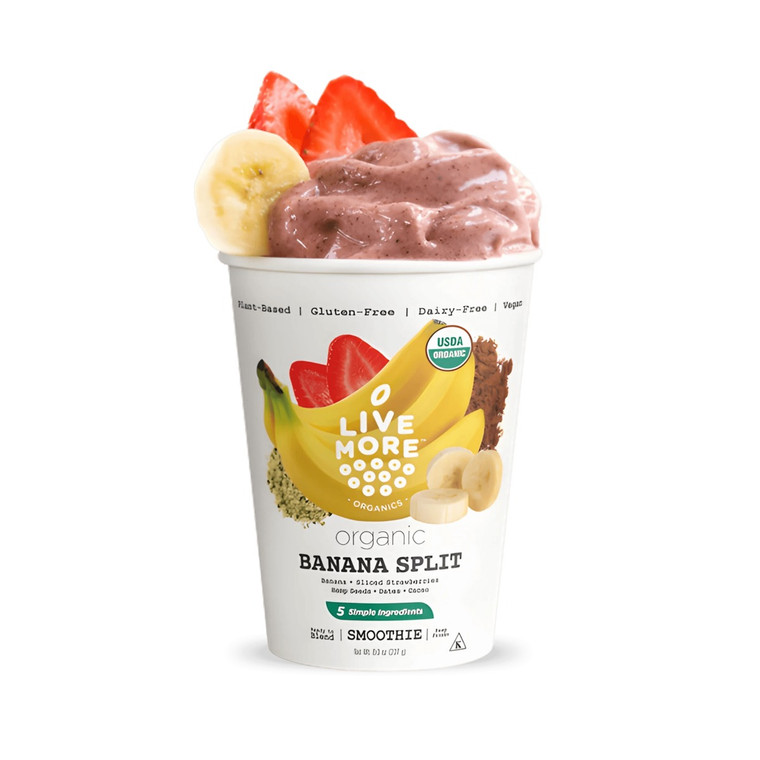
Live More Organics
Banana Split Smoothie Cup - 8 oz
A frozen smoothie cup that tastes like dessert — because it's built from five whole-food ingredients that earn every calorie. LiveMore Organics' Banana Split cup packs 7g of complete protein from hemp seeds (one of the few plant sources delivering all nine essential amino acids), 7g of dietary fiber, and 778mg of potassium into a single 227g serving — with zero added sugar, zero preservatives, and zero dairy. Just organic bananas, strawberries, hemp seeds, dates, and cacao, pre-portioned and frozen at peak ripeness so you blend it in under two minutes.
- Pre- or post-workout fuel, quick breakfast, or an after-dinner fix — blends straight from frozen with your liquid of choice; pour it back into the cup and sip without a bowl to wash.
- Hemp seeds are a complete protein — unlike most plant proteins, they supply all nine essential amino acids alongside healthy fats; dates add soluble fiber that supports digestive regularity without a sugar spike from added sweeteners.
- Certified Organic, 100% plant-based, gluten-free, and dairy-free — fits vegan, vegetarian, and most clean-eating frameworks right out of the freezer.
LiveMore Organics built the Banana Split Smoothie Cup around a simple idea: if the ingredients are good enough, you don't need a recipe. Five certified-organic whole foods — bananas, strawberries, hemp seeds, dates, and cacao — are portioned, frozen, and handed to you ready to blend. No protein powders. No sweetener packets. No "natural flavors" standing in for real fruit.
Each 227g cup delivers 370 calories, 7g of protein, 7g of dietary fiber (26% DV), and 778mg of potassium (17% DV) — alongside 14% of your daily iron and 11% of your daily Vitamin D — all from the ingredients themselves, not from fortification. The protein comes entirely from hemp seeds, one of the rare plant foods that qualifies as a complete protein, supplying all nine essential amino acids plus omega-rich fats. Dates contribute soluble fiber that pairs with hemp's insoluble fiber to support digestive motility, and they bring the sweetness so the label can honestly read 0g added sugars.
The chocolate note comes from raw cacao — not cocoa powder processed with alkali — which preserves naturally occurring flavanols and contributes to the 2.49mg of iron per serving.
To blend: pour the frozen cup contents into a blender, add your liquid of choice (water, oat milk, almond milk) to the fill line marked on the cup, blend until smooth, pour back in, and drink. Less liquid = thicker, spoonable texture; more liquid = a thinner, pourable smoothie. No added ice needed.
Verified buyer experience: The one published review reflects daily use over an extended period, with a customer describing it as part of a consistent morning routine — signaling this is a product people return to, not just try once.
Certified Organic, 100% plant-based, gluten-free, dairy-free, and made with no preservatives or added sugars. Store frozen; blend directly from frozen — no thawing required.
Ingredients: Bananas, Strawberries, Hemp Seeds, Dates, and Cacao.
Common Questions
How does the nutrition in this smoothie cup compare to a typical store-bought fruit smoothie?
Most commercial bottled smoothies and smoothie chain drinks rely on juice concentrates, added syrups, or sweetener blends to hit their flavor profile, which inflates sugar content — often 30–50g of added sugars per serving — while delivering minimal fiber or protein. The Banana Split cup contains 0g added sugars, sourcing all sweetness from whole dates and ripe bananas, and delivers 7g of dietary fiber (26% DV) and 7g of complete protein per 227g serving. A comparable 12-oz bottled smoothie from a major grocery brand typically provides 1–2g of fiber and 2–3g of protein. The nutrient density difference comes down to ingredient form: whole frozen fruit retains more fiber and phytonutrients than juice, and hemp seeds add protein and omega fats that juice-based drinks simply don't contain.
What makes hemp seeds a meaningful protein source, and how does the protein in this cup actually work nutritionally?
Hemp seeds are one of a small number of plant foods classified as a complete protein, meaning they supply all nine essential amino acids — including the three branched-chain amino acids (leucine, isoleucine, valine) that are particularly relevant to muscle protein synthesis. Per 30g serving, hemp seeds contain roughly 9–10g of protein along with a favorable ratio of omega-6 to omega-3 fatty acids (approximately 3:1), which is considered nutritionally balanced compared to many seed oils that skew toward 15:1 or higher. The 7g of protein in this cup comes entirely from hemp seeds, not from added protein isolates or concentrates, so the amino acid profile and the fats arrive together as they exist in the whole seed. This matters because isolated protein powders strip away the co-occurring fats and fiber that affect how protein is absorbed and how satiated you feel afterward.
What is raw cacao, and why does it matter that this product uses it instead of regular cocoa powder?
Raw cacao and cocoa powder both come from cacao beans, but cocoa powder is typically processed using an alkalization method (called Dutch processing) that raises the pH of the bean to reduce bitterness — a process that degrades a significant portion of the naturally occurring flavanols. Studies published in the Journal of Agricultural and Food Chemistry have shown that Dutch-processed cocoa can lose 60–90% of its original flavanol content compared to minimally processed cacao. Cacao flavanols, particularly epicatechin and catechin, are associated with nitric oxide-mediated vasodilation, which supports healthy blood flow. Raw cacao also retains more of its natural iron content; this product delivers 2.49mg of iron per serving (14% DV), which comes from the cacao and hemp seeds rather than fortification. Using raw cacao means the nutritional profile on the label reflects what the ingredient actually contains, not what was added back after processing.
Is this smoothie cup appropriate for people following a gluten-free or dairy-free diet, and what certifications back that up?
Yes — the product carries both a certified Gluten-Free certification and a Dairy-Free certification, in addition to USDA Organic and 100% Plant-Based designations. Certified Gluten-Free means the product has been tested and verified to contain fewer than 20 parts per million (ppm) of gluten, which is the threshold established by the FDA for gluten-free labeling and the standard used by major celiac and gluten-sensitivity organizations. Dairy-Free certification confirms the absence of milk-derived ingredients, which matters for people managing lactose intolerance or casein sensitivity. All five ingredients — bananas, strawberries, hemp seeds, dates, and cacao — are inherently free of gluten and dairy, and the certifications provide third-party verification that cross-contamination controls are in place during production. The USDA Organic certification additionally confirms that no synthetic pesticides, herbicides, or GMO inputs were used in growing the source ingredients.
How do dates contribute to fiber and sweetness without adding sugar to the label?
Dates contain fructose, glucose, and sucrose in their natural form as part of the whole fruit, which means the sweetness they provide is counted as naturally occurring sugar — not added sugar — under FDA labeling rules. Added sugars on a nutrition label refer specifically to sugars introduced during processing (such as cane sugar, honey, or agave syrup added as separate ingredients), not the sugars inherently present in whole fruit. Nutritionally, dates are notable for their soluble fiber content — primarily in the form of pectin and beta-glucan — which slows glucose absorption and can moderate the glycemic response compared to equivalent sweetness from refined sugar. This soluble fiber from dates complements the insoluble fiber found in hemp seeds, and together they contribute to the 7g total dietary fiber per serving that supports digestive motility. The result is a cup that tastes sweet because of real fruit, not because of any sweetener added at the manufacturing stage.
Can this smoothie cup be prepared as a thick bowl rather than a drinkable smoothie, and does the ratio of liquid change anything nutritionally?
Yes — the texture is fully adjustable based on how much liquid you add, and the nutritional content of the cup itself stays identical regardless. Using less liquid (closer to 4–6 oz) produces a thick, spoonable consistency similar to a smoothie bowl that can be topped with granola, nuts, or fruit. Adding more liquid (8–12 oz) produces a thinner, pourable smoothie. The cup's fill line provides a reference point, but you can go above or below it based on your preferred texture. No ice needs to be added because the ingredients are already frozen, and the blending process handles the chilling. The 370 calories, 7g protein, 7g fiber, and all other nutrients listed reflect only the contents of the cup — whatever liquid you add (water, oat milk, almond milk) will contribute its own separate calories and nutrients on top of that baseline.
What does the Organic certification actually verify, and how is it different from a product that just says 'made with natural ingredients'?
USDA Organic certification is a federally regulated designation that requires producers to meet and maintain specific standards verified by an accredited third-party certifying agent — it is not self-declared. To carry the USDA Organic seal, at least 95% of ingredients (by weight, excluding water and salt) must be certified organic, meaning they were grown without synthetic pesticides, synthetic fertilizers, sewage sludge, ionizing radiation, or genetically engineered seeds. The certifying agent conducts annual on-site inspections and can require soil and product testing. By contrast, the phrase 'made with natural ingredients' has no legal definition under FDA or USDA regulations — any manufacturer can use it without third-party review or any specific input restrictions. For a product like this, where the entire ingredient list is five whole foods, the Organic certification applies to all five of those source ingredients and is the clearest available signal that the farming practices meet a documented, inspected standard.
Each 227g cup delivers 370 calories, 7g of protein, 7g of dietary fiber (26% DV), and 778mg of potassium (17% DV) — alongside 14% of your daily iron and 11% of your daily Vitamin D — all from the ingredients themselves, not from fortification. The protein comes entirely from hemp seeds, one of the rare plant foods that qualifies as a complete protein, supplying all nine essential amino acids plus omega-rich fats. Dates contribute soluble fiber that pairs with hemp's insoluble fiber to support digestive motility, and they bring the sweetness so the label can honestly read 0g added sugars.
The chocolate note comes from raw cacao — not cocoa powder processed with alkali — which preserves naturally occurring flavanols and contributes to the 2.49mg of iron per serving.
To blend: pour the frozen cup contents into a blender, add your liquid of choice (water, oat milk, almond milk) to the fill line marked on the cup, blend until smooth, pour back in, and drink. Less liquid = thicker, spoonable texture; more liquid = a thinner, pourable smoothie. No added ice needed.
Verified buyer experience: The one published review reflects daily use over an extended period, with a customer describing it as part of a consistent morning routine — signaling this is a product people return to, not just try once.
- "Excellent!! I've had one of these every morning.. They are the best.." — Joy Y., Verified Buyer
Certified Organic, 100% plant-based, gluten-free, dairy-free, and made with no preservatives or added sugars. Store frozen; blend directly from frozen — no thawing required.
Ingredients: Bananas, Strawberries, Hemp Seeds, Dates, and Cacao.
Common Questions
How does the nutrition in this smoothie cup compare to a typical store-bought fruit smoothie?
Most commercial bottled smoothies and smoothie chain drinks rely on juice concentrates, added syrups, or sweetener blends to hit their flavor profile, which inflates sugar content — often 30–50g of added sugars per serving — while delivering minimal fiber or protein. The Banana Split cup contains 0g added sugars, sourcing all sweetness from whole dates and ripe bananas, and delivers 7g of dietary fiber (26% DV) and 7g of complete protein per 227g serving. A comparable 12-oz bottled smoothie from a major grocery brand typically provides 1–2g of fiber and 2–3g of protein. The nutrient density difference comes down to ingredient form: whole frozen fruit retains more fiber and phytonutrients than juice, and hemp seeds add protein and omega fats that juice-based drinks simply don't contain.
What makes hemp seeds a meaningful protein source, and how does the protein in this cup actually work nutritionally?
Hemp seeds are one of a small number of plant foods classified as a complete protein, meaning they supply all nine essential amino acids — including the three branched-chain amino acids (leucine, isoleucine, valine) that are particularly relevant to muscle protein synthesis. Per 30g serving, hemp seeds contain roughly 9–10g of protein along with a favorable ratio of omega-6 to omega-3 fatty acids (approximately 3:1), which is considered nutritionally balanced compared to many seed oils that skew toward 15:1 or higher. The 7g of protein in this cup comes entirely from hemp seeds, not from added protein isolates or concentrates, so the amino acid profile and the fats arrive together as they exist in the whole seed. This matters because isolated protein powders strip away the co-occurring fats and fiber that affect how protein is absorbed and how satiated you feel afterward.
What is raw cacao, and why does it matter that this product uses it instead of regular cocoa powder?
Raw cacao and cocoa powder both come from cacao beans, but cocoa powder is typically processed using an alkalization method (called Dutch processing) that raises the pH of the bean to reduce bitterness — a process that degrades a significant portion of the naturally occurring flavanols. Studies published in the Journal of Agricultural and Food Chemistry have shown that Dutch-processed cocoa can lose 60–90% of its original flavanol content compared to minimally processed cacao. Cacao flavanols, particularly epicatechin and catechin, are associated with nitric oxide-mediated vasodilation, which supports healthy blood flow. Raw cacao also retains more of its natural iron content; this product delivers 2.49mg of iron per serving (14% DV), which comes from the cacao and hemp seeds rather than fortification. Using raw cacao means the nutritional profile on the label reflects what the ingredient actually contains, not what was added back after processing.
Is this smoothie cup appropriate for people following a gluten-free or dairy-free diet, and what certifications back that up?
Yes — the product carries both a certified Gluten-Free certification and a Dairy-Free certification, in addition to USDA Organic and 100% Plant-Based designations. Certified Gluten-Free means the product has been tested and verified to contain fewer than 20 parts per million (ppm) of gluten, which is the threshold established by the FDA for gluten-free labeling and the standard used by major celiac and gluten-sensitivity organizations. Dairy-Free certification confirms the absence of milk-derived ingredients, which matters for people managing lactose intolerance or casein sensitivity. All five ingredients — bananas, strawberries, hemp seeds, dates, and cacao — are inherently free of gluten and dairy, and the certifications provide third-party verification that cross-contamination controls are in place during production. The USDA Organic certification additionally confirms that no synthetic pesticides, herbicides, or GMO inputs were used in growing the source ingredients.
How do dates contribute to fiber and sweetness without adding sugar to the label?
Dates contain fructose, glucose, and sucrose in their natural form as part of the whole fruit, which means the sweetness they provide is counted as naturally occurring sugar — not added sugar — under FDA labeling rules. Added sugars on a nutrition label refer specifically to sugars introduced during processing (such as cane sugar, honey, or agave syrup added as separate ingredients), not the sugars inherently present in whole fruit. Nutritionally, dates are notable for their soluble fiber content — primarily in the form of pectin and beta-glucan — which slows glucose absorption and can moderate the glycemic response compared to equivalent sweetness from refined sugar. This soluble fiber from dates complements the insoluble fiber found in hemp seeds, and together they contribute to the 7g total dietary fiber per serving that supports digestive motility. The result is a cup that tastes sweet because of real fruit, not because of any sweetener added at the manufacturing stage.
Can this smoothie cup be prepared as a thick bowl rather than a drinkable smoothie, and does the ratio of liquid change anything nutritionally?
Yes — the texture is fully adjustable based on how much liquid you add, and the nutritional content of the cup itself stays identical regardless. Using less liquid (closer to 4–6 oz) produces a thick, spoonable consistency similar to a smoothie bowl that can be topped with granola, nuts, or fruit. Adding more liquid (8–12 oz) produces a thinner, pourable smoothie. The cup's fill line provides a reference point, but you can go above or below it based on your preferred texture. No ice needs to be added because the ingredients are already frozen, and the blending process handles the chilling. The 370 calories, 7g protein, 7g fiber, and all other nutrients listed reflect only the contents of the cup — whatever liquid you add (water, oat milk, almond milk) will contribute its own separate calories and nutrients on top of that baseline.
What does the Organic certification actually verify, and how is it different from a product that just says 'made with natural ingredients'?
USDA Organic certification is a federally regulated designation that requires producers to meet and maintain specific standards verified by an accredited third-party certifying agent — it is not self-declared. To carry the USDA Organic seal, at least 95% of ingredients (by weight, excluding water and salt) must be certified organic, meaning they were grown without synthetic pesticides, synthetic fertilizers, sewage sludge, ionizing radiation, or genetically engineered seeds. The certifying agent conducts annual on-site inspections and can require soil and product testing. By contrast, the phrase 'made with natural ingredients' has no legal definition under FDA or USDA regulations — any manufacturer can use it without third-party review or any specific input restrictions. For a product like this, where the entire ingredient list is five whole foods, the Organic certification applies to all five of those source ingredients and is the clearest available signal that the farming practices meet a documented, inspected standard.
- __Storage_Location:
- FrozenICE
- __Volume:
- 400
- __Owner:
- TCFarm
- __badge:
- 100% Plant-Based