


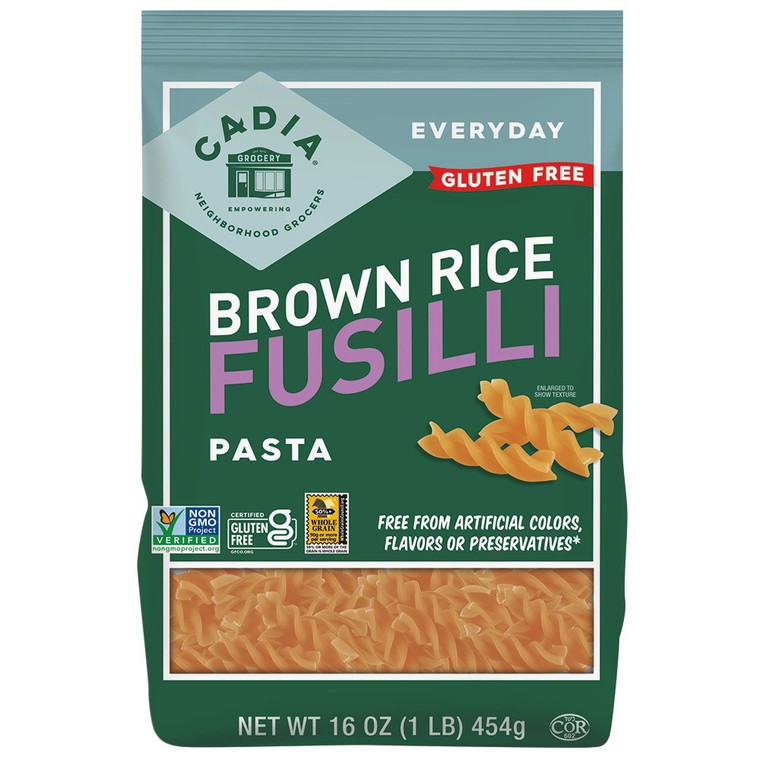
Brown Rice Fusilli - 16 oz
Cadia
$2.99
Below are the available bulk discount rates for each individual item when you purchase a certain amount
- Buy 2 - 5 and get 2% off
- Buy 6 - 11 and get 4% off
- Buy 12 or above and get 8% off
(No reviews yet)

Write a Review
Cadia
Brown Rice Fusilli - 16 oz
This fusilli is built from three ingredients, full stop: organic whole grain brown rice, rice bran, and water. No gums, no starch blends, no corn fillers to fake a wheat-like bite — the kind of short ingredient panel that's rare in the gluten-free pasta aisle, where most brands need five or six additives to hold a noodle together. Available exclusively at independent neighborhood grocers, it's organic, non-GMO, and priced so your local grocer can compete with the chain down the street.
- Holds its ridges and chew through a simmering marinara or a heavy cream sauce — built to carry weight, not fall apart in the pot
- Milled from organic whole grain brown rice with just rice bran and water added — no gums or starch fillers common in other gluten-free pastas
- Certified gluten-free, kosher, and made from non-GMO ingredients — fits gluten-free and plant-based tables without compromise
Cadia Everyday exists for one reason: to give the neighborhood grocer down the street the same clean-label, fairly-priced pantry staples the big-box chains stock -- without the markup or the mystery ingredients.
This Brown Rice Fusilli, a clean-label organic gluten-free pasta, is milled from organic whole grain brown rice into a gluten-free flour, then shaped into a ridged fusilli that holds sauce in every twist. The texture is distinctly chewy compared to thinner rice pastas -- it stands up to a heavy Alfredo, a slow-simmered marinara, or a cold pasta salad without turning to mush. Each box is 16 oz. Pack of 12.
Because the ingredient list stops at three items -- organic whole grain brown rice, rice bran, and water -- there's nothing here working to mimic wheat's gluten structure. That's the tradeoff and the payoff of a genuinely short label: cook it just to al dente (start checking a minute or two before the package time) and rinse briefly if you're serving it cold, since rice pasta firms up fast as it cools.
Certified gluten-free, Non-GMO Project Verified, kosher, and USDA Organic, this fusilli fits gluten-free kitchens, plant-based tables, and anyone reading every line of the ingredient panel before it goes in the cart -- though as a grain-based pasta it's not suited to keto, paleo, or carnivore diets, which call for grain-free carb sources. Store it in the pantry at room temperature until you're ready to cook.
Ingredients: Whole Grain Brown Rice, Rice Bran, and Water.
Common Questions
How does this compare nutritionally to regular wheat fusilli?
A 2 oz dry serving of this brown rice fusilli runs about 200 calories, 43g carbohydrate, 2g fiber, and 4g protein, with less than 1g fat. A comparable serving of conventional durum wheat fusilli lands close on calories and carbs but delivers more protein, usually 7-8g, thanks to wheat's higher gluten content. The tradeoff is that wheat pasta contains gluten protein that this rice-based version doesn't, so if you need the protein bump you'll want to pair this with a protein-forward sauce like a meat ragu or add beans to a cold pasta salad.
What does keeping the rice bran in this pasta actually do nutritionally?
Rice bran is the outer layer of the grain that's stripped away to make white rice and white rice pasta, and it's where most of the grain's gamma-oryzanol and tocotrienols (a form of vitamin E) are concentrated. Gamma-oryzanol is an antioxidant compound studied for supporting healthy cholesterol metabolism, and it's largely absent from pasta made with white rice flour. Keeping the bran also means more fiber per serving than a stripped-white-rice noodle and is part of why this fusilli has a firmer, chewier bite instead of going soft and gummy.
Does this fit a keto, paleo, or carnivore diet?
No. At roughly 41g net carbs per 2 oz dry serving, this pasta is too high in carbohydrate for a standard keto protocol, which typically caps daily net carbs around 20-50g total. It's also grain-based, so it doesn't fit paleo or carnivore frameworks, both of which exclude grains entirely regardless of gluten content. Where it does fit well is any gluten-free diet, whether for celiac disease, non-celiac gluten sensitivity, or general wheat avoidance, since brown rice contains no gluten protein at all.
What dishes can I substitute this for wheat pasta in, and does the cooking change?
This works as a direct swap in baked ziti, pasta salad, a heavy Alfredo, slow-simmered marinara, or mac and cheese, since the ridges in the fusilli shape grip sauce the same way wheat fusilli does. The main adaptation is timing: start checking for doneness one to two minutes before the package time, because rice pasta goes from al dente to mushy faster than wheat pasta does. If you're building a cold pasta salad, rinse the noodles briefly under cool water right after draining, since rice pasta firms up and can clump as it cools.
What do the Organic, Non-GMO Project Verified, and kosher labels on this box actually certify?
USDA Organic certification means the brown rice was grown without synthetic pesticides or fertilizers and the product was inspected by a USDA-accredited certifying agent, verifiable through the USDA's Organic Integrity Database using the certifier listed on the package. Non-GMO Project Verified is a separate, third-party audit requiring ingredient testing to confirm GMO content stays below 0.9%, which you can check against the product's unique verification number on the Non-GMO Project's own database. The kosher certification confirms a rabbinical supervising agency inspected the production process and ingredients, which for a three-ingredient rice product mainly verifies equipment and facility practices.
Why is the ingredient list just three items, and does that affect texture or cooking?
Many gluten-free pastas add gums like xanthan or guar, or blend in corn and potato starch, to mimic the elasticity gluten normally provides. This fusilli skips all of that, relying only on organic whole grain brown rice, rice bran, and water, which means the bite comes from the rice starch and bran fiber structure rather than an added binder. The practical effect is a noodle that's noticeably chewier than thin rice noodles or gum-thickened gluten-free pastas, but one that also requires closer attention at the stove since there's no gum holding it together if it overcooks.
Is this a good choice for someone with celiac disease specifically, not just gluten sensitivity?
Yes, the product carries a Certified Gluten-Free label, which in the US requires testing below 20 parts per million of gluten, the threshold set by FDA regulation for gluten-free labeling claims and the same standard used for celiac-safe foods. The ingredient list itself contains no wheat, barley, rye, or oat-derived ingredients, and no shared-grain cross-contact ingredients like malt or modified food starch of unspecified origin. As with any packaged gluten-free food, checking the lot-specific certification mark on the box is the most direct way to confirm current testing status if you have celiac disease and need documentation beyond the label claim.
This Brown Rice Fusilli, a clean-label organic gluten-free pasta, is milled from organic whole grain brown rice into a gluten-free flour, then shaped into a ridged fusilli that holds sauce in every twist. The texture is distinctly chewy compared to thinner rice pastas -- it stands up to a heavy Alfredo, a slow-simmered marinara, or a cold pasta salad without turning to mush. Each box is 16 oz. Pack of 12.
Because the ingredient list stops at three items -- organic whole grain brown rice, rice bran, and water -- there's nothing here working to mimic wheat's gluten structure. That's the tradeoff and the payoff of a genuinely short label: cook it just to al dente (start checking a minute or two before the package time) and rinse briefly if you're serving it cold, since rice pasta firms up fast as it cools.
Certified gluten-free, Non-GMO Project Verified, kosher, and USDA Organic, this fusilli fits gluten-free kitchens, plant-based tables, and anyone reading every line of the ingredient panel before it goes in the cart -- though as a grain-based pasta it's not suited to keto, paleo, or carnivore diets, which call for grain-free carb sources. Store it in the pantry at room temperature until you're ready to cook.
Ingredients: Whole Grain Brown Rice, Rice Bran, and Water.
Common Questions
How does this compare nutritionally to regular wheat fusilli?
A 2 oz dry serving of this brown rice fusilli runs about 200 calories, 43g carbohydrate, 2g fiber, and 4g protein, with less than 1g fat. A comparable serving of conventional durum wheat fusilli lands close on calories and carbs but delivers more protein, usually 7-8g, thanks to wheat's higher gluten content. The tradeoff is that wheat pasta contains gluten protein that this rice-based version doesn't, so if you need the protein bump you'll want to pair this with a protein-forward sauce like a meat ragu or add beans to a cold pasta salad.
What does keeping the rice bran in this pasta actually do nutritionally?
Rice bran is the outer layer of the grain that's stripped away to make white rice and white rice pasta, and it's where most of the grain's gamma-oryzanol and tocotrienols (a form of vitamin E) are concentrated. Gamma-oryzanol is an antioxidant compound studied for supporting healthy cholesterol metabolism, and it's largely absent from pasta made with white rice flour. Keeping the bran also means more fiber per serving than a stripped-white-rice noodle and is part of why this fusilli has a firmer, chewier bite instead of going soft and gummy.
Does this fit a keto, paleo, or carnivore diet?
No. At roughly 41g net carbs per 2 oz dry serving, this pasta is too high in carbohydrate for a standard keto protocol, which typically caps daily net carbs around 20-50g total. It's also grain-based, so it doesn't fit paleo or carnivore frameworks, both of which exclude grains entirely regardless of gluten content. Where it does fit well is any gluten-free diet, whether for celiac disease, non-celiac gluten sensitivity, or general wheat avoidance, since brown rice contains no gluten protein at all.
What dishes can I substitute this for wheat pasta in, and does the cooking change?
This works as a direct swap in baked ziti, pasta salad, a heavy Alfredo, slow-simmered marinara, or mac and cheese, since the ridges in the fusilli shape grip sauce the same way wheat fusilli does. The main adaptation is timing: start checking for doneness one to two minutes before the package time, because rice pasta goes from al dente to mushy faster than wheat pasta does. If you're building a cold pasta salad, rinse the noodles briefly under cool water right after draining, since rice pasta firms up and can clump as it cools.
What do the Organic, Non-GMO Project Verified, and kosher labels on this box actually certify?
USDA Organic certification means the brown rice was grown without synthetic pesticides or fertilizers and the product was inspected by a USDA-accredited certifying agent, verifiable through the USDA's Organic Integrity Database using the certifier listed on the package. Non-GMO Project Verified is a separate, third-party audit requiring ingredient testing to confirm GMO content stays below 0.9%, which you can check against the product's unique verification number on the Non-GMO Project's own database. The kosher certification confirms a rabbinical supervising agency inspected the production process and ingredients, which for a three-ingredient rice product mainly verifies equipment and facility practices.
Why is the ingredient list just three items, and does that affect texture or cooking?
Many gluten-free pastas add gums like xanthan or guar, or blend in corn and potato starch, to mimic the elasticity gluten normally provides. This fusilli skips all of that, relying only on organic whole grain brown rice, rice bran, and water, which means the bite comes from the rice starch and bran fiber structure rather than an added binder. The practical effect is a noodle that's noticeably chewier than thin rice noodles or gum-thickened gluten-free pastas, but one that also requires closer attention at the stove since there's no gum holding it together if it overcooks.
Is this a good choice for someone with celiac disease specifically, not just gluten sensitivity?
Yes, the product carries a Certified Gluten-Free label, which in the US requires testing below 20 parts per million of gluten, the threshold set by FDA regulation for gluten-free labeling claims and the same standard used for celiac-safe foods. The ingredient list itself contains no wheat, barley, rye, or oat-derived ingredients, and no shared-grain cross-contact ingredients like malt or modified food starch of unspecified origin. As with any packaged gluten-free food, checking the lot-specific certification mark on the box is the most direct way to confirm current testing status if you have celiac disease and need documentation beyond the label claim.
- __Storage_Location:
- Dry
- __Volume:
- 1560
- __Owner:
- TCFarm
- __badge:
- Organic