


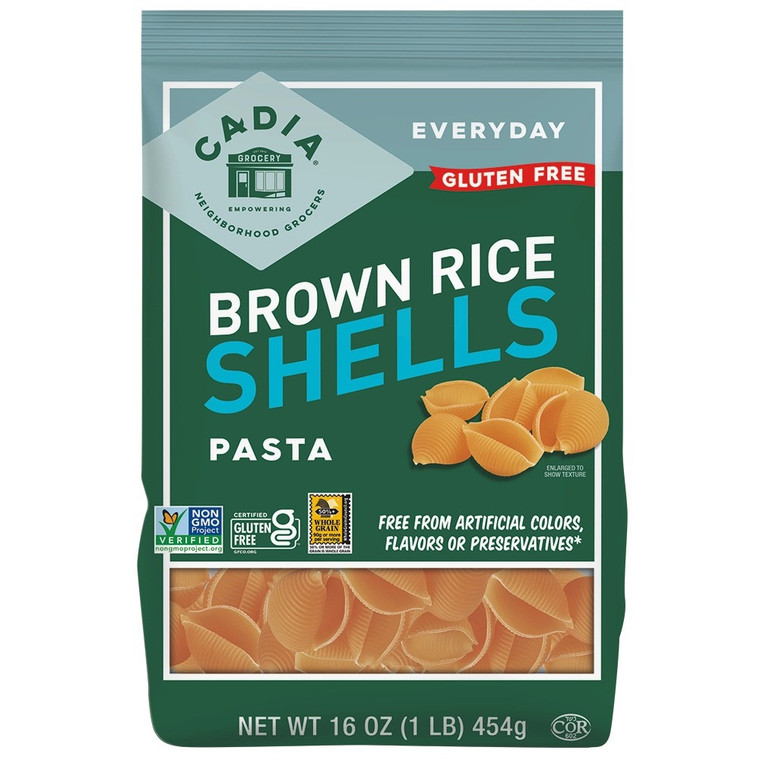
Brown Rice Pasta Shells - 16 oz
Cadia
$2.99
Below are the available bulk discount rates for each individual item when you purchase a certain amount
- Buy 2 - 5 and get 2% off
- Buy 6 - 11 and get 4% off
- Buy 12 or above and get 8% off
(No reviews yet)

Write a Review
Cadia
Brown Rice Pasta Shells - 16 oz
Three ingredients. That's the entire ingredient panel on Cadia Everyday Brown Rice Pasta Shells — organic whole grain brown rice, rice bran, and water. No wheat, no gums, no dried egg powder to fake a chewier bite. Just rice milled to a shell shape and dried, so the nutty, whole-grain flavor of the rice itself is what carries the dish. Every box is sustainably sourced and made from non-GMO ingredients, and sold exclusively at independent neighborhood grocers — the kind of shop where the person restocking the pasta aisle actually knows your name.
- Holds sauce, cheese, and baked casseroles in its ridges — built for baked ziti, pasta salads, and skillet dishes that need a shell that won't fall apart
- Made from just three ingredients: organic whole grain brown rice, rice bran, and water — no gluten-masking additives or texture agents
- Certified organic, gluten-free, kosher, and non-GMO — works for gluten-sensitive households without a separate specialty aisle
Cadia Everyday Brown Rice Pasta Shells trade wheat for organic whole grain brown rice, milled and shaped into a shell sturdy enough to hold its structure through a boil, a bake, or a cold pasta salad.
Each 16 oz box is made from three ingredients - organic whole grain brown rice, rice bran, and water. Rice bran carries the germ layer's fiber and nutrients back into the pasta, since the shells are milled from the whole grain rather than a stripped starch. The result is a firmer bite than typical white rice pasta and a nuttier flavor that stands up to olive oil, tomato sauce, or a baked cheese casserole.
Because it's 100% whole grain, this gluten-free pasta brings more fiber to the plate than a refined wheat or white rice noodle - useful for anyone building meals around whole grains rather than refined starches. Cook it slightly under the package time if you want firmer shells for a cold pasta salad, or a full boil if you're baking it into a casserole where it'll absorb more liquid.
Suitable for gluten-free, kosher, and vegan diets, and verified non-GMO. As a grain-based whole food, it's not appropriate for keto, paleo, or carnivore eating plans, which exclude grains entirely. Store the unopened box in a cool, dry pantry; once cooked, refrigerate leftovers in a sealed container for up to four days.
Ingredients: Whole Grain Brown Rice, Rice Bran, and Water.
Common Questions
How does this brown rice pasta compare nutritionally to regular wheat pasta and white rice pasta?
A 2 oz dry serving of these shells runs about 190 calories, 41 grams of carbohydrate, 3 grams of fiber, and 4 grams of protein. Standard durum wheat pasta in the same serving size has slightly less carbohydrate but more protein, around 7 grams, because gluten proteins make up a meaningful share of wheat's dry weight. White rice pasta, made from milled white rice flour with the bran removed, typically has only 1 gram of fiber per serving since the fiber-rich bran layer is stripped out during milling. So this pasta sits between the two: it has the higher fiber content that comes from keeping the bran intact, but it doesn't match wheat pasta's protein because rice simply contains less protein than wheat by weight.
What does keeping the rice bran in actually do nutritionally?
Rice bran is the outer layer of the brown rice kernel, and it's where most of the grain's fiber, B vitamins, magnesium, and manganese are concentrated. When rice is milled into white rice or white rice flour, this bran layer is polished away, which is why white rice pasta tests so low in fiber. Cadia mills the whole grain, including the bran, into the pasta dough, which is the mechanical reason this product carries roughly three times the fiber of a white rice pasta. Rice bran also contains gamma-oryzanol, a plant compound studied for antioxidant activity, though the amounts in a single pasta serving are modest compared to concentrated rice bran oil supplements.
Does this fit a keto, paleo, or carnivore diet?
No, not for keto or carnivore. At 41 grams of carbohydrate per 2 oz serving, this pasta would use up most or all of a typical daily keto carb allowance in a single serving, and it's plant-based, so it has no place in a carnivore protocol at all. Paleo is more nuanced: strict paleo frameworks exclude all grains, including rice, because grains weren't part of pre-agricultural diets, so purists would skip this too. Some looser paleo and gluten-free adaptations do allow whole grain rice as a wheat substitute, so it depends on which version of the diet someone is following.
What dishes work best with these shells, and does the cooking method need to change?
The shells hold up well in stuffed shells with ricotta filling, baked pasta casseroles, and cold pasta salads, since the shape is sturdy enough to survive stuffing and baking without collapsing. Brown rice pasta cooks faster than wheat pasta and can go from al dente to mushy in a narrow window, so it's worth checking it a minute or two before the package time states, especially for salads where you want a firmer bite. For baked dishes where the pasta will keep absorbing liquid in the oven, cook it to a full boil first so it doesn't overcook further and turn soft during baking. Rinsing briefly after draining helps stop the cooking process if you're not using the pasta immediately.
What does the organic certification on this pasta actually guarantee?
USDA Organic certification means the brown rice was grown without synthetic pesticides, synthetic fertilizers, or genetically engineered seed, and the field has to maintain that status for at least three years before the crop can be certified. A third-party certifying agent audits the farm and the processing facility to confirm this, and that paperwork is available on request from the certifier, not just taken on the brand's word. The Non-GMO Project verification is a separate, additional layer that involves testing the ingredient supply chain specifically for genetically modified material, which is stricter than what organic certification alone requires. Kosher certification is granted by a rabbinical certifying body that inspects the equipment and production line, confirming no cross-contact with non-kosher ingredients during manufacturing.
Why only three ingredients, and does that matter for anything besides simplicity?
Whole grain brown rice, rice bran, and water is a minimal formula because the pasta doesn't need gums, binders, or added starches to hold its shape the way some gluten-free pastas do. Many gluten-free pastas rely on added tapioca starch, corn starch, or xanthan gum to compensate for the lack of gluten's binding properties, which dilutes the whole grain content and adds refined starch back into the product. Because rice bran itself contains natural starches and fiber that help the dough bind during extrusion, Cadia doesn't need those additives, which is also why the ingredient panel stays at three items instead of six or seven. This matters most for anyone reading labels specifically to avoid added starches or gums in gluten-free products.
Is this pasta suitable for someone with a gluten allergy or celiac disease?
Yes, it's made entirely from rice with no wheat, barley, or rye in the ingredient list, and it's labeled gluten-free. That said, anyone with celiac disease should check the current package for a specific gluten-free certification seal and cross-contact statement, since manufacturing facility practices can change and the most current label information supersedes what's printed in older marketing materials. The ingredient list itself, whole grain brown rice, rice bran, and water, contains no gluten-containing grains by design.
Each 16 oz box is made from three ingredients - organic whole grain brown rice, rice bran, and water. Rice bran carries the germ layer's fiber and nutrients back into the pasta, since the shells are milled from the whole grain rather than a stripped starch. The result is a firmer bite than typical white rice pasta and a nuttier flavor that stands up to olive oil, tomato sauce, or a baked cheese casserole.
Because it's 100% whole grain, this gluten-free pasta brings more fiber to the plate than a refined wheat or white rice noodle - useful for anyone building meals around whole grains rather than refined starches. Cook it slightly under the package time if you want firmer shells for a cold pasta salad, or a full boil if you're baking it into a casserole where it'll absorb more liquid.
Suitable for gluten-free, kosher, and vegan diets, and verified non-GMO. As a grain-based whole food, it's not appropriate for keto, paleo, or carnivore eating plans, which exclude grains entirely. Store the unopened box in a cool, dry pantry; once cooked, refrigerate leftovers in a sealed container for up to four days.
Ingredients: Whole Grain Brown Rice, Rice Bran, and Water.
Common Questions
How does this brown rice pasta compare nutritionally to regular wheat pasta and white rice pasta?
A 2 oz dry serving of these shells runs about 190 calories, 41 grams of carbohydrate, 3 grams of fiber, and 4 grams of protein. Standard durum wheat pasta in the same serving size has slightly less carbohydrate but more protein, around 7 grams, because gluten proteins make up a meaningful share of wheat's dry weight. White rice pasta, made from milled white rice flour with the bran removed, typically has only 1 gram of fiber per serving since the fiber-rich bran layer is stripped out during milling. So this pasta sits between the two: it has the higher fiber content that comes from keeping the bran intact, but it doesn't match wheat pasta's protein because rice simply contains less protein than wheat by weight.
What does keeping the rice bran in actually do nutritionally?
Rice bran is the outer layer of the brown rice kernel, and it's where most of the grain's fiber, B vitamins, magnesium, and manganese are concentrated. When rice is milled into white rice or white rice flour, this bran layer is polished away, which is why white rice pasta tests so low in fiber. Cadia mills the whole grain, including the bran, into the pasta dough, which is the mechanical reason this product carries roughly three times the fiber of a white rice pasta. Rice bran also contains gamma-oryzanol, a plant compound studied for antioxidant activity, though the amounts in a single pasta serving are modest compared to concentrated rice bran oil supplements.
Does this fit a keto, paleo, or carnivore diet?
No, not for keto or carnivore. At 41 grams of carbohydrate per 2 oz serving, this pasta would use up most or all of a typical daily keto carb allowance in a single serving, and it's plant-based, so it has no place in a carnivore protocol at all. Paleo is more nuanced: strict paleo frameworks exclude all grains, including rice, because grains weren't part of pre-agricultural diets, so purists would skip this too. Some looser paleo and gluten-free adaptations do allow whole grain rice as a wheat substitute, so it depends on which version of the diet someone is following.
What dishes work best with these shells, and does the cooking method need to change?
The shells hold up well in stuffed shells with ricotta filling, baked pasta casseroles, and cold pasta salads, since the shape is sturdy enough to survive stuffing and baking without collapsing. Brown rice pasta cooks faster than wheat pasta and can go from al dente to mushy in a narrow window, so it's worth checking it a minute or two before the package time states, especially for salads where you want a firmer bite. For baked dishes where the pasta will keep absorbing liquid in the oven, cook it to a full boil first so it doesn't overcook further and turn soft during baking. Rinsing briefly after draining helps stop the cooking process if you're not using the pasta immediately.
What does the organic certification on this pasta actually guarantee?
USDA Organic certification means the brown rice was grown without synthetic pesticides, synthetic fertilizers, or genetically engineered seed, and the field has to maintain that status for at least three years before the crop can be certified. A third-party certifying agent audits the farm and the processing facility to confirm this, and that paperwork is available on request from the certifier, not just taken on the brand's word. The Non-GMO Project verification is a separate, additional layer that involves testing the ingredient supply chain specifically for genetically modified material, which is stricter than what organic certification alone requires. Kosher certification is granted by a rabbinical certifying body that inspects the equipment and production line, confirming no cross-contact with non-kosher ingredients during manufacturing.
Why only three ingredients, and does that matter for anything besides simplicity?
Whole grain brown rice, rice bran, and water is a minimal formula because the pasta doesn't need gums, binders, or added starches to hold its shape the way some gluten-free pastas do. Many gluten-free pastas rely on added tapioca starch, corn starch, or xanthan gum to compensate for the lack of gluten's binding properties, which dilutes the whole grain content and adds refined starch back into the product. Because rice bran itself contains natural starches and fiber that help the dough bind during extrusion, Cadia doesn't need those additives, which is also why the ingredient panel stays at three items instead of six or seven. This matters most for anyone reading labels specifically to avoid added starches or gums in gluten-free products.
Is this pasta suitable for someone with a gluten allergy or celiac disease?
Yes, it's made entirely from rice with no wheat, barley, or rye in the ingredient list, and it's labeled gluten-free. That said, anyone with celiac disease should check the current package for a specific gluten-free certification seal and cross-contact statement, since manufacturing facility practices can change and the most current label information supersedes what's printed in older marketing materials. The ingredient list itself, whole grain brown rice, rice bran, and water, contains no gluten-containing grains by design.
- __Storage_Location:
- Dry
- __Volume:
- 1560
- __Owner:
- TCFarm
- __badge:
- Organic