

Sale
Citrus All-Purpose Cleaner - 32 fl oz
Cadia
$4.29
$3.99
Below are the available bulk discount rates for each individual item when you purchase a certain amount
- Buy 2 - 5 and get 2% off
- Buy 6 - 11 and get 4% off
- Buy 12 or above and get 8% off
(No reviews yet)

Write a Review
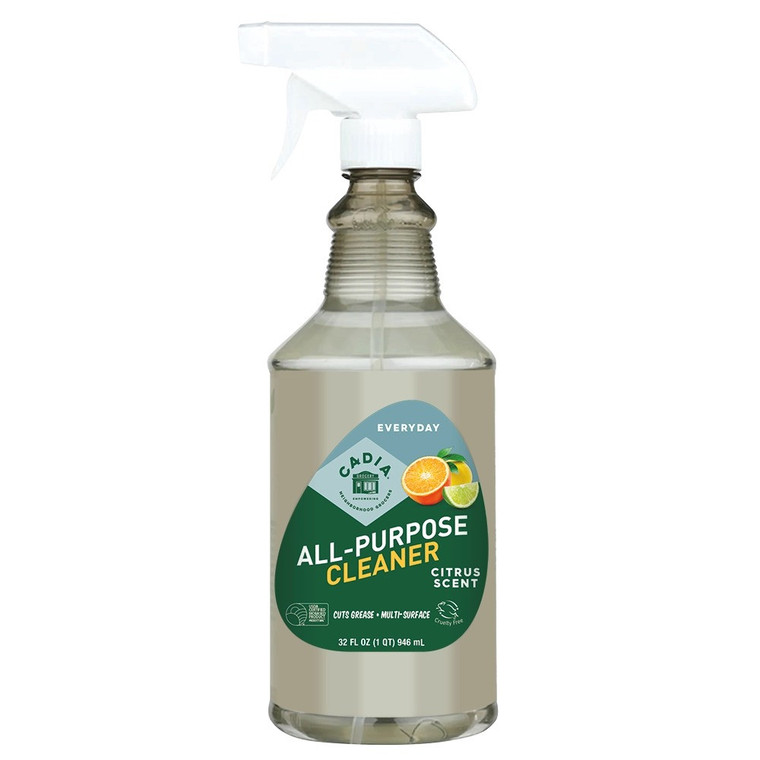
Cadia
Citrus All-Purpose Cleaner - 32 fl oz
Cadia Citrus All-Purpose Cleaner replaces the ammonia, phosphates, and synthetic degreasers found in most grocery-aisle cleaners with a plant-based formula built around citrus oil. It's sold exclusively at independent neighborhood grocers, made with ingredients that are sustainably sourced, and carries USDA Certified Biobased status — a third-party benchmark most cleaners on a big-box shelf can't touch.
- Cuts grease and grime on kitchen counters, stovetops, and sinks; bathroom vanities, tubs, and tile; and general surfaces like stainless steel, sealed stone, glass, and laminate
- USDA Certified Biobased formula built on plant-derived surfactants — no ammonia, no phosphates added
- Vegan and cruelty-free, with no animal-derived ingredients and no animal testing at any stage
Cadia Citrus All-Purpose Cleaner is a plant-based cleaning spray built around a simple idea: cleaning power shouldn't require a chemistry set of harsh synthetics. The citrus oil fragrance comes through bright and uplifting, not masked behind a wall of artificial perfume.
The formula pairs Ethoxylated Alcohol (a biodegradable, plant-derived surfactant) with Sodium Gluconate to bind hard-water minerals and Sodium Carbonate to lift grease - the same mineral-based ingredient long used as washing soda, here doing the heavy lifting instead of ammonia or phosphates. A small amount of Benzisothiazolinone keeps the formula shelf-stable without parabens.
Use it on kitchen countertops, stovetops, and sinks; bathroom vanities, tubs, and tile; and general surfaces including tables, shelves, stainless steel, sealed stone, glass, and laminate. Spray directly on the surface and wipe - no rinsing required on sealed, non-porous materials.
Cadia is a private-label line sold exclusively at independent neighborhood grocers, giving small retailers a way to offer sustainably sourced products at prices that compete with the big chains.
Store at room temperature out of direct sunlight. Formula is vegan, cruelty-free, non-toxic, and biodegradable - suitable for households avoiding synthetic fragrance and animal-derived ingredients.
Ingredients: Water, Ethoxylated Alcohol, Sodium Gluconate, Sodium Carbonate, Natural Fragrances (Contains Fragrance Allergens: Citral, D'Limonene), Benzisothiazolinone.
Common Questions
How does this compare to a conventional all-purpose cleaner like Formula 409 or Fantastik?
Conventional all-purpose cleaners typically rely on ammonia or butyl-based solvents (2-butoxyethanol) to cut grease, plus synthetic fragrance blends that can carry dozens of undisclosed compounds under the umbrella term 'fragrance.' Cadia's formula swaps that out for Sodium Carbonate, the same mineral compound used in washing soda, to do the degreasing work, and lists its only two fragrance-related compounds by name: Citral and D'Limonene, both naturally occurring in citrus oil. On the numbers side, this formula contains zero phosphates and zero ammonia, whereas many conventional degreasers still use ammonia concentrations around 1-3% by weight. The tradeoff is that Cadia may need slightly more contact time on baked-on grease since it isn't using a solvent-based degreaser.
What does Sodium Gluconate actually do in this formula?
Sodium Gluconate is a chelating agent, meaning it binds to calcium and magnesium ions in hard water before they can bond with the surfactant and leave behind streaky mineral film. This is the same mechanism used in some dishwasher detergents to prevent hard-water spotting on glassware. Without a chelator, hard water (generally anything above 120 mg/L calcium carbonate) reduces surfactant efficiency because minerals compete for the same binding sites the surfactant would otherwise use on grease and dirt. Sodium Gluconate is also readily biodegradable, breaking down via microbial action rather than persisting in wastewater, which supports the product's biodegradable certification.
Is this safe for households with fragrance sensitivities or asthma?
The formula discloses two fragrance allergens on the label, Citral and D'Limonene, both naturally derived from citrus peel oil rather than synthetic fragrance compounds. These two compounds are on the EU's list of 26 declarable allergens because a small percentage of people can develop skin or respiratory sensitivity to them, so anyone with a known citrus or limonene sensitivity should patch-test before regular use. That said, the product contains no ammonia and no chlorine, which are the two most common asthma triggers in household cleaners, and it carries a Non-Toxic certification. As with any scented cleaner, ventilate the room during use if you're sensitive to strong smells.
What surfaces or cleaning jobs should I NOT use this on?
This is a general-purpose spray formulated for sealed, non-porous surfaces like sealed stone, laminate, stainless steel, tile, and glass, so it's a direct substitute for products like Method All-Purpose or Mrs. Meyer's Multi-Surface spray in your cleaning rotation. It is not formulated as a disinfectant, so it won't carry an EPA registration number or kill-claim against viruses and bacteria the way products like Lysol or Clorox wipes do — if you need pathogen kill claims for illness cleanup, pair this with a registered disinfectant instead. Avoid using it on unsealed or unfinished stone (like raw marble or granite that hasn't been sealed), since the mild alkalinity from Sodium Carbonate can etch porous natural stone over repeated use. It's also not designed for laundry or dishwashing, despite sharing washing-soda chemistry with those product categories.
What does USDA Certified Biobased actually verify, and how do I check it?
The USDA Certified Biobased Product label means the product has been tested by an independent, USDA-approved laboratory using ASTM D6866 radiocarbon testing, which measures the percentage of carbon in the product that comes from renewable plant or animal sources rather than petroleum. Products are then assigned a minimum biobased content percentage that must be verified and re-tested periodically to keep the certification active. You can look up any certified product's registration and verified percentage in the USDA BioPreferred Catalog, which is a public database searchable by brand or product name. This is different from a marketing claim of 'natural' or 'plant-based,' which carry no third-party testing requirement in the U.S.
Why doesn't this cleaner need a preservative-free claim, and is Benzisothiazolinone a concern?
Benzisothiazolinone (BIT) is an isothiazolinone-class preservative used at very low concentrations, typically under 0.1%, to prevent mold and bacterial growth in water-based formulas once they're opened and exposed to air repeatedly. Without a preservative, a water-based cleaner like this one would be vulnerable to microbial contamination within weeks of opening, especially if the spray nozzle touches wet surfaces. BIT is used instead of parabens or formaldehyde-releasing preservatives, which is why the product can carry a paraben-free claim alongside its Non-Toxic certification. It's classified by the EU as a skin sensitizer at higher concentrations, so people with known isothiazolinone allergies (a recognized but uncommon contact allergy) should check ingredient labels on any water-based cleaner, not just this one.
Does 'no ammonia, no phosphates' actually matter for cleaning performance or is it just a marketing claim?
It matters for two different reasons: performance on certain surfaces and downstream environmental impact. Phosphates were phased out of most U.S. household cleaners starting in the 1970s and further restricted state-by-state through the 2010s because they act as a fertilizer in waterways, feeding algae blooms that deplete oxygen and kill fish, so their absence here reflects a wastewater-safety standard more than a cleaning-power upgrade. Ammonia's absence is more directly a performance and safety tradeoff: ammonia is a strong solvent that cuts through baked-on grease fast, but it's also the compound responsible for the toxic chloramine gas that forms if you accidentally mix a cleaner with bleach. Cadia's Sodium Carbonate-based degreasing works more gradually and requires letting the product sit on tougher grime for 30-60 seconds before wiping, rather than the near-instant cut of an ammonia-based spray.
The formula pairs Ethoxylated Alcohol (a biodegradable, plant-derived surfactant) with Sodium Gluconate to bind hard-water minerals and Sodium Carbonate to lift grease - the same mineral-based ingredient long used as washing soda, here doing the heavy lifting instead of ammonia or phosphates. A small amount of Benzisothiazolinone keeps the formula shelf-stable without parabens.
Use it on kitchen countertops, stovetops, and sinks; bathroom vanities, tubs, and tile; and general surfaces including tables, shelves, stainless steel, sealed stone, glass, and laminate. Spray directly on the surface and wipe - no rinsing required on sealed, non-porous materials.
Cadia is a private-label line sold exclusively at independent neighborhood grocers, giving small retailers a way to offer sustainably sourced products at prices that compete with the big chains.
Store at room temperature out of direct sunlight. Formula is vegan, cruelty-free, non-toxic, and biodegradable - suitable for households avoiding synthetic fragrance and animal-derived ingredients.
Ingredients: Water, Ethoxylated Alcohol, Sodium Gluconate, Sodium Carbonate, Natural Fragrances (Contains Fragrance Allergens: Citral, D'Limonene), Benzisothiazolinone.
Common Questions
How does this compare to a conventional all-purpose cleaner like Formula 409 or Fantastik?
Conventional all-purpose cleaners typically rely on ammonia or butyl-based solvents (2-butoxyethanol) to cut grease, plus synthetic fragrance blends that can carry dozens of undisclosed compounds under the umbrella term 'fragrance.' Cadia's formula swaps that out for Sodium Carbonate, the same mineral compound used in washing soda, to do the degreasing work, and lists its only two fragrance-related compounds by name: Citral and D'Limonene, both naturally occurring in citrus oil. On the numbers side, this formula contains zero phosphates and zero ammonia, whereas many conventional degreasers still use ammonia concentrations around 1-3% by weight. The tradeoff is that Cadia may need slightly more contact time on baked-on grease since it isn't using a solvent-based degreaser.
What does Sodium Gluconate actually do in this formula?
Sodium Gluconate is a chelating agent, meaning it binds to calcium and magnesium ions in hard water before they can bond with the surfactant and leave behind streaky mineral film. This is the same mechanism used in some dishwasher detergents to prevent hard-water spotting on glassware. Without a chelator, hard water (generally anything above 120 mg/L calcium carbonate) reduces surfactant efficiency because minerals compete for the same binding sites the surfactant would otherwise use on grease and dirt. Sodium Gluconate is also readily biodegradable, breaking down via microbial action rather than persisting in wastewater, which supports the product's biodegradable certification.
Is this safe for households with fragrance sensitivities or asthma?
The formula discloses two fragrance allergens on the label, Citral and D'Limonene, both naturally derived from citrus peel oil rather than synthetic fragrance compounds. These two compounds are on the EU's list of 26 declarable allergens because a small percentage of people can develop skin or respiratory sensitivity to them, so anyone with a known citrus or limonene sensitivity should patch-test before regular use. That said, the product contains no ammonia and no chlorine, which are the two most common asthma triggers in household cleaners, and it carries a Non-Toxic certification. As with any scented cleaner, ventilate the room during use if you're sensitive to strong smells.
What surfaces or cleaning jobs should I NOT use this on?
This is a general-purpose spray formulated for sealed, non-porous surfaces like sealed stone, laminate, stainless steel, tile, and glass, so it's a direct substitute for products like Method All-Purpose or Mrs. Meyer's Multi-Surface spray in your cleaning rotation. It is not formulated as a disinfectant, so it won't carry an EPA registration number or kill-claim against viruses and bacteria the way products like Lysol or Clorox wipes do — if you need pathogen kill claims for illness cleanup, pair this with a registered disinfectant instead. Avoid using it on unsealed or unfinished stone (like raw marble or granite that hasn't been sealed), since the mild alkalinity from Sodium Carbonate can etch porous natural stone over repeated use. It's also not designed for laundry or dishwashing, despite sharing washing-soda chemistry with those product categories.
What does USDA Certified Biobased actually verify, and how do I check it?
The USDA Certified Biobased Product label means the product has been tested by an independent, USDA-approved laboratory using ASTM D6866 radiocarbon testing, which measures the percentage of carbon in the product that comes from renewable plant or animal sources rather than petroleum. Products are then assigned a minimum biobased content percentage that must be verified and re-tested periodically to keep the certification active. You can look up any certified product's registration and verified percentage in the USDA BioPreferred Catalog, which is a public database searchable by brand or product name. This is different from a marketing claim of 'natural' or 'plant-based,' which carry no third-party testing requirement in the U.S.
Why doesn't this cleaner need a preservative-free claim, and is Benzisothiazolinone a concern?
Benzisothiazolinone (BIT) is an isothiazolinone-class preservative used at very low concentrations, typically under 0.1%, to prevent mold and bacterial growth in water-based formulas once they're opened and exposed to air repeatedly. Without a preservative, a water-based cleaner like this one would be vulnerable to microbial contamination within weeks of opening, especially if the spray nozzle touches wet surfaces. BIT is used instead of parabens or formaldehyde-releasing preservatives, which is why the product can carry a paraben-free claim alongside its Non-Toxic certification. It's classified by the EU as a skin sensitizer at higher concentrations, so people with known isothiazolinone allergies (a recognized but uncommon contact allergy) should check ingredient labels on any water-based cleaner, not just this one.
Does 'no ammonia, no phosphates' actually matter for cleaning performance or is it just a marketing claim?
It matters for two different reasons: performance on certain surfaces and downstream environmental impact. Phosphates were phased out of most U.S. household cleaners starting in the 1970s and further restricted state-by-state through the 2010s because they act as a fertilizer in waterways, feeding algae blooms that deplete oxygen and kill fish, so their absence here reflects a wastewater-safety standard more than a cleaning-power upgrade. Ammonia's absence is more directly a performance and safety tradeoff: ammonia is a strong solvent that cuts through baked-on grease fast, but it's also the compound responsible for the toxic chloramine gas that forms if you accidentally mix a cleaner with bleach. Cadia's Sodium Carbonate-based degreasing works more gradually and requires letting the product sit on tougher grime for 30-60 seconds before wiping, rather than the near-instant cut of an ammonia-based spray.
- __Storage_Location:
- Dry
- __Volume:
- 1792
- __Owner:
- TCFarm
- __badge:
- for delivery by 10/14