


Crispy Wheat Crackers - 6.5 oz
Back to Nature
$5.59
(No reviews yet)

Write a Review
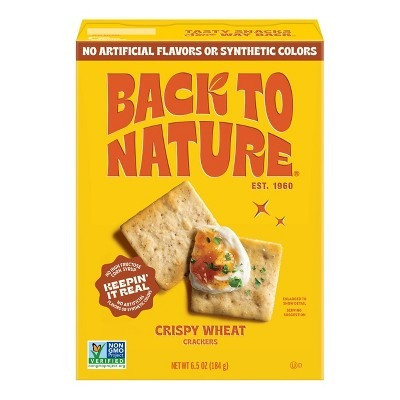
Back to Nature
Crispy Wheat Crackers - 6.5 oz
Back to Nature's Crispy Wheat Crackers bring a clean, lightly sweet crunch to your snack board — made with real wheat germ and a short list of recognizable ingredients, colored only with turmeric extract. No artificial colors, no artificial flavors, no high-fructose corn syrup.
- Snack board staple or pantry workhorse: Pairs cleanly with cheese, hummus, or nut butter — thin and crisp enough to hold toppings without overpowering them.
- Wheat germ included: Most commercial crackers remove the germ during processing; Back to Nature retains defatted wheat germ, adding a nutty depth and the micronutrients that come with it.
- Short ingredient list, no artificial additives: Sweetened with cane sugar and brown rice syrup, colored with turmeric extract — nothing synthetic in the formula.
Back to Nature has built its cracker lineup around a simple premise: familiar pantry ingredients, nothing artificial, and a texture that holds up. The Crispy Wheat Crackers deliver on all three — a lightly golden, snappy cracker with a hint of sweetness from cane sugar and brown rice syrup, and a warm undertone from defatted wheat germ.
Each 6.5 oz box contains shelf-stable crackers made with unbleached enriched wheat flour and a leavening system of monocalcium phosphate and baking soda — a clean combination that gives a consistent rise without chemical shortcuts. Safflower oil replaces the partially hydrogenated oils common in conventional cracker formulas, and turmeric extract stands in for artificial yellow dyes. Malted barley extract rounds out the flavor profile with mild fermented depth.
For shoppers who read every label: this product contains wheat and barley (gluten-containing grains) and is not suitable for gluten-free diets. It is free from dairy, eggs, and artificial additives, making it broadly suitable for vegan and dairy-free snacking. Store at room temperature in a cool, dry place; reseal the inner tray after opening to maintain crunch.
Ingredients: Unbleached Enriched Wheat Flour (Wheat Flour, Niacin, Reduced Iron, Thiamine Mononitrate, Riboflavin, Folic Acid), Safflower Oil, Cane Sugar, Defatted Wheat Germ, Corn Starch, Sea Salt, Brown Rice Syrup, Malted Barley Extract, Leavening (Monocalcium Phosphate, Baking Soda), And Turmeric Extract (For Color).
Common Questions
How do these crackers compare to conventional wheat crackers like Wheat Thins in terms of ingredients and fat quality?
The most meaningful difference is the fat source. Back to Nature uses safflower oil, which is high in linoleic acid (an omega-6 polyunsaturated fat) and contains no trans fats. Conventional crackers like original Wheat Thins have historically used partially hydrogenated oils, which introduce artificial trans fats linked to elevated LDL cholesterol — the FDA banned partially hydrogenated oils from the U.S. food supply in 2018, so most major brands have since reformulated. Back to Nature also uses unbleached flour and cane sugar rather than high-fructose corn syrup, and replaces artificial dyes with turmeric extract for color. The ingredient list is meaningfully shorter and free of artificial preservatives, though both products are wheat-based and contain gluten.
What does defatted wheat germ actually contribute nutritionally, and why is it listed separately from the flour?
Wheat germ is the embryo of the wheat kernel and is one of the most nutrient-dense parts of the grain, containing vitamin E (primarily as alpha-tocopherol), folate, zinc, magnesium, and thiamine in concentrated amounts. The defatted version has had most of its natural oils removed to extend shelf stability — wheat germ oil goes rancid quickly — while retaining much of the protein and micronutrient content. It is listed separately because it is added back as a distinct ingredient rather than being retained through whole-grain milling, which is a different process. Its presence adds a mild, slightly nutty flavor and contributes to the cracker's nutritional profile beyond what enriched white flour alone provides. The enrichment nutrients in the flour (niacin, reduced iron, thiamine mononitrate, riboflavin, folic acid) are federally mandated additions to replace what is lost in refining, while the wheat germ provides naturally occurring micronutrients.
Are these crackers suitable for a vegan diet, and do any ingredients come from animal sources?
Every ingredient in these crackers is plant-derived or mineral-based, making them suitable for vegan diets. The sweeteners are cane sugar and brown rice syrup — neither involves animal processing. Safflower oil is a plant seed oil. Turmeric extract is a root-derived colorant. The leavening agents, monocalcium phosphate and baking soda (sodium bicarbonate), are mineral compounds with no animal origin. Malted barley extract is produced by germinating barley and extracting its sugars, a process that involves no animal inputs. There are no dairy, egg, honey, or gelatin-derived ingredients.
Are these crackers appropriate for gluten-free, keto, or paleo diets?
These crackers are not suitable for gluten-free diets under any interpretation — they contain both wheat (in the flour and wheat germ) and malted barley extract, both of which contain gluten. For keto diets, the carbohydrate load is disqualifying: crackers of this type typically deliver around 22-24 grams of net carbs per serving of roughly 16 crackers, far exceeding the 20-50 gram daily net carb ceiling most keto protocols require. Paleo diets exclude grains as a category, so wheat-based crackers are not considered compliant regardless of ingredient quality. For general reduced-sugar or whole-food-adjacent eating, the absence of artificial additives, high-fructose corn syrup, and partially hydrogenated oils makes these a cleaner option than many conventional crackers, even if they are not compatible with strict elimination protocols.
What role does malted barley extract play, and is it just added sugar?
Malted barley extract is produced by allowing barley grains to germinate, then drying and extracting the resulting sugars and enzymes. It does contribute fermentable sugars — primarily maltose — so it functions partly as a sweetener, but its primary value in baked goods is flavor complexity: it adds a mild, slightly toasty, fermented depth that plain sugar cannot replicate. This is the same compound used in beer brewing and some bread baking to develop color and flavor through Maillard browning reactions during baking. Because it is derived from barley, it is a gluten-containing ingredient and is relevant information for anyone with celiac disease or non-celiac gluten sensitivity. The product label correctly identifies barley as a component, and it appears in the ingredients at a concentration below 2% by weight.
How should these crackers be stored after opening to preserve texture?
Crackers go stale primarily through moisture absorption from ambient air, which softens the starch network that creates the snap. After opening, the inner tray or bag should be resealed as tightly as possible — using a clip or transferring to an airtight container is more effective than folding the bag. Store at room temperature away from heat sources, as warmth accelerates oil oxidation in the safflower oil, which can produce off-flavors over time. Humidity is the more immediate enemy of crunch: in humid climates or during summer months, an airtight container is strongly preferable to the original packaging alone. The sealed, unopened box is shelf-stable and does not require refrigeration.
What does turmeric extract actually do in this product, and how much curcumin does it contribute?
Turmeric extract is used here exclusively as a natural colorant, providing the warm golden hue that gives the cracker its baked appearance without synthetic dyes like Yellow 5 or Yellow 6. At the concentrations used in food coloring applications — typically a fraction of a percent by weight — the curcumin content (the bioactive compound in turmeric associated with anti-inflammatory research) is nutritionally negligible. Studies on curcumin bioavailability generally use doses of 500-2,000 mg of curcumin per day to observe measurable effects, far beyond what a serving of these crackers would deliver. The ingredient is accurately described on the label with the parenthetical 'for color,' which is standard FDA-compliant labeling for colorants. Its inclusion is primarily a formulation choice to avoid petroleum-derived artificial dyes, not a health claim.
Each 6.5 oz box contains shelf-stable crackers made with unbleached enriched wheat flour and a leavening system of monocalcium phosphate and baking soda — a clean combination that gives a consistent rise without chemical shortcuts. Safflower oil replaces the partially hydrogenated oils common in conventional cracker formulas, and turmeric extract stands in for artificial yellow dyes. Malted barley extract rounds out the flavor profile with mild fermented depth.
For shoppers who read every label: this product contains wheat and barley (gluten-containing grains) and is not suitable for gluten-free diets. It is free from dairy, eggs, and artificial additives, making it broadly suitable for vegan and dairy-free snacking. Store at room temperature in a cool, dry place; reseal the inner tray after opening to maintain crunch.
Ingredients: Unbleached Enriched Wheat Flour (Wheat Flour, Niacin, Reduced Iron, Thiamine Mononitrate, Riboflavin, Folic Acid), Safflower Oil, Cane Sugar, Defatted Wheat Germ, Corn Starch, Sea Salt, Brown Rice Syrup, Malted Barley Extract, Leavening (Monocalcium Phosphate, Baking Soda), And Turmeric Extract (For Color).
Common Questions
How do these crackers compare to conventional wheat crackers like Wheat Thins in terms of ingredients and fat quality?
The most meaningful difference is the fat source. Back to Nature uses safflower oil, which is high in linoleic acid (an omega-6 polyunsaturated fat) and contains no trans fats. Conventional crackers like original Wheat Thins have historically used partially hydrogenated oils, which introduce artificial trans fats linked to elevated LDL cholesterol — the FDA banned partially hydrogenated oils from the U.S. food supply in 2018, so most major brands have since reformulated. Back to Nature also uses unbleached flour and cane sugar rather than high-fructose corn syrup, and replaces artificial dyes with turmeric extract for color. The ingredient list is meaningfully shorter and free of artificial preservatives, though both products are wheat-based and contain gluten.
What does defatted wheat germ actually contribute nutritionally, and why is it listed separately from the flour?
Wheat germ is the embryo of the wheat kernel and is one of the most nutrient-dense parts of the grain, containing vitamin E (primarily as alpha-tocopherol), folate, zinc, magnesium, and thiamine in concentrated amounts. The defatted version has had most of its natural oils removed to extend shelf stability — wheat germ oil goes rancid quickly — while retaining much of the protein and micronutrient content. It is listed separately because it is added back as a distinct ingredient rather than being retained through whole-grain milling, which is a different process. Its presence adds a mild, slightly nutty flavor and contributes to the cracker's nutritional profile beyond what enriched white flour alone provides. The enrichment nutrients in the flour (niacin, reduced iron, thiamine mononitrate, riboflavin, folic acid) are federally mandated additions to replace what is lost in refining, while the wheat germ provides naturally occurring micronutrients.
Are these crackers suitable for a vegan diet, and do any ingredients come from animal sources?
Every ingredient in these crackers is plant-derived or mineral-based, making them suitable for vegan diets. The sweeteners are cane sugar and brown rice syrup — neither involves animal processing. Safflower oil is a plant seed oil. Turmeric extract is a root-derived colorant. The leavening agents, monocalcium phosphate and baking soda (sodium bicarbonate), are mineral compounds with no animal origin. Malted barley extract is produced by germinating barley and extracting its sugars, a process that involves no animal inputs. There are no dairy, egg, honey, or gelatin-derived ingredients.
Are these crackers appropriate for gluten-free, keto, or paleo diets?
These crackers are not suitable for gluten-free diets under any interpretation — they contain both wheat (in the flour and wheat germ) and malted barley extract, both of which contain gluten. For keto diets, the carbohydrate load is disqualifying: crackers of this type typically deliver around 22-24 grams of net carbs per serving of roughly 16 crackers, far exceeding the 20-50 gram daily net carb ceiling most keto protocols require. Paleo diets exclude grains as a category, so wheat-based crackers are not considered compliant regardless of ingredient quality. For general reduced-sugar or whole-food-adjacent eating, the absence of artificial additives, high-fructose corn syrup, and partially hydrogenated oils makes these a cleaner option than many conventional crackers, even if they are not compatible with strict elimination protocols.
What role does malted barley extract play, and is it just added sugar?
Malted barley extract is produced by allowing barley grains to germinate, then drying and extracting the resulting sugars and enzymes. It does contribute fermentable sugars — primarily maltose — so it functions partly as a sweetener, but its primary value in baked goods is flavor complexity: it adds a mild, slightly toasty, fermented depth that plain sugar cannot replicate. This is the same compound used in beer brewing and some bread baking to develop color and flavor through Maillard browning reactions during baking. Because it is derived from barley, it is a gluten-containing ingredient and is relevant information for anyone with celiac disease or non-celiac gluten sensitivity. The product label correctly identifies barley as a component, and it appears in the ingredients at a concentration below 2% by weight.
How should these crackers be stored after opening to preserve texture?
Crackers go stale primarily through moisture absorption from ambient air, which softens the starch network that creates the snap. After opening, the inner tray or bag should be resealed as tightly as possible — using a clip or transferring to an airtight container is more effective than folding the bag. Store at room temperature away from heat sources, as warmth accelerates oil oxidation in the safflower oil, which can produce off-flavors over time. Humidity is the more immediate enemy of crunch: in humid climates or during summer months, an airtight container is strongly preferable to the original packaging alone. The sealed, unopened box is shelf-stable and does not require refrigeration.
What does turmeric extract actually do in this product, and how much curcumin does it contribute?
Turmeric extract is used here exclusively as a natural colorant, providing the warm golden hue that gives the cracker its baked appearance without synthetic dyes like Yellow 5 or Yellow 6. At the concentrations used in food coloring applications — typically a fraction of a percent by weight — the curcumin content (the bioactive compound in turmeric associated with anti-inflammatory research) is nutritionally negligible. Studies on curcumin bioavailability generally use doses of 500-2,000 mg of curcumin per day to observe measurable effects, far beyond what a serving of these crackers would deliver. The ingredient is accurately described on the label with the parenthetical 'for color,' which is standard FDA-compliant labeling for colorants. Its inclusion is primarily a formulation choice to avoid petroleum-derived artificial dyes, not a health claim.
- __Owner:
- TCFarm
- __Storage_Location:
- Dry
- __Volume:
- 400
- __badge:
- Non-GMO