


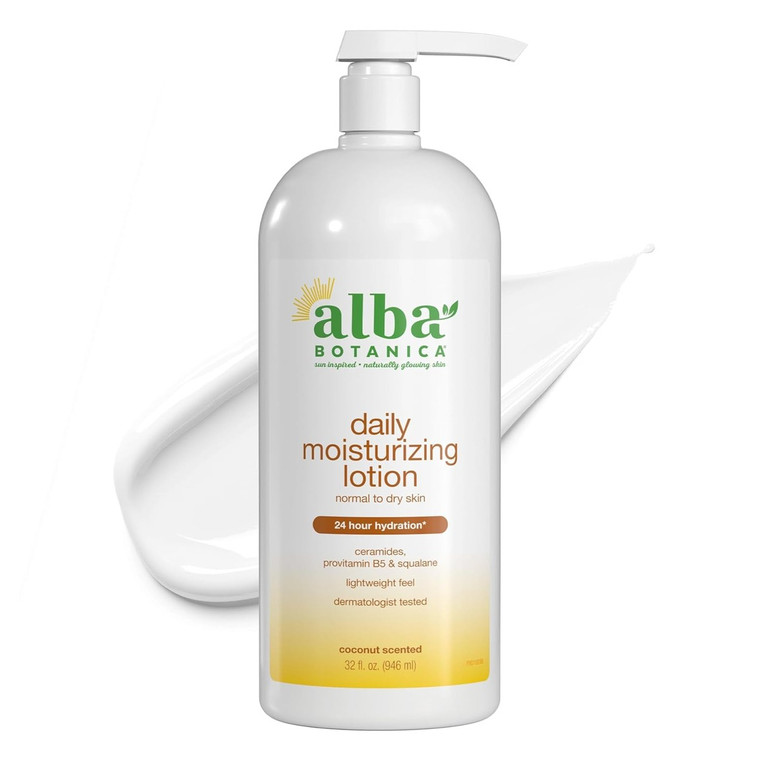
Coconut Scented Daily Moisturizing Lotion, Dry to Very Dry Skin, with Shea Butter and Coconut Oil - 32 Oz
Alba BotanicaWrite a Review
Alba Botanica
Coconut Scented Daily Moisturizing Lotion, Dry to Very Dry Skin, with Shea Butter and Coconut Oil - 32 Oz
- Who it's for: Daily use on dry to very dry skin — face, hands, and body — for anyone seeking plant-based hydration without hormone-disrupting additives.
- What sets it apart: Unrefined (not processed) coconut oil preserves its natural fatty acid profile; formula is free from parabens, phthalates, and synthetic fragrances — three ingredient categories commonly found in mass-market lotions.
- Diet & lifestyle fit: 100% vegetarian, cruelty-free (Leaping Bunny certified), hypoallergenic, and packaged in bottles made from 100% post-consumer resin with FSC-certified paperboard cartons.
Alba Botanica's Daily Moisturizing Lotion is a 32 oz workhorse formula built specifically for dry to very dry skin — rich enough to address real dryness, clean enough for daily use without accumulating problematic chemistry on your skin.
The formula centers on virgin, unrefined coconut oil and coconut milk — not the refined, deodorized coconut oil common in mass-market products, but a version that retains its natural fatty acid composition. Sunflower seed oil adds linoleic acid, a known skin-barrier support compound, and shea butter rounds out the moisture matrix with long-chain fatty acids and triterpenes. The lotion is hypoallergenic and free from parabens, phthalates, and synthetic fragrances — three categories of conventional lotion additives that health-conscious shoppers actively avoid.
Alba Botanica earned its Leaping Bunny certification from the CCIC on October 1, 2008 — one of the most rigorous cruelty-free standards available, covering both finished product and every ingredient in the supply chain. The brand was founded in 1979 around a 100% vegetarian formulation commitment it has never walked back. Bottles are made from 100% post-consumer resin; cartons carry FSC certification for sustainably sourced paperboard.
Apply liberally to dry skin as needed. The 32 oz size is well-suited for whole-body daily use. Store at room temperature, away from direct heat or sunlight.
INGREDIENTS — Water (Aqua), Cocos Nucifera (Coconut) Oil, Glycerin, Glyceryl Stearate SE, Dimethicone, Caprylic/Capric Triglyceride, Cetyl Alcohol, Oryza Sativa (Rice) Starch, Stearyl Alcohol, Butyrospermum Parkii (Shea) Butter, Niacinamide, Panthenol**, Ceramide NP, Citric Acid, Sodium Stearoyl Glutamate, Squalane, Xanthan Gum, Ethylhexylglycerin, Phenoxyethanol, Sodium Benzoate, Benzyl Benzoate, Coumarin, Fragrance (Parfum)
**provitamin B5
(Packaging may vary)
Common Questions
How does this lotion actually work to relieve very dry skin, and what do the key ingredients do at the skin level?
The formula uses a layered approach that addresses dryness through three distinct mechanisms. Glycerin is a humectant — it draws water from the dermis and surrounding air into the outer skin layer (stratum corneum), which directly increases surface hydration. Coconut oil and shea butter function as occlusives, meaning they deposit a lipid film over the skin surface that slows transepidermal water loss (TEWL), the primary driver of chronic dryness. Shea butter specifically contains triterpenes — naturally occurring compounds including lupeol and butyrospermol — that have been studied for their ability to support skin barrier integrity. Sunflower seed oil contributes linoleic acid, an omega-6 fatty acid that is a structural component of the skin's own lipid barrier; skin that is deficient in linoleic acid is known to develop impaired barrier function and increased TEWL. Together, these mechanisms make the formula relevant for both temporary dryness and chronically compromised skin.
What exactly does hypoallergenic mean on a lotion label, and is there a regulatory standard behind it?
In the United States, the term hypoallergenic on a cosmetic product has no formal FDA regulatory definition or required testing protocol — any brand can use it without submitting clinical proof. In practice, it is interpreted to mean the formula omits common sensitizing ingredients, and for this product that includes synthetic fragrances, parabens, and phthalates, all of which appear on dermatologist watch lists as frequent contact allergens or irritants. The absence of synthetic fragrance is particularly meaningful, since fragrance is the single most common cause of allergic contact dermatitis in leave-on skin care products, affecting an estimated 1-4% of the general population according to patch-test study data. Consumers with reactive or eczema-prone skin should still patch test any new product, as individual sensitivities vary and naturally derived ingredients like coconut oil can occasionally trigger reactions in people with specific tree nut sensitivities. The honest takeaway: hypoallergenic here reflects a meaningful formulation choice, not a certified clinical outcome.
What does the Leaping Bunny certification actually require, and how does it differ from a brand just claiming cruelty-free on the label?
Leaping Bunny is administered by the Coalition for Consumer Information on Cosmetics (CCIC) and is widely considered the most rigorous cruelty-free certification available in North America. Unlike a self-declared cruelty-free claim — which has no independent verification and no supply chain requirement — Leaping Bunny mandates that the brand audit its entire ingredient supply chain, not just the finished product, to confirm no animal testing occurs at any stage. Brands must recommit to the standard annually and agree to independent audits upon request. Alba Botanica received its Leaping Bunny certification on October 1, 2008, giving it a multi-decade track record under the standard rather than a recent rebranding claim. This distinction matters because some brands test individual ingredients through third-party suppliers in markets that legally require animal testing (such as certain product categories in China), while still labeling the finished product cruelty-free — a loophole the Leaping Bunny supply chain audit is specifically designed to close.
Is this lotion genuinely vegan, or just vegetarian — and what is the practical difference for plant-based shoppers?
Alba Botanica holds a Vegetarian certification and has maintained a 100% vegetarian formulation policy since the brand's founding in 1979, meaning no animal-derived ingredients are used. For most formulations including this one, the ingredients listed — coconut oil, coconut milk, sunflower seed oil, shea butter, glycerin — are plant-derived, which would qualify the product as vegan in common usage. The distinction between vegetarian and vegan certification in cosmetics often comes down to beeswax, lanolin, or carmine, none of which appear to be present here. However, the brand's formal claim is vegetarian rather than vegan, so shoppers who follow a strict vegan standard should confirm the current full ingredient list directly, since glycerin can be derived from animal fats in some formulations and supply chains can change between production runs. The Leaping Bunny certification addresses animal testing but does not independently verify vegan ingredient sourcing.
What does unrefined coconut oil bring to a lotion that refined coconut oil does not?
Refined coconut oil is processed with heat and often chemical solvents to remove odor, color, and impurities, which also strips out minor lipid compounds and some naturally occurring antioxidants like tocopherols (vitamin E). Virgin or unrefined coconut oil retains its full fatty acid profile, predominantly lauric acid (approximately 49% of total fatty acids), along with myristic and caprylic acids, and maintains its natural antioxidant content. Lauric acid specifically has been studied for antimicrobial properties — it disrupts the lipid membranes of certain bacteria and fungi — which may contribute to skin health beyond basic moisturization. In a lotion context, unrefined coconut oil also tends to absorb into the skin differently than its refined counterpart due to its intact molecular structure, though direct comparative clinical data on topical absorption rates between the two forms is limited. The practical signal for shoppers is that unrefined sourcing reflects a formulation choice prioritizing the ingredient's natural composition over cost efficiency or processing standardization.
How does the 32 oz size compare to standard lotion bottle sizes, and is the formulation the same as the smaller sizes?
Standard retail body lotion bottles in the mass market typically range from 10 oz to 18 oz, making this 32 oz size roughly 1.8 to 3 times the volume of a conventional single purchase. For daily whole-body application, which typically requires approximately 1 oz of lotion per full-body use according to general dermatological guidance on moisturizer coverage, a 32 oz bottle represents approximately a one-month supply for consistent daily use, or longer for targeted application. Alba Botanica produces this formula in multiple sizes, and the formulation is intended to be identical across sizes — the larger format is a quantity difference, not a dilution or reformulation. Shoppers who find the formula works well for them often prefer the 32 oz size for cost-per-ounce efficiency and reduced packaging frequency. Because the bottle is made from 100% post-consumer resin, the larger format also reduces per-ounce packaging material relative to buying multiple smaller bottles.
Are there any skin types or conditions for which this lotion would not be appropriate?
Coconut oil, while effective for dry skin in most users, has a comedogenic rating of approximately 4 on a 0-5 scale, meaning it has a relatively high likelihood of clogging pores compared to lighter oils like sunflower or rosehip. People with acne-prone or oily facial skin are generally advised by dermatologists to avoid coconut oil-based products on the face, though the formula is appropriate for body use where pore size is smaller and acne risk is lower. Individuals with a documented allergy to tree nuts — particularly coconut, which is classified as a tree nut by the FDA — should consult a physician before using any coconut oil-containing product topically, even though contact allergy to topical coconut oil is distinct from and less common than ingestion allergy. The fragrance-free, paraben-free formulation makes it more suitable than average for sensitive skin and eczema-prone skin, but anyone with active broken skin or a diagnosed dermatological condition should confirm product suitability with a dermatologist. Patch testing on a small area for 24-48 hours before full application is a reasonable precaution for any new skincare product.
- __Owner:
- TCFarm
- __Storage_Location:
- Dry
- __Volume:
- 500
- __badge:
- for delivery by 11/4