


Sale
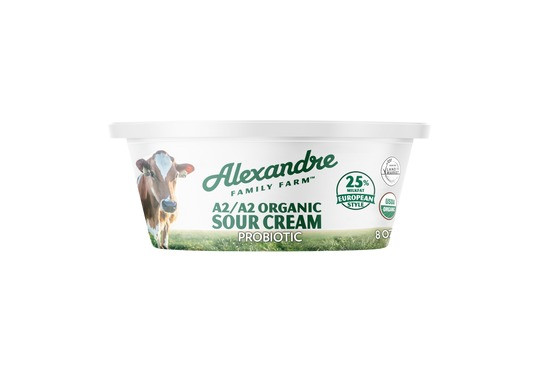
European Style A2 Sour Cream - 8 oz
Alexandre Family Farm
$7.89
$7.10
(No reviews yet)

Write a Review
Alexandre Family Farm
European Style A2 Sour Cream - 8 oz
The only A2/A2 certified organic sour cream in America — made at Alexandre Family Farm from a 100% A2/A2 grass-grazed herd, with 25% milkfat (nearly double the standard American-style 12–16%) and four named live probiotic cultures.
- Rich, thick, and versatile: The elevated milkfat holds its structure under heat, making it ideal for baking into quiches, tarts, and cobblers — or dolloping over chili, enchiladas, and dips where a thinner sour cream would weep.
- A1-free dairy from a verified A2/A2 herd: Alexandre's entire herd carries only the A2 beta-casein gene — the variant that many people with dairy sensitivity tolerate far better than conventional A1 dairy — backed by the farm's own herd certification.
- Certified USDA Organic, gut-friendly, and broadly diet-compatible: Three simple organic ingredients plus Lactococcus lactis, Leuconostoc, Bifidobacterium, and Lactobacillus acidophilus — no fillers, no stabilizers, no artificial thickeners.
Alexandre Family Farm's European-Style Probiotic Sour Cream starts where most dairy brands stop: a fully certified A2/A2 organic herd grazing on living pasture on the Northern California coast. The result is milk dense enough in natural butterfat that no thickeners, gums, or stabilizers are needed to achieve a genuinely thick, spoonable body.
This is a European-style formulation at 25% milkfat — compared to the 12–16% milkfat standard in American sour cream. That gap isn't cosmetic. Higher milkfat means a richer, more complex flavor, a body that doesn't break or weep when baked, and better moisture retention in cooked dishes. It dollops cleanly on hot chili or enchiladas and folds smoothly into pastry batters, tart shells, and savory quiches without curdling.
What makes this formulation genuinely rare is the A2/A2 sourcing combined with USDA Organic certification. Conventional dairy herds carry a mix of A1 and A2 beta-casein proteins; it is the A1 protein that researchers associate with digestive discomfort in people who struggle with standard dairy. Alexandre's herd is genetically verified as exclusively A2/A2 — meaning every drop of milk used here is A1-free. This is, per the brand's own research, the only A2/A2 certified organic sour cream commercially available in the U.S.
The probiotic profile adds a further functional dimension: four named live and active cultures — Lactococcus lactis subsp. cremoris & lactis, Leuconostoc, Bifidobacterium species, and Lactobacillus acidophilus — are preserved through the fermentation process and remain active in the finished product, supporting a healthy gut microbiome.
Store refrigerated. Three ingredients, no stabilizers, no artificial additives.
Ingredients: Organic Milk, Organic Cream, and Live & Active Cultures.
Common Questions
How does this sour cream compare nutritionally to standard American sour cream?
The most significant difference is milkfat content: this European-style formulation contains 25% milkfat, while conventional American sour cream sits at 12–16% milkfat. That higher fat content translates directly into more fat-soluble vitamins — A, D, E, and K2 — per serving, since those nutrients are carried in the fat fraction of the milk. The lower water content that comes with higher butterfat also means the product holds its structure better in heat, resists weeping in cold applications, and delivers a denser caloric profile per tablespoon. Standard American sour cream typically contains around 2–3 grams of fat per tablespoon; a 25% milkfat product delivers closer to 4–5 grams per tablespoon, with correspondingly fewer carbohydrates and more satisfying caloric density.
What is A2/A2 beta-casein and why does it matter for digestion?
Beta-casein is one of the primary proteins in cow's milk, and it comes in two main genetic variants: A1 and A2. When A1 beta-casein is digested, it releases a peptide called beta-casomorphin-7 (BCM-7), which some researchers associate with gastrointestinal discomfort including bloating, cramping, and loose stool in sensitive individuals — symptoms that are often mistakenly attributed to lactose intolerance. A2 beta-casein does not produce BCM-7 during digestion. Alexandre's herd is genetically tested and certified as exclusively A2/A2, meaning every animal carries two copies of the A2 gene and produces only A2 beta-casein, with zero A1 protein entering the milk supply. A 2020 review published in Nutrients found that participants consuming A2 milk reported significantly less digestive discomfort compared to those consuming conventional A1/A2 milk, even when lactose content was identical between samples.
How do the live probiotic cultures in this sour cream support gut health?
This product contains four named live and active cultures: Lactococcus lactis subsp. cremoris and lactis, Leuconostoc species, Bifidobacterium species, and Lactobacillus acidophilus. Each plays a distinct role — Lactococcus strains are primary lactic acid fermenters that create the tangy flavor and lower the pH to preserve the product naturally; Leuconostoc species contribute diacetyl, the compound responsible for buttery notes in fermented dairy; Lactobacillus acidophilus is one of the most studied probiotic strains and has demonstrated effects on improving lactose digestion and modulating intestinal microbiota composition; and Bifidobacterium species are among the dominant beneficial bacteria in the human large intestine, associated with reduced intestinal permeability and immune modulation. Because the cultures are preserved through fermentation rather than added post-pasteurization, they remain live and active in the finished refrigerated product.
Is this sour cream appropriate for keto, paleo, or carnivore eating patterns?
For ketogenic diets, this product fits well: the high milkfat content means a favorable fat-to-carbohydrate ratio, with roughly 4–5 grams of fat and approximately 1 gram of carbohydrate per tablespoon, making it easy to incorporate without disrupting ketosis. Paleo protocols vary — strict interpretations exclude all dairy, but a large subset of paleo practitioners allow full-fat fermented dairy on the basis that fermentation reduces lactose and alters protein structure, and many specifically seek A2 sources for better tolerability. For carnivore dieters, sour cream is one of the more commonly permitted dairy items because of its minimal carbohydrate load and animal-only ingredient profile; the three-ingredient formula here — organic milk, organic cream, and live cultures — aligns with that requirement. The absence of gums, starches, or any plant-derived stabilizers means there are no hidden carbohydrate sources to account for.
Can I use this sour cream as a substitute for other dairy ingredients in baking and cooking?
The 25% milkfat content and fermented acidity make this a versatile substitute across a range of applications. In baking, it can replace buttermilk at a 1:1 ratio after thinning slightly with water or milk — the lactic acid in both performs the same role of reacting with baking soda to provide lift. It substitutes directly for crème fraîche in sauces and tart fillings, and because the higher fat content resists breaking at heat, it can be stirred into hot pan sauces or soups without curdling, unlike lower-fat American sour cream which separates above roughly 160°F. In pastry, it can replace up to half the butter or all of the yogurt in coffee cake, scone, and quick bread recipes, adding moisture and a slight tang. For savory applications — stroganoff, enchiladas, quiche fillings, or cold dips — it can substitute 1:1 for conventional sour cream with a noticeably richer result.
How can I verify that the A2/A2 and Organic certifications are legitimate and not just marketing claims?
USDA Organic certification is a federally regulated standard with third-party audits; the certifying agency's name is required to appear on the label alongside the USDA Organic seal, and certification records are publicly searchable through the USDA's organic integrity database at ams.usda.gov. The A2/A2 claim is verified through genetic testing of individual animals — each cow in the herd is DNA-tested to confirm it carries two copies of the A2 beta-casein gene variant, and Alexandre Family Farm documents this at the herd level rather than relying on breed averages. Unlike the term 'grass-fed,' which has no legally enforced federal standard on dairy labels, A2/A2 is an objective genetic designation that can be confirmed through testing rather than a self-applied marketing term. Alexandre Family Farm is also a Certified B Corporation, which requires third-party social and environmental audits, providing an additional independent accountability layer beyond food-specific certifications.
Does pasture-raised dairy from a coastal California farm produce milk with a different fatty acid profile than conventional dairy?
Yes, and the difference is measurable. Pasture-grazed cows consuming fresh grass consistently produce milk with higher concentrations of conjugated linoleic acid (CLA) and omega-3 fatty acids compared to cows fed grain-based diets. A landmark study published in the Journal of Dairy Science found that milk from grass-fed cows contained up to 500% more CLA than milk from conventionally managed cows. CLA is associated in research with anti-inflammatory effects, improved insulin sensitivity, and reduced body fat accumulation. The omega-3 to omega-6 ratio also improves significantly with pasture-feeding — grain-fed dairy tends to run omega-6 ratios of 5:1 to 10:1, while grass-fed milk can approach 1:1, which more closely mirrors the ratio researchers link to lower systemic inflammation. The Northern California coastal climate extends grazing seasons and maintains consistent grass quality, which supports a more stable fatty acid profile year-round compared to farms in regions with harsher seasonal variation.
This is a European-style formulation at 25% milkfat — compared to the 12–16% milkfat standard in American sour cream. That gap isn't cosmetic. Higher milkfat means a richer, more complex flavor, a body that doesn't break or weep when baked, and better moisture retention in cooked dishes. It dollops cleanly on hot chili or enchiladas and folds smoothly into pastry batters, tart shells, and savory quiches without curdling.
What makes this formulation genuinely rare is the A2/A2 sourcing combined with USDA Organic certification. Conventional dairy herds carry a mix of A1 and A2 beta-casein proteins; it is the A1 protein that researchers associate with digestive discomfort in people who struggle with standard dairy. Alexandre's herd is genetically verified as exclusively A2/A2 — meaning every drop of milk used here is A1-free. This is, per the brand's own research, the only A2/A2 certified organic sour cream commercially available in the U.S.
The probiotic profile adds a further functional dimension: four named live and active cultures — Lactococcus lactis subsp. cremoris & lactis, Leuconostoc, Bifidobacterium species, and Lactobacillus acidophilus — are preserved through the fermentation process and remain active in the finished product, supporting a healthy gut microbiome.
Store refrigerated. Three ingredients, no stabilizers, no artificial additives.
Ingredients: Organic Milk, Organic Cream, and Live & Active Cultures.
Common Questions
How does this sour cream compare nutritionally to standard American sour cream?
The most significant difference is milkfat content: this European-style formulation contains 25% milkfat, while conventional American sour cream sits at 12–16% milkfat. That higher fat content translates directly into more fat-soluble vitamins — A, D, E, and K2 — per serving, since those nutrients are carried in the fat fraction of the milk. The lower water content that comes with higher butterfat also means the product holds its structure better in heat, resists weeping in cold applications, and delivers a denser caloric profile per tablespoon. Standard American sour cream typically contains around 2–3 grams of fat per tablespoon; a 25% milkfat product delivers closer to 4–5 grams per tablespoon, with correspondingly fewer carbohydrates and more satisfying caloric density.
What is A2/A2 beta-casein and why does it matter for digestion?
Beta-casein is one of the primary proteins in cow's milk, and it comes in two main genetic variants: A1 and A2. When A1 beta-casein is digested, it releases a peptide called beta-casomorphin-7 (BCM-7), which some researchers associate with gastrointestinal discomfort including bloating, cramping, and loose stool in sensitive individuals — symptoms that are often mistakenly attributed to lactose intolerance. A2 beta-casein does not produce BCM-7 during digestion. Alexandre's herd is genetically tested and certified as exclusively A2/A2, meaning every animal carries two copies of the A2 gene and produces only A2 beta-casein, with zero A1 protein entering the milk supply. A 2020 review published in Nutrients found that participants consuming A2 milk reported significantly less digestive discomfort compared to those consuming conventional A1/A2 milk, even when lactose content was identical between samples.
How do the live probiotic cultures in this sour cream support gut health?
This product contains four named live and active cultures: Lactococcus lactis subsp. cremoris and lactis, Leuconostoc species, Bifidobacterium species, and Lactobacillus acidophilus. Each plays a distinct role — Lactococcus strains are primary lactic acid fermenters that create the tangy flavor and lower the pH to preserve the product naturally; Leuconostoc species contribute diacetyl, the compound responsible for buttery notes in fermented dairy; Lactobacillus acidophilus is one of the most studied probiotic strains and has demonstrated effects on improving lactose digestion and modulating intestinal microbiota composition; and Bifidobacterium species are among the dominant beneficial bacteria in the human large intestine, associated with reduced intestinal permeability and immune modulation. Because the cultures are preserved through fermentation rather than added post-pasteurization, they remain live and active in the finished refrigerated product.
Is this sour cream appropriate for keto, paleo, or carnivore eating patterns?
For ketogenic diets, this product fits well: the high milkfat content means a favorable fat-to-carbohydrate ratio, with roughly 4–5 grams of fat and approximately 1 gram of carbohydrate per tablespoon, making it easy to incorporate without disrupting ketosis. Paleo protocols vary — strict interpretations exclude all dairy, but a large subset of paleo practitioners allow full-fat fermented dairy on the basis that fermentation reduces lactose and alters protein structure, and many specifically seek A2 sources for better tolerability. For carnivore dieters, sour cream is one of the more commonly permitted dairy items because of its minimal carbohydrate load and animal-only ingredient profile; the three-ingredient formula here — organic milk, organic cream, and live cultures — aligns with that requirement. The absence of gums, starches, or any plant-derived stabilizers means there are no hidden carbohydrate sources to account for.
Can I use this sour cream as a substitute for other dairy ingredients in baking and cooking?
The 25% milkfat content and fermented acidity make this a versatile substitute across a range of applications. In baking, it can replace buttermilk at a 1:1 ratio after thinning slightly with water or milk — the lactic acid in both performs the same role of reacting with baking soda to provide lift. It substitutes directly for crème fraîche in sauces and tart fillings, and because the higher fat content resists breaking at heat, it can be stirred into hot pan sauces or soups without curdling, unlike lower-fat American sour cream which separates above roughly 160°F. In pastry, it can replace up to half the butter or all of the yogurt in coffee cake, scone, and quick bread recipes, adding moisture and a slight tang. For savory applications — stroganoff, enchiladas, quiche fillings, or cold dips — it can substitute 1:1 for conventional sour cream with a noticeably richer result.
How can I verify that the A2/A2 and Organic certifications are legitimate and not just marketing claims?
USDA Organic certification is a federally regulated standard with third-party audits; the certifying agency's name is required to appear on the label alongside the USDA Organic seal, and certification records are publicly searchable through the USDA's organic integrity database at ams.usda.gov. The A2/A2 claim is verified through genetic testing of individual animals — each cow in the herd is DNA-tested to confirm it carries two copies of the A2 beta-casein gene variant, and Alexandre Family Farm documents this at the herd level rather than relying on breed averages. Unlike the term 'grass-fed,' which has no legally enforced federal standard on dairy labels, A2/A2 is an objective genetic designation that can be confirmed through testing rather than a self-applied marketing term. Alexandre Family Farm is also a Certified B Corporation, which requires third-party social and environmental audits, providing an additional independent accountability layer beyond food-specific certifications.
Does pasture-raised dairy from a coastal California farm produce milk with a different fatty acid profile than conventional dairy?
Yes, and the difference is measurable. Pasture-grazed cows consuming fresh grass consistently produce milk with higher concentrations of conjugated linoleic acid (CLA) and omega-3 fatty acids compared to cows fed grain-based diets. A landmark study published in the Journal of Dairy Science found that milk from grass-fed cows contained up to 500% more CLA than milk from conventionally managed cows. CLA is associated in research with anti-inflammatory effects, improved insulin sensitivity, and reduced body fat accumulation. The omega-3 to omega-6 ratio also improves significantly with pasture-feeding — grain-fed dairy tends to run omega-6 ratios of 5:1 to 10:1, while grass-fed milk can approach 1:1, which more closely mirrors the ratio researchers link to lower systemic inflammation. The Northern California coastal climate extends grazing seasons and maintains consistent grass quality, which supports a more stable fatty acid profile year-round compared to farms in regions with harsher seasonal variation.
- __Owner:
- TCFarm
- __Storage_Location:
- Refrigerated
- __Volume:
- 400
- __badge:
- for delivery by 10/28