


Fajita Sliced Pork - 1 lb
TC Farm
$14.99
Below are the available bulk discount rates for each individual item when you purchase a certain amount
- Buy 2 - 4 and get 8% off
- Buy 5 - 14 and get 13% off
- Buy 15 - 49 and get 18% off
- Buy 50 or above and get 22% off
(No reviews yet)

Write a Review
TC Farm
Fajita Sliced Pork - 1 lb
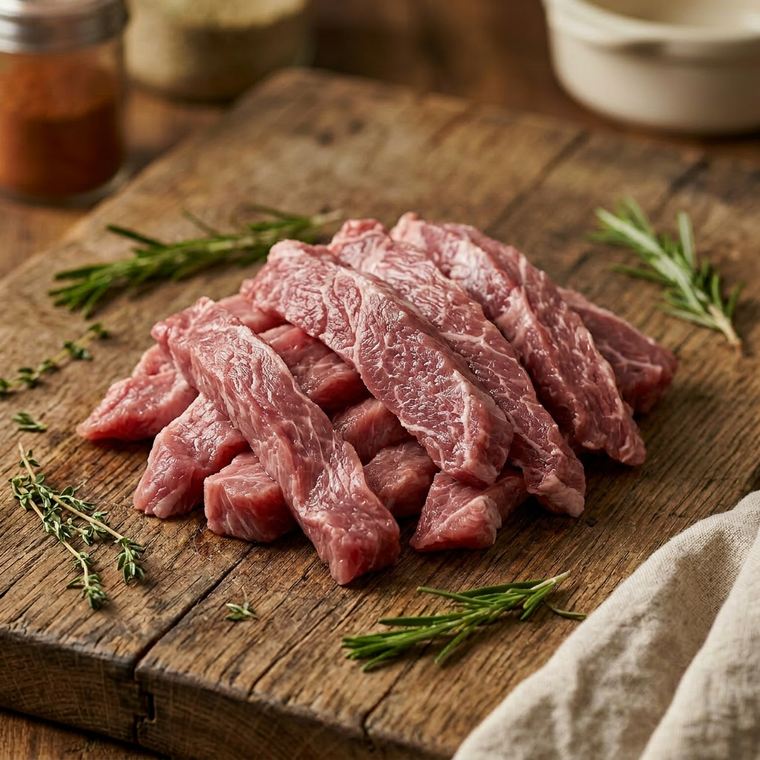
These fajita strips are sliced thin from the butt end of the ham roast — a dense, well-exercised muscle that holds a clean sear under high heat without shredding. They come from one of two partner family farms: Farmer Keith's 550-acre operation raising roughly 250 hogs a year, or Farmer Kerry's farm in Montrose, Minnesota, where heritage forest hogs graze rotational pasture and wooded lots — both raised to the exact same TC Farm standard, no shortcuts.
- Year-round pasture and wooded-lot access on both farms — hogs forage naturally through every season, not just fair-weather months.
- Fed transitional organic corn, barley, and alfalfa grown on-farm; no soy, no hormones, no growth drugs, ever.
- 20% slower natural growth than conventional pork — more time on diverse forage means measurably higher Vitamin D and deeper developed flavor.
This is thinly sliced pork cut straight from the butt end of the ham roast, portioned to roughly one pound and ready for the skillet or grill. The butt end of the ham is a hardworking muscle — dense enough to hold a clean sear at high heat without collapsing into strings, and structured enough to pull seasoning down into the meat rather than just coating the surface. It comes from one of two partner family farms — Farmer Keith's 550-acre operation or Farmer Kerry's farm in Montrose, Minnesota — both raised to the same TC Farm standard: pasture-raised, soy-free, slow-grown on transitional organic feed.
On Keith's farm, about 250 hogs move across 550 acres of pasture ground and wooded lots every year. That year-round access is worth spelling out: these pigs are outside rooting and foraging in February the same as they are in July. Wooded lots let hogs do what hogs are built to do — root, explore, move — and that natural activity reduces stress hormones in the muscle and contributes to the kind of clean, firm texture you notice the moment the meat hits a hot pan. On Kerry's farm in Montrose, heritage forest hogs — a rare small lard heritage breed — graze on rotational pasture and wooded lots under a system Kerry learned during his culinary-school years in Sonoma County. His hogs carry more intramuscular fat than most heritage breeds, fat he describes as tasting almost like butter. When you're slicing thin for fajitas, that marbling matters: it keeps the meat moist through a fast, hot cook.
Both farms feed the same ration: transitional organic corn, barley, and alfalfa, grown on the same land the hogs graze. No soy, full stop. Soy-free pork is genuinely hard to find at any consistent scale in the United States. The commercial hog industry runs on soybean meal because it is cheap and calorie-dense; pulling it out of the feed program requires both a deliberate feed-growing operation and a willingness to raise fewer animals for more cost. For families managing soy allergies — or anyone trying to reduce processed seed-oil derivatives in their diet — that distinction is not minor. TC Farm is one of the very few sources offering it at a price that doesn't require a specialty food budget.
Kerry's rotational grazing system means his fields get time to recover between grazing cycles. That protects native plant species, keeps root systems intact, and prevents the soil compaction and runoff that degrade pasture over time. Keith's operation works on similar principles across his 550 acres. Both farms grow slower animals — roughly 20% slower to finish than conventionally raised hogs. That additional time on diverse forage has a measurable nutritional outcome: pasture-raised pork carries significantly higher Vitamin D levels than confinement pork, a direct result of sunlight exposure and varied diet. Slower growth also allows intramuscular fat to develop gradually, which is where flavor actually lives in pork.
For fajita strips, a cast-iron skillet or a hot grill grate is the right tool. Get the surface to high heat — around 450°F on a grill or a skillet just past the smoke point of your cooking fat — and cook in a single layer, two to three minutes total, turning once. Don't crowd the pan or the meat steams instead of sears. USDA recommends a minimum internal temperature of 145°F for whole-muscle pork cuts, followed by a three-minute rest, though at this slice thickness the cook time itself gets you there fast. This cut works equally well for stir-fry, Korean-style ssam, or quick weeknight tacos — anything that benefits from thin pork with actual flavor behind it.
Ingredients: Pork.
Common Questions
Where exactly on the pig does fajita-sliced pork come from, and why does that matter for high-heat cooking?
This cut is sliced from the butt end of the ham roast — the upper rear leg of the hog, a muscle group that works constantly and develops dense, tightly organized fibers. That muscle structure is exactly what you want for a fast, hot cook: it holds its shape under high heat instead of pulling apart into shreds the way loin-based cuts sometimes do when sliced thin. The intramuscular structure also gives the meat something to grip seasoning and marinade with, so flavor penetrates the slice rather than sitting on the surface. It's a working-muscle cut, which in practice means it rewards the high-heat, short-cook method that defines fajita prep.
How rare is soy-free pork in the United States, and why does it matter for my family?
Soybean meal is the dominant protein supplement in American commercial hog production because it is inexpensive, calorie-dense, and widely available — the majority of conventionally raised pork in the U.S. is finished on rations that include soy in some form. Finding a consistent, reliably soy-free source at any meaningful scale is genuinely difficult; most operations that eliminate soy are very small or intermittently available. For families managing confirmed soy allergies, or for anyone reducing soy-derived compounds in their diet for other health reasons, that scarcity is a real problem. Both TC Farm partner farms — Farmer Keith's 550-acre operation and Farmer Kerry's farm in Montrose, Minnesota — feed only transitional organic corn, barley, and alfalfa grown on the same land the hogs graze. No soybean meal, no soy-based supplements, at any point in the feed program.
What does transitional organic feed mean, and is it the same as USDA Certified Organic?
Transitional organic refers to feed grown on farmland that is actively moving through the USDA's three-year certification window required before ground can carry the Certified Organic label. The land is farmed without synthetic pesticides or fertilizers during that entire period, but the three years have not yet elapsed, so the crop cannot legally be sold or labeled as Certified Organic. Both TC Farm partner farms grow their own corn, barley, and alfalfa under these transitional organic practices on the same acreage the hogs graze. TC Farm does not claim USDA Certified Organic status for this pork because that would be inaccurate — but the feeding and land-management practices that define organic are already in place. For most buyers the practical difference in what the animal consumed is minimal; the label difference is a function of time and certification paperwork, not farming practice.
Does 'pasture-raised' on the label have a legal USDA definition I can rely on?
It does not. The USDA has no enforceable federal standard for the term 'pasture-raised' on pork — any producer can print it on packaging with minimal oversight. What distinguishes TC Farm's sourcing is the specifics behind the claim: both partner farms provide year-round pasture and wooded-lot access, meaning these hogs are outside and foraging in the middle of winter, not just during favorable weather. Farmer Keith's 250 hogs roam 550 acres of pasture and wooded ground through every season. Farmer Kerry's heritage forest hogs in Montrose, Minnesota graze on rotational pasture and wooded lots under a system designed to protect soil health and native plant species. Neither farm confines animals during off-season months. The difference between genuine year-round pasture access and a marketing use of the term is exactly that — whether the animals are actually outside in February.
Does pasture raising actually change the nutrition profile of the pork, or is that a marketing claim?
Pasture-raised pork does carry measurably higher Vitamin D levels than confinement-raised pork, and the mechanism is straightforward: sunlight exposure triggers Vitamin D synthesis in the skin and fat of the animal, the same way it does in humans. Pigs kept indoors year-round produce very little of it. Both TC Farm partner farms provide genuine year-round outdoor access, which means the animals receive consistent sunlight exposure across all seasons. The 20% slower growth rate on these farms — a direct result of natural forage-based development rather than accelerated feed programs — also allows intramuscular fat to accumulate gradually, which is the primary driver of pork flavor. Intramuscular fat developed slowly over a longer grow-out period has a different fatty-acid composition than fat deposited rapidly in a confinement system, and that difference is detectable in the flavor of the cooked meat.
How do I cook fajita-sliced pork correctly, and what internal temperature am I aiming for?
The USDA recommends a minimum internal temperature of 145°F for whole-muscle pork cuts, followed by a three-minute rest before serving. For slices this thin, reaching that temperature happens quickly — the cooking time itself, not the resting period, is your primary control. Use a cast-iron skillet or a grill grate brought to high heat, roughly 450°F surface temperature, with just enough fat to coat the pan. Cook in a single layer for two to three minutes total, turning once; crowding the pan drops the surface temperature and causes the meat to steam rather than sear, which eliminates the crust that makes this cut work. This same approach translates directly to stir-fry and taco applications — high heat, short time, single layer.
How should I store and thaw this product?
Keep the pack frozen until the day before you plan to cook it. The safest and most consistent thaw method is overnight in the refrigerator — approximately 24 hours for a one-pound pack — which keeps the meat at a stable temperature and prevents the surface from entering the bacterial growth zone while the center is still frozen. If you need same-day thawing, a sealed cold-water bath works: submerge the sealed pack in cold tap water and change the water every 30 minutes; a one-pound pack of thin-sliced pork is typically thawed through in under an hour this way. Do not thaw at room temperature. Frozen, the product keeps well for several months without quality loss; once thawed, cook within two days.
On Keith's farm, about 250 hogs move across 550 acres of pasture ground and wooded lots every year. That year-round access is worth spelling out: these pigs are outside rooting and foraging in February the same as they are in July. Wooded lots let hogs do what hogs are built to do — root, explore, move — and that natural activity reduces stress hormones in the muscle and contributes to the kind of clean, firm texture you notice the moment the meat hits a hot pan. On Kerry's farm in Montrose, heritage forest hogs — a rare small lard heritage breed — graze on rotational pasture and wooded lots under a system Kerry learned during his culinary-school years in Sonoma County. His hogs carry more intramuscular fat than most heritage breeds, fat he describes as tasting almost like butter. When you're slicing thin for fajitas, that marbling matters: it keeps the meat moist through a fast, hot cook.
Both farms feed the same ration: transitional organic corn, barley, and alfalfa, grown on the same land the hogs graze. No soy, full stop. Soy-free pork is genuinely hard to find at any consistent scale in the United States. The commercial hog industry runs on soybean meal because it is cheap and calorie-dense; pulling it out of the feed program requires both a deliberate feed-growing operation and a willingness to raise fewer animals for more cost. For families managing soy allergies — or anyone trying to reduce processed seed-oil derivatives in their diet — that distinction is not minor. TC Farm is one of the very few sources offering it at a price that doesn't require a specialty food budget.
Kerry's rotational grazing system means his fields get time to recover between grazing cycles. That protects native plant species, keeps root systems intact, and prevents the soil compaction and runoff that degrade pasture over time. Keith's operation works on similar principles across his 550 acres. Both farms grow slower animals — roughly 20% slower to finish than conventionally raised hogs. That additional time on diverse forage has a measurable nutritional outcome: pasture-raised pork carries significantly higher Vitamin D levels than confinement pork, a direct result of sunlight exposure and varied diet. Slower growth also allows intramuscular fat to develop gradually, which is where flavor actually lives in pork.
For fajita strips, a cast-iron skillet or a hot grill grate is the right tool. Get the surface to high heat — around 450°F on a grill or a skillet just past the smoke point of your cooking fat — and cook in a single layer, two to three minutes total, turning once. Don't crowd the pan or the meat steams instead of sears. USDA recommends a minimum internal temperature of 145°F for whole-muscle pork cuts, followed by a three-minute rest, though at this slice thickness the cook time itself gets you there fast. This cut works equally well for stir-fry, Korean-style ssam, or quick weeknight tacos — anything that benefits from thin pork with actual flavor behind it.
Ingredients: Pork.
Common Questions
Where exactly on the pig does fajita-sliced pork come from, and why does that matter for high-heat cooking?
This cut is sliced from the butt end of the ham roast — the upper rear leg of the hog, a muscle group that works constantly and develops dense, tightly organized fibers. That muscle structure is exactly what you want for a fast, hot cook: it holds its shape under high heat instead of pulling apart into shreds the way loin-based cuts sometimes do when sliced thin. The intramuscular structure also gives the meat something to grip seasoning and marinade with, so flavor penetrates the slice rather than sitting on the surface. It's a working-muscle cut, which in practice means it rewards the high-heat, short-cook method that defines fajita prep.
How rare is soy-free pork in the United States, and why does it matter for my family?
Soybean meal is the dominant protein supplement in American commercial hog production because it is inexpensive, calorie-dense, and widely available — the majority of conventionally raised pork in the U.S. is finished on rations that include soy in some form. Finding a consistent, reliably soy-free source at any meaningful scale is genuinely difficult; most operations that eliminate soy are very small or intermittently available. For families managing confirmed soy allergies, or for anyone reducing soy-derived compounds in their diet for other health reasons, that scarcity is a real problem. Both TC Farm partner farms — Farmer Keith's 550-acre operation and Farmer Kerry's farm in Montrose, Minnesota — feed only transitional organic corn, barley, and alfalfa grown on the same land the hogs graze. No soybean meal, no soy-based supplements, at any point in the feed program.
What does transitional organic feed mean, and is it the same as USDA Certified Organic?
Transitional organic refers to feed grown on farmland that is actively moving through the USDA's three-year certification window required before ground can carry the Certified Organic label. The land is farmed without synthetic pesticides or fertilizers during that entire period, but the three years have not yet elapsed, so the crop cannot legally be sold or labeled as Certified Organic. Both TC Farm partner farms grow their own corn, barley, and alfalfa under these transitional organic practices on the same acreage the hogs graze. TC Farm does not claim USDA Certified Organic status for this pork because that would be inaccurate — but the feeding and land-management practices that define organic are already in place. For most buyers the practical difference in what the animal consumed is minimal; the label difference is a function of time and certification paperwork, not farming practice.
Does 'pasture-raised' on the label have a legal USDA definition I can rely on?
It does not. The USDA has no enforceable federal standard for the term 'pasture-raised' on pork — any producer can print it on packaging with minimal oversight. What distinguishes TC Farm's sourcing is the specifics behind the claim: both partner farms provide year-round pasture and wooded-lot access, meaning these hogs are outside and foraging in the middle of winter, not just during favorable weather. Farmer Keith's 250 hogs roam 550 acres of pasture and wooded ground through every season. Farmer Kerry's heritage forest hogs in Montrose, Minnesota graze on rotational pasture and wooded lots under a system designed to protect soil health and native plant species. Neither farm confines animals during off-season months. The difference between genuine year-round pasture access and a marketing use of the term is exactly that — whether the animals are actually outside in February.
Does pasture raising actually change the nutrition profile of the pork, or is that a marketing claim?
Pasture-raised pork does carry measurably higher Vitamin D levels than confinement-raised pork, and the mechanism is straightforward: sunlight exposure triggers Vitamin D synthesis in the skin and fat of the animal, the same way it does in humans. Pigs kept indoors year-round produce very little of it. Both TC Farm partner farms provide genuine year-round outdoor access, which means the animals receive consistent sunlight exposure across all seasons. The 20% slower growth rate on these farms — a direct result of natural forage-based development rather than accelerated feed programs — also allows intramuscular fat to accumulate gradually, which is the primary driver of pork flavor. Intramuscular fat developed slowly over a longer grow-out period has a different fatty-acid composition than fat deposited rapidly in a confinement system, and that difference is detectable in the flavor of the cooked meat.
How do I cook fajita-sliced pork correctly, and what internal temperature am I aiming for?
The USDA recommends a minimum internal temperature of 145°F for whole-muscle pork cuts, followed by a three-minute rest before serving. For slices this thin, reaching that temperature happens quickly — the cooking time itself, not the resting period, is your primary control. Use a cast-iron skillet or a grill grate brought to high heat, roughly 450°F surface temperature, with just enough fat to coat the pan. Cook in a single layer for two to three minutes total, turning once; crowding the pan drops the surface temperature and causes the meat to steam rather than sear, which eliminates the crust that makes this cut work. This same approach translates directly to stir-fry and taco applications — high heat, short time, single layer.
How should I store and thaw this product?
Keep the pack frozen until the day before you plan to cook it. The safest and most consistent thaw method is overnight in the refrigerator — approximately 24 hours for a one-pound pack — which keeps the meat at a stable temperature and prevents the surface from entering the bacterial growth zone while the center is still frozen. If you need same-day thawing, a sealed cold-water bath works: submerge the sealed pack in cold tap water and change the water every 30 minutes; a one-pound pack of thin-sliced pork is typically thawed through in under an hour this way. Do not thaw at room temperature. Frozen, the product keeps well for several months without quality loss; once thawed, cook within two days.
- __Storage_Location:
- Frozen
- __Volume:
- 700
- __Owner:
- TCFarm
- __badge:
- Pasture-Raised