


Focaccia - 14 oz
Cappellos
$11.89
(No reviews yet)

Write a Review
Cappellos
Focaccia - 14 oz
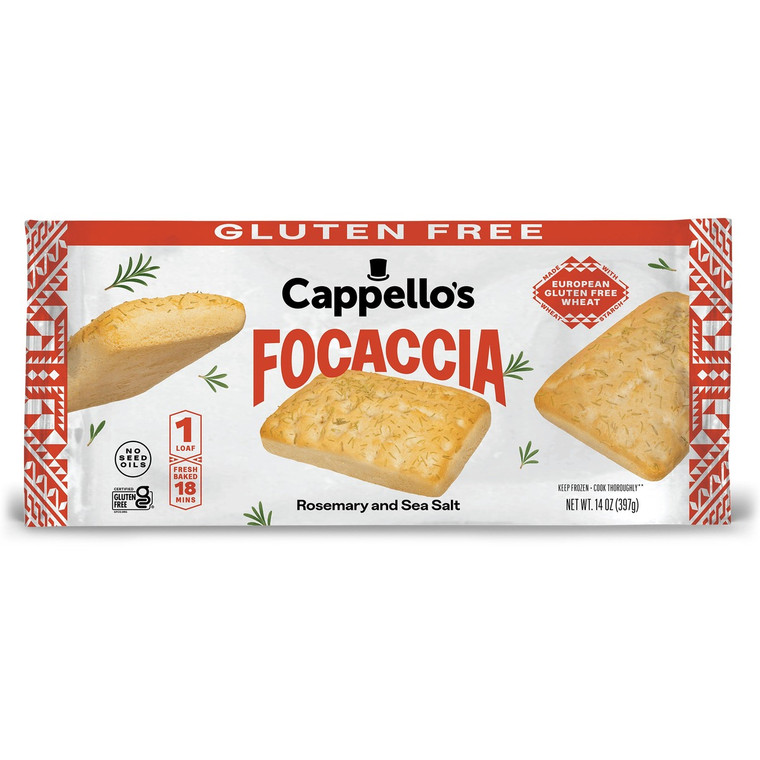
Focaccia that's genuinely gluten-free — and actually tastes like focaccia. Cappello's cracked the code by using European wheat starch with the gluten washed out of it, not replaced by a parade of gummy starches. What's left is the authentic flavor and chew of real wheat bread, minus the gluten — then finished with olive pomace oil, rosemary, and flaky sea salt. Certified gluten-free by GFCO and tested to less than 5 PPM, making it safe for celiac and anyone serious about avoiding gluten.
- Tear-and-dip ready: bakes up crispy-edged and airy-crumbed in under 25 minutes — built for olive oil, soups, antipasto boards, and bruschetta toppings.
- European wheat starch, gluten washed out: GFCO-certified to <5 PPM and also Glyphosate-Free — a process no commodity gluten-free bread can replicate.
- Gluten-Free certified: safe for celiac disease and gluten intolerance; free from artificial preservatives and artificial flavors.
Cappello's set out to answer a question that's stumped gluten-free bakers for decades: why does gluten-free bread taste like gluten-free bread? The answer, they found, is that most brands replace wheat entirely with blends of rice flour, tapioca, and xanthan gum — and the result tastes like it. Cappello's went a different direction.
This Olive Oil & Rosemary Focaccia is built on European wheat starch with the gluten physically removed — a washing process that strips out the gluten proteins while leaving behind the starch that gives wheat bread its characteristic flavor and texture. The result bakes up with a crispy bottom crust, an open airy crumb, and the savory depth you'd expect from a real Italian flatbread. Finished with olive pomace oil, rosemary, and flaky sea salt.
The gluten-free claim isn't self-certified. This focaccia carries GFCO Certification, tested to less than 5 parts per million — the threshold recognized as safe for individuals with celiac disease, not just gluten sensitivity. It is also certified Glyphosate-Free.
To serve: thaw for 15 minutes while your oven preheats to 375°F. Bake on a lightly oiled sheet pan on the middle rack for 18–24 minutes. Serve immediately — best warm, with a shallow dish of good olive oil alongside. Works equally well as a base for bruschetta, torn alongside minestrone, or as a pull-apart side for a cheese board.
Certified Gluten-Free (GFCO, <5 PPM). Glyphosate-Free. Arrives frozen; store frozen and bake from thawed. Contains wheat (gluten-free processed).
Ingredients: Water, Gluten Free Wheat Starch, Corn Starch, Olive Pomace Oil, Soluble Corn Fiber, Tapioca Flour, Sugar, Yeast, Buckwheat Flour, Rice Starch, Sea Salt, Psyllium Husk Powder, Guar Gum, Rosemary, and Garlic Powder.
Common Questions
How is gluten-free wheat starch different from regular wheat flour, and why does it matter for texture?
Wheat starch is produced by washing wheat flour with water until the gluten proteins — primarily gliadin and glutenin — are physically separated and removed, leaving behind the starch granules intact. Because the starch originates from wheat rather than rice, corn, or tapioca, it retains the same gelatinization behavior and subtle flavor compounds that give conventional wheat bread its characteristic crumb structure. Most gluten-free breads substitute these wheat starches entirely with rice flour and tapioca, which have different water absorption rates and produce a gummy or crumbly texture. The retained wheat starch in this focaccia allows yeast fermentation to produce CO2 in a matrix that behaves structurally closer to conventional dough, which is why the finished crumb is open and airy rather than dense. The final product still contains no detectable gluten — it tests below 5 parts per million — but the baking chemistry works more like traditional focaccia than like a typical gluten-free substitute.
What does the GFCO certification actually mean, and how is it different from a brand self-certifying as gluten-free?
GFCO stands for Gluten-Free Certification Organization, an independent third-party program operated by the Allergen Control Group. GFCO-certified products are tested to a threshold of less than 10 parts per million of gluten at the program level, but Cappello's specifies their product tests below 5 ppm, which is the most conservative standard in the industry and the level the Canadian Celiac Association recommends as safe for individuals with celiac disease. By contrast, the FDA's gluten-free labeling rule only requires a product to contain fewer than 20 ppm, and brands can self-certify to that threshold without any third-party audit or testing. A self-certified label means the company is attesting to the claim internally; a GFCO seal means an outside organization has reviewed the facility, supply chain, and finished product. For people with celiac disease — where even trace exposure can trigger intestinal damage — that distinction is clinically meaningful.
What is the Glyphosate-Free certification, and why would it matter for a gluten-free product?
Glyphosate-Free certification, typically issued by the Detox Project or a similar third-party organization, requires testing of the finished product to confirm glyphosate residues fall below a defined threshold — usually 0.01 mg/kg or lower. Glyphosate is the active herbicide in Roundup and is commonly applied to conventional wheat crops as a pre-harvest desiccant, meaning it is sprayed shortly before harvest to speed drying and can leave residues in the grain. This is particularly relevant for wheat starch, since it is derived directly from wheat. For individuals with celiac disease or gluten sensitivity, who are often managing broader digestive inflammation, minimizing pesticide exposure through a certified product offers an additional documented assurance beyond the gluten testing alone. The certification requires ongoing testing, not a one-time assessment.
Is this focaccia suitable for people with celiac disease, or just those with non-celiac gluten sensitivity?
Based on the available certifications, this product is formulated and tested to standards considered safe for celiac disease, not only for gluten sensitivity. The GFCO certification and the stated threshold of less than 5 ppm are the benchmarks most gastroenterologists and celiac advocacy organizations point to when distinguishing products safe for celiac disease from those only suitable for preference-based avoidance. That said, the product does contain wheat starch — with the gluten removed — and the label notes it is processed wheat. Individuals with celiac disease who are also wheat-allergic (a distinct immune mechanism from celiac) would need to consult their physician, since a wheat allergy reacts to wheat proteins broadly, not only to gluten. For the celiac population without a concurrent wheat allergy, the sub-5-ppm testing standard is the relevant metric.
How should this focaccia be reheated if there are leftovers, and does it hold up the next day?
Focaccia made with wheat starch and psyllium husk behaves similarly to conventional focaccia in that it is best the day it is baked but can be revived. If you have leftover baked focaccia, store it at room temperature wrapped loosely in a kitchen towel — not in an airtight container, which traps moisture and softens the crust. To reheat, place it directly on the oven rack or a preheated sheet pan at 350 to 375 degrees Fahrenheit for 6 to 8 minutes; this re-crisps the bottom crust without drying out the interior. Avoid the microwave, which rehydrates the surface unevenly and produces a soft, chewy texture that does not reflect how the bread is intended to eat. If you want to extend storage beyond one day, it is better to keep the focaccia in the freezer in its pre-baked state and bake individual portions to order rather than freezing already-baked pieces.
What are some specific uses for this focaccia beyond serving it as a side bread?
Focaccia's open crumb and olive oil content make it structurally suitable for a range of preparations that standard sandwich bread cannot handle. Sliced horizontally, a piece makes a sturdy base for a pressed sandwich — the crumb compresses without crumbling, and the rosemary and sea salt complement cured meats, fresh mozzarella, or roasted vegetables. Cut into cubes and returned to the oven at 400 degrees Fahrenheit for 10 to 12 minutes, it produces croutons with more flavor depth than plain bread. It also works as a pizza-adjacent base: top unbaked, thawed focaccia with crushed tomato, cheese, and toppings and bake according to the standard directions, adding 3 to 5 minutes to account for the additional moisture from toppings. For a simple bruschetta, bake the focaccia as directed, rub the surface with a raw garlic clove while hot, and top with diced tomato, basil, and a drizzle of finishing olive oil.
How does psyllium husk function in this recipe, and why is it used in gluten-free baking?
Psyllium husk is a soluble dietary fiber derived from the seeds of Plantago ovata. In gluten-free baking, it serves as a structural binder and moisture-retention agent, partially mimicking the network that gluten proteins form in conventional dough. When hydrated, psyllium husk forms a gel that traps the carbon dioxide produced by yeast fermentation, allowing the dough to rise rather than collapse — a property that rice flour or tapioca starch alone cannot provide. Research published in food science journals has shown that psyllium husk at concentrations of 2 to 5 percent of flour weight meaningfully improves loaf volume, crumb cohesion, and crust formation in gluten-free formulations. In combination with guar gum, which also appears in this ingredient list, it provides both the elasticity and the moisture retention needed to produce a crumb that stays open rather than gummy after baking.
This Olive Oil & Rosemary Focaccia is built on European wheat starch with the gluten physically removed — a washing process that strips out the gluten proteins while leaving behind the starch that gives wheat bread its characteristic flavor and texture. The result bakes up with a crispy bottom crust, an open airy crumb, and the savory depth you'd expect from a real Italian flatbread. Finished with olive pomace oil, rosemary, and flaky sea salt.
The gluten-free claim isn't self-certified. This focaccia carries GFCO Certification, tested to less than 5 parts per million — the threshold recognized as safe for individuals with celiac disease, not just gluten sensitivity. It is also certified Glyphosate-Free.
To serve: thaw for 15 minutes while your oven preheats to 375°F. Bake on a lightly oiled sheet pan on the middle rack for 18–24 minutes. Serve immediately — best warm, with a shallow dish of good olive oil alongside. Works equally well as a base for bruschetta, torn alongside minestrone, or as a pull-apart side for a cheese board.
Certified Gluten-Free (GFCO, <5 PPM). Glyphosate-Free. Arrives frozen; store frozen and bake from thawed. Contains wheat (gluten-free processed).
Ingredients: Water, Gluten Free Wheat Starch, Corn Starch, Olive Pomace Oil, Soluble Corn Fiber, Tapioca Flour, Sugar, Yeast, Buckwheat Flour, Rice Starch, Sea Salt, Psyllium Husk Powder, Guar Gum, Rosemary, and Garlic Powder.
Common Questions
How is gluten-free wheat starch different from regular wheat flour, and why does it matter for texture?
Wheat starch is produced by washing wheat flour with water until the gluten proteins — primarily gliadin and glutenin — are physically separated and removed, leaving behind the starch granules intact. Because the starch originates from wheat rather than rice, corn, or tapioca, it retains the same gelatinization behavior and subtle flavor compounds that give conventional wheat bread its characteristic crumb structure. Most gluten-free breads substitute these wheat starches entirely with rice flour and tapioca, which have different water absorption rates and produce a gummy or crumbly texture. The retained wheat starch in this focaccia allows yeast fermentation to produce CO2 in a matrix that behaves structurally closer to conventional dough, which is why the finished crumb is open and airy rather than dense. The final product still contains no detectable gluten — it tests below 5 parts per million — but the baking chemistry works more like traditional focaccia than like a typical gluten-free substitute.
What does the GFCO certification actually mean, and how is it different from a brand self-certifying as gluten-free?
GFCO stands for Gluten-Free Certification Organization, an independent third-party program operated by the Allergen Control Group. GFCO-certified products are tested to a threshold of less than 10 parts per million of gluten at the program level, but Cappello's specifies their product tests below 5 ppm, which is the most conservative standard in the industry and the level the Canadian Celiac Association recommends as safe for individuals with celiac disease. By contrast, the FDA's gluten-free labeling rule only requires a product to contain fewer than 20 ppm, and brands can self-certify to that threshold without any third-party audit or testing. A self-certified label means the company is attesting to the claim internally; a GFCO seal means an outside organization has reviewed the facility, supply chain, and finished product. For people with celiac disease — where even trace exposure can trigger intestinal damage — that distinction is clinically meaningful.
What is the Glyphosate-Free certification, and why would it matter for a gluten-free product?
Glyphosate-Free certification, typically issued by the Detox Project or a similar third-party organization, requires testing of the finished product to confirm glyphosate residues fall below a defined threshold — usually 0.01 mg/kg or lower. Glyphosate is the active herbicide in Roundup and is commonly applied to conventional wheat crops as a pre-harvest desiccant, meaning it is sprayed shortly before harvest to speed drying and can leave residues in the grain. This is particularly relevant for wheat starch, since it is derived directly from wheat. For individuals with celiac disease or gluten sensitivity, who are often managing broader digestive inflammation, minimizing pesticide exposure through a certified product offers an additional documented assurance beyond the gluten testing alone. The certification requires ongoing testing, not a one-time assessment.
Is this focaccia suitable for people with celiac disease, or just those with non-celiac gluten sensitivity?
Based on the available certifications, this product is formulated and tested to standards considered safe for celiac disease, not only for gluten sensitivity. The GFCO certification and the stated threshold of less than 5 ppm are the benchmarks most gastroenterologists and celiac advocacy organizations point to when distinguishing products safe for celiac disease from those only suitable for preference-based avoidance. That said, the product does contain wheat starch — with the gluten removed — and the label notes it is processed wheat. Individuals with celiac disease who are also wheat-allergic (a distinct immune mechanism from celiac) would need to consult their physician, since a wheat allergy reacts to wheat proteins broadly, not only to gluten. For the celiac population without a concurrent wheat allergy, the sub-5-ppm testing standard is the relevant metric.
How should this focaccia be reheated if there are leftovers, and does it hold up the next day?
Focaccia made with wheat starch and psyllium husk behaves similarly to conventional focaccia in that it is best the day it is baked but can be revived. If you have leftover baked focaccia, store it at room temperature wrapped loosely in a kitchen towel — not in an airtight container, which traps moisture and softens the crust. To reheat, place it directly on the oven rack or a preheated sheet pan at 350 to 375 degrees Fahrenheit for 6 to 8 minutes; this re-crisps the bottom crust without drying out the interior. Avoid the microwave, which rehydrates the surface unevenly and produces a soft, chewy texture that does not reflect how the bread is intended to eat. If you want to extend storage beyond one day, it is better to keep the focaccia in the freezer in its pre-baked state and bake individual portions to order rather than freezing already-baked pieces.
What are some specific uses for this focaccia beyond serving it as a side bread?
Focaccia's open crumb and olive oil content make it structurally suitable for a range of preparations that standard sandwich bread cannot handle. Sliced horizontally, a piece makes a sturdy base for a pressed sandwich — the crumb compresses without crumbling, and the rosemary and sea salt complement cured meats, fresh mozzarella, or roasted vegetables. Cut into cubes and returned to the oven at 400 degrees Fahrenheit for 10 to 12 minutes, it produces croutons with more flavor depth than plain bread. It also works as a pizza-adjacent base: top unbaked, thawed focaccia with crushed tomato, cheese, and toppings and bake according to the standard directions, adding 3 to 5 minutes to account for the additional moisture from toppings. For a simple bruschetta, bake the focaccia as directed, rub the surface with a raw garlic clove while hot, and top with diced tomato, basil, and a drizzle of finishing olive oil.
How does psyllium husk function in this recipe, and why is it used in gluten-free baking?
Psyllium husk is a soluble dietary fiber derived from the seeds of Plantago ovata. In gluten-free baking, it serves as a structural binder and moisture-retention agent, partially mimicking the network that gluten proteins form in conventional dough. When hydrated, psyllium husk forms a gel that traps the carbon dioxide produced by yeast fermentation, allowing the dough to rise rather than collapse — a property that rice flour or tapioca starch alone cannot provide. Research published in food science journals has shown that psyllium husk at concentrations of 2 to 5 percent of flour weight meaningfully improves loaf volume, crumb cohesion, and crust formation in gluten-free formulations. In combination with guar gum, which also appears in this ingredient list, it provides both the elasticity and the moisture retention needed to produce a crumb that stays open rather than gummy after baking.
- __Storage_Location:
- Frozen
- __Volume:
- 400
- __Owner:
- TCFarm
- __badge:
- Gluten-Free