


Sale
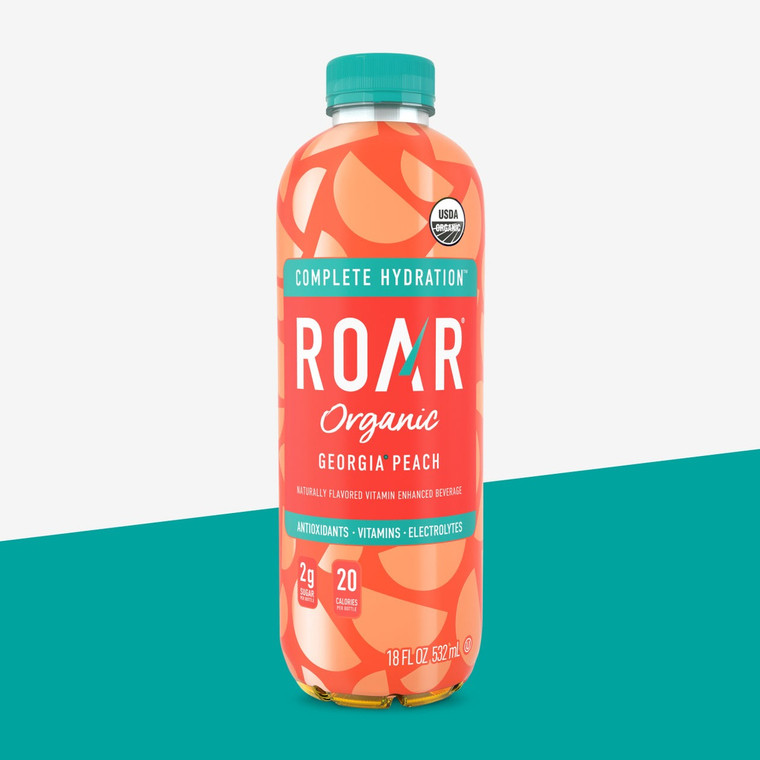
Georgia Peach Hydration Drink - 18 fl oz
Roar Beverages
$2.49
$2.29
Below are the available bulk discount rates for each individual item when you purchase a certain amount
- Buy 2 - 5 and get 5% off
- Buy 6 - 11 and get 10% off
- Buy 12 or above and get 20% off
(No reviews yet)

Write a Review
Roar Beverages
Georgia Peach Hydration Drink - 18 fl oz
Clean hydration that earns its electrolytes — no synthetic dyes, no caffeine, and only 3g of sugar per bottle. Roar Organic's Georgia Peach drink delivers a full B-vitamin complex (B-3, B-5, B-6) alongside vitamin C and coconut water electrolytes, all in a USDA Organic, certified keto-friendly, vegan formula that fits into the tightest wellness routine without compromise.
- Made for any moment: Post-workout, afternoon slump, or early morning — 20 calories and a naturally colored peach flavor built from organic fruit & vegetable juice make this a grab-and-go upgrade over conventional sports drinks.
- Vitamin-forward electrolyte formula: Coconut water from concentrate provides naturally occurring electrolytes; organic erythritol and stevia keep sugar to 3g per bottle — a meaningful gap below the 20–34g found in mainstream sports drinks.
- Certified for multiple lifestyles: USDA Organic, keto-friendly, vegan, and gluten-free — verified by third-party certification, not just label copy.
Roar Organic Georgia Peach is built around a simple principle: real hydration support shouldn't come loaded with synthetic dyes, artificial sweeteners, or caffeine. Each 18 fl oz bottle delivers filtered water and organic coconut water concentrate as its electrolyte base, layered with a functional B-vitamin stack — niacinamide (B-3), calcium D pantothenate (B-5), and pyridoxine hydrochloride (B-6) — plus ascorbic acid (vitamin C) for antioxidant support.
The sweetness comes from a blend of organic cane sugar, organic erythritol, and organic rebaudioside A (stevia), landing at just 3 grams of sugar and 20 calories per bottle. Color is derived entirely from organic fruit & vegetable juice — not petroleum-based dyes. Organic gum acacia, citric acid, and L-malic acid round out the formula, balancing mouthfeel and tartness without any artificial flavor enhancers.
For shoppers comparing this to the conventional sports drink aisle: most leading hydration beverages carry 20–34g of sugar per serving, synthetic FD&C dyes (Red 40, Yellow 5), and zero organic certification. Roar Organic holds USDA Organic status — meaning every ingredient in this bottle passed federal organic standards, from the coconut water to the stevia extract. That's a bar the vast majority of mainstream electrolyte drinks cannot clear.
Nutritionally, the 20-calorie, 3g-sugar profile makes this legitimately keto-compatible — certified as such by a third-party keto program. It's also vegan and gluten-free certified, making it one of the few electrolyte beverages that fits simultaneously across keto, vegan, and organic dietary frameworks without any trade-offs in taste or function.
Serve chilled straight from the bottle. Pairs naturally with a post-workout snack or as a mid-afternoon hydration reset when water alone feels flat. Store at room temperature; refrigerate after opening and consume within 3 days.
Ingredients: Filtered Water, Organic Coconut Water From Concentrate, Organic Erythritol, Organic Cane Sugar, Organic Flavor, Organic Fruit & Vegetable Juice For Color, Sea Salt, Citric Acid, Organic Gum Acacia, L-Malic Acid, Ascorbic Acid (Vitamin C), Organic Rebaudioside A (Stevia), Niacinamide (Vitamin B-3), Calcium D Pantothenate (Vitamin B-5), Pyridoxine Hydrochloride (Vitamin B-6).
Common Questions
How does Roar Organic Georgia Peach compare nutritionally to mainstream sports drinks like Gatorade or Powerade?
A standard 20 oz bottle of Gatorade Thirst Quencher contains 34 grams of sugar and 140 calories, colored with Yellow 5 and Yellow 6 (petroleum-derived FD&C dyes). A comparable serving of Powerade carries roughly 21 grams of sugar and uses Blue 1 and Yellow 6. Roar Organic Georgia Peach delivers 3 grams of sugar and 20 calories per 18 fl oz bottle, with color sourced entirely from organic fruit and vegetable juice. Neither Gatorade nor Powerade holds USDA Organic certification, meaning their ingredient sourcing is not subject to federal organic standards. For someone managing sugar intake or avoiding synthetic additives, the gap between these products is substantial on nearly every measurable axis.
How does erythritol affect blood sugar, and why is it used here instead of just stevia alone?
Erythritol is a sugar alcohol that is absorbed in the small intestine and excreted largely unchanged in urine, meaning it contributes negligible net carbohydrates and has a glycemic index of approximately 0. It provides roughly 0.24 calories per gram compared to sugar's 4 calories per gram, so it adds bulk and mouthfeel that pure high-intensity sweeteners like stevia cannot replicate on their own. Stevia (rebaudioside A specifically) is 200-400 times sweeter than sucrose by weight, which means very small amounts are used — too little to create the rounded sweetness profile most consumers expect from a beverage. Blending erythritol with rebaudioside A and a small amount of organic cane sugar (3g total) allows the formula to hit a natural sweetness curve without the bitter aftertaste that high stevia concentrations often produce. This three-sweetener approach is a documented formulation strategy for achieving sugar-like taste at low caloric cost.
What do the B vitamins in this drink actually do, and are the forms used here bioavailable?
Roar Organic includes three B vitamins: niacinamide (B-3), calcium D pantothenate (B-5), and pyridoxine hydrochloride (B-6). Niacinamide is a direct precursor to NAD+ and NADH, coenzymes involved in cellular energy metabolism and DNA repair. Calcium D pantothenate is a stable, well-absorbed salt form of pantothenic acid (B-5), which supports coenzyme A synthesis — the molecule central to fatty acid oxidation and the citric acid cycle. Pyridoxine hydrochloride is the standard supplemental form of B-6, a cofactor in over 100 enzymatic reactions including amino acid metabolism and neurotransmitter synthesis; its bioavailability is well-established in clinical literature. The formula also includes ascorbic acid (vitamin C), which functions as a water-soluble antioxidant and supports collagen synthesis. These are functional, recognized forms — not novel or experimental compounds.
Is this drink genuinely keto-compatible, or is the keto certification mostly a marketing label?
The keto certification here reflects third-party verification, not just a self-applied label — and the nutritional data supports it. At 3 grams of sugar and 20 calories per 18 fl oz bottle, the net carbohydrate load is low enough to fit within standard ketogenic daily carbohydrate targets, which typically range from 20 to 50 grams of net carbs per day. The 3 grams of organic cane sugar are real sugar (not a labeling artifact), but at that quantity they represent a minor fraction of even the strictest keto budgets. Erythritol, while a carbohydrate by chemical classification, is not counted toward net carbs in most ketogenic frameworks because it is not metabolized for energy. The absence of caffeine is also relevant for keto practitioners who track cortisol and insulin response, as caffeine can trigger a modest insulin spike in sensitive individuals. So both the certification and the ingredient math hold up under scrutiny.
What does USDA Organic certification actually require, and which ingredients in this bottle does it cover?
USDA Organic certification under the National Organic Program (NOP) requires that all certified ingredients be produced without synthetic pesticides, synthetic fertilizers, genetic engineering, irradiation, or sewage sludge. For a multi-ingredient product to carry the USDA Organic seal, at least 95% of its ingredients by weight (excluding water and salt) must be certified organic. In Roar Organic Georgia Peach, the certified organic ingredients include the coconut water concentrate, erythritol, cane sugar, flavor, fruit and vegetable juice for color, gum acacia, and rebaudioside A (stevia) — which together account for the formulation's organic claim. Sea salt and citric acid are among the non-organic ingredients permitted under NOP rules in the remaining 5% threshold. The certification is issued by an accredited third-party certifying agent, not self-declared, and USDA conducts audits of those certifiers — making this one of the more rigorous food certification frameworks in U.S. commerce.
Can this drink be used as a base or mixer in recipes, such as smoothies, popsicles, or cocktails?
Yes, the Georgia Peach flavor profile — built on organic peach flavoring, coconut water, and balanced tartness from citric acid and L-malic acid — translates well into several recipe applications. For popsicles, pour directly into molds and freeze; the 3g sugar content means a slightly softer freeze than high-sugar mixes, so extending freeze time by 1-2 hours improves texture. In smoothies, it substitutes cleanly for coconut water or fruit juice as the liquid base, contributing electrolytes and B vitamins without significantly altering macros. As a cocktail mixer, it pairs with light rum or vodka and works well with muddled ginger or fresh mint since its natural tartness provides structure without added syrup. One practical note: because the color comes from fruit and vegetable juice rather than synthetic dyes, it may show slight natural variation in hue across batches, which can affect the final color of frozen or blended preparations but has no impact on flavor.
How does coconut water concentrate function as an electrolyte source compared to synthetic electrolyte blends?
Coconut water is naturally rich in potassium, providing roughly 400-600 mg per 8 oz of not-from-concentrate coconut water, along with smaller amounts of sodium, magnesium, and calcium. When processed into concentrate, water is removed but the electrolyte mineral profile remains intact, meaning the concentrate retains potassium and other minerals at a higher density per unit volume. Synthetic electrolyte blends, by contrast, use isolated mineral salts — typically sodium chloride, potassium chloride, and magnesium sulfate — which are pharmaceutically precise but derived through industrial processes rather than whole food sources. Roar Organic uses both coconut water concentrate and sea salt, giving the formula a dual electrolyte sourcing approach: coconut water for potassium and trace minerals, sea salt for sodium and chloride. This is functionally meaningful for hydration because sodium drives fluid retention in the extracellular space while potassium supports intracellular fluid balance — and both are present here without synthetic mineral compounds.
The sweetness comes from a blend of organic cane sugar, organic erythritol, and organic rebaudioside A (stevia), landing at just 3 grams of sugar and 20 calories per bottle. Color is derived entirely from organic fruit & vegetable juice — not petroleum-based dyes. Organic gum acacia, citric acid, and L-malic acid round out the formula, balancing mouthfeel and tartness without any artificial flavor enhancers.
For shoppers comparing this to the conventional sports drink aisle: most leading hydration beverages carry 20–34g of sugar per serving, synthetic FD&C dyes (Red 40, Yellow 5), and zero organic certification. Roar Organic holds USDA Organic status — meaning every ingredient in this bottle passed federal organic standards, from the coconut water to the stevia extract. That's a bar the vast majority of mainstream electrolyte drinks cannot clear.
Nutritionally, the 20-calorie, 3g-sugar profile makes this legitimately keto-compatible — certified as such by a third-party keto program. It's also vegan and gluten-free certified, making it one of the few electrolyte beverages that fits simultaneously across keto, vegan, and organic dietary frameworks without any trade-offs in taste or function.
Serve chilled straight from the bottle. Pairs naturally with a post-workout snack or as a mid-afternoon hydration reset when water alone feels flat. Store at room temperature; refrigerate after opening and consume within 3 days.
Ingredients: Filtered Water, Organic Coconut Water From Concentrate, Organic Erythritol, Organic Cane Sugar, Organic Flavor, Organic Fruit & Vegetable Juice For Color, Sea Salt, Citric Acid, Organic Gum Acacia, L-Malic Acid, Ascorbic Acid (Vitamin C), Organic Rebaudioside A (Stevia), Niacinamide (Vitamin B-3), Calcium D Pantothenate (Vitamin B-5), Pyridoxine Hydrochloride (Vitamin B-6).
Common Questions
How does Roar Organic Georgia Peach compare nutritionally to mainstream sports drinks like Gatorade or Powerade?
A standard 20 oz bottle of Gatorade Thirst Quencher contains 34 grams of sugar and 140 calories, colored with Yellow 5 and Yellow 6 (petroleum-derived FD&C dyes). A comparable serving of Powerade carries roughly 21 grams of sugar and uses Blue 1 and Yellow 6. Roar Organic Georgia Peach delivers 3 grams of sugar and 20 calories per 18 fl oz bottle, with color sourced entirely from organic fruit and vegetable juice. Neither Gatorade nor Powerade holds USDA Organic certification, meaning their ingredient sourcing is not subject to federal organic standards. For someone managing sugar intake or avoiding synthetic additives, the gap between these products is substantial on nearly every measurable axis.
How does erythritol affect blood sugar, and why is it used here instead of just stevia alone?
Erythritol is a sugar alcohol that is absorbed in the small intestine and excreted largely unchanged in urine, meaning it contributes negligible net carbohydrates and has a glycemic index of approximately 0. It provides roughly 0.24 calories per gram compared to sugar's 4 calories per gram, so it adds bulk and mouthfeel that pure high-intensity sweeteners like stevia cannot replicate on their own. Stevia (rebaudioside A specifically) is 200-400 times sweeter than sucrose by weight, which means very small amounts are used — too little to create the rounded sweetness profile most consumers expect from a beverage. Blending erythritol with rebaudioside A and a small amount of organic cane sugar (3g total) allows the formula to hit a natural sweetness curve without the bitter aftertaste that high stevia concentrations often produce. This three-sweetener approach is a documented formulation strategy for achieving sugar-like taste at low caloric cost.
What do the B vitamins in this drink actually do, and are the forms used here bioavailable?
Roar Organic includes three B vitamins: niacinamide (B-3), calcium D pantothenate (B-5), and pyridoxine hydrochloride (B-6). Niacinamide is a direct precursor to NAD+ and NADH, coenzymes involved in cellular energy metabolism and DNA repair. Calcium D pantothenate is a stable, well-absorbed salt form of pantothenic acid (B-5), which supports coenzyme A synthesis — the molecule central to fatty acid oxidation and the citric acid cycle. Pyridoxine hydrochloride is the standard supplemental form of B-6, a cofactor in over 100 enzymatic reactions including amino acid metabolism and neurotransmitter synthesis; its bioavailability is well-established in clinical literature. The formula also includes ascorbic acid (vitamin C), which functions as a water-soluble antioxidant and supports collagen synthesis. These are functional, recognized forms — not novel or experimental compounds.
Is this drink genuinely keto-compatible, or is the keto certification mostly a marketing label?
The keto certification here reflects third-party verification, not just a self-applied label — and the nutritional data supports it. At 3 grams of sugar and 20 calories per 18 fl oz bottle, the net carbohydrate load is low enough to fit within standard ketogenic daily carbohydrate targets, which typically range from 20 to 50 grams of net carbs per day. The 3 grams of organic cane sugar are real sugar (not a labeling artifact), but at that quantity they represent a minor fraction of even the strictest keto budgets. Erythritol, while a carbohydrate by chemical classification, is not counted toward net carbs in most ketogenic frameworks because it is not metabolized for energy. The absence of caffeine is also relevant for keto practitioners who track cortisol and insulin response, as caffeine can trigger a modest insulin spike in sensitive individuals. So both the certification and the ingredient math hold up under scrutiny.
What does USDA Organic certification actually require, and which ingredients in this bottle does it cover?
USDA Organic certification under the National Organic Program (NOP) requires that all certified ingredients be produced without synthetic pesticides, synthetic fertilizers, genetic engineering, irradiation, or sewage sludge. For a multi-ingredient product to carry the USDA Organic seal, at least 95% of its ingredients by weight (excluding water and salt) must be certified organic. In Roar Organic Georgia Peach, the certified organic ingredients include the coconut water concentrate, erythritol, cane sugar, flavor, fruit and vegetable juice for color, gum acacia, and rebaudioside A (stevia) — which together account for the formulation's organic claim. Sea salt and citric acid are among the non-organic ingredients permitted under NOP rules in the remaining 5% threshold. The certification is issued by an accredited third-party certifying agent, not self-declared, and USDA conducts audits of those certifiers — making this one of the more rigorous food certification frameworks in U.S. commerce.
Can this drink be used as a base or mixer in recipes, such as smoothies, popsicles, or cocktails?
Yes, the Georgia Peach flavor profile — built on organic peach flavoring, coconut water, and balanced tartness from citric acid and L-malic acid — translates well into several recipe applications. For popsicles, pour directly into molds and freeze; the 3g sugar content means a slightly softer freeze than high-sugar mixes, so extending freeze time by 1-2 hours improves texture. In smoothies, it substitutes cleanly for coconut water or fruit juice as the liquid base, contributing electrolytes and B vitamins without significantly altering macros. As a cocktail mixer, it pairs with light rum or vodka and works well with muddled ginger or fresh mint since its natural tartness provides structure without added syrup. One practical note: because the color comes from fruit and vegetable juice rather than synthetic dyes, it may show slight natural variation in hue across batches, which can affect the final color of frozen or blended preparations but has no impact on flavor.
How does coconut water concentrate function as an electrolyte source compared to synthetic electrolyte blends?
Coconut water is naturally rich in potassium, providing roughly 400-600 mg per 8 oz of not-from-concentrate coconut water, along with smaller amounts of sodium, magnesium, and calcium. When processed into concentrate, water is removed but the electrolyte mineral profile remains intact, meaning the concentrate retains potassium and other minerals at a higher density per unit volume. Synthetic electrolyte blends, by contrast, use isolated mineral salts — typically sodium chloride, potassium chloride, and magnesium sulfate — which are pharmaceutically precise but derived through industrial processes rather than whole food sources. Roar Organic uses both coconut water concentrate and sea salt, giving the formula a dual electrolyte sourcing approach: coconut water for potassium and trace minerals, sea salt for sodium and chloride. This is functionally meaningful for hydration because sodium drives fluid retention in the extracellular space while potassium supports intracellular fluid balance — and both are present here without synthetic mineral compounds.
- __Storage_Location:
- Dry
- __Volume:
- 400
- __Owner:
- TCFarm
- __badge:
- for delivery by 10/21