


Italian Sparkling Mineral Water - 33.8 oz
Cadia
$3.49
(No reviews yet)

Write a Review
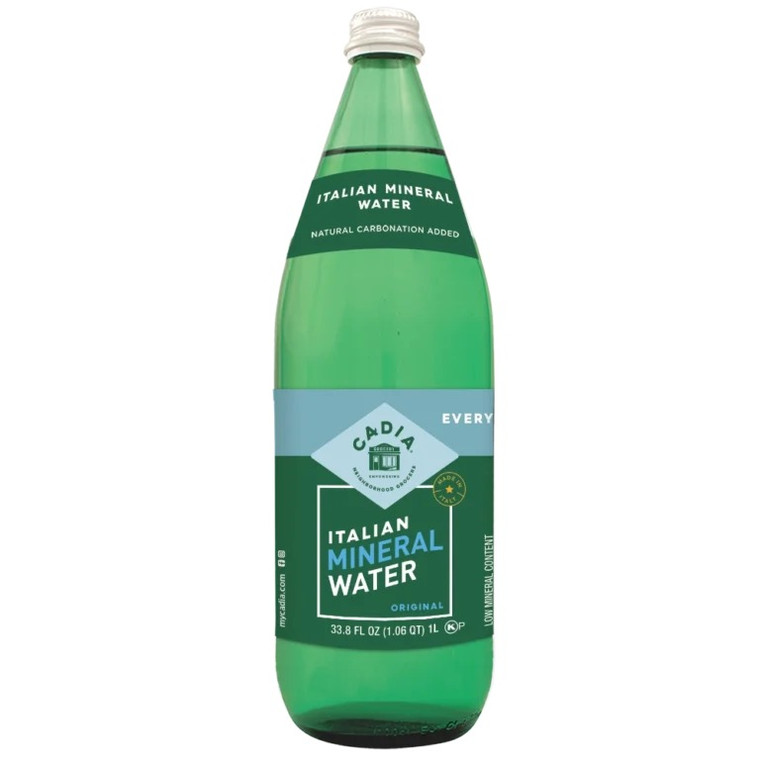
Cadia
Italian Sparkling Mineral Water - 33.8 oz
Drawn from an ancient Roman spring in the Northern Apennine Mountains, this sparkling mineral water travels from one of Italy's most storied geological regions directly to your glass — with nothing added beyond what the earth provides: pure mineral water and natural carbon dioxide.
- Versatile beyond the glass: Use as a cocktail mixer for mojitos and Bellinis, as a carbonation source in baking and cooking, or as a crisp pairing alongside meals.
- Source-verified Italian spring water: Bottled at an ancient Roman spring in the Apennine foothills, carrying natural minerals from the aquifer with no added flavors, sweeteners, or synthetic carbonation — only naturally occurring CO₂.
- Certified Organic and Kosher: Dual-certified for shoppers who expect verified standards from every item in their basket, including water.
Sourced from an ancient Roman spring nestled in the foothills of Italy's Northern Apennine Mountains, this Cadia Italian Sparkling Mineral Water brings centuries of geological filtration into every bottle. The spring's natural mineral profile and native carbonation are preserved as-is — no synthetic additives, no added flavors, and no blended tap sources.
Each 33.8 fl oz bottle (a full liter-plus) is Organic-certified and Kosher-certified, making it one of the few bottled waters on the market to carry both designations simultaneously. The natural CO₂ provides a fine, clean effervescence — lighter in most comparisons to aggressively carbonated commercial sparkling waters — which makes it equally at home at the dinner table, the bar cart, or the kitchen counter as a cooking ingredient. Italian mineral waters with Apennine mountain sourcing have historically provided calcium, magnesium, and bicarbonate from the rock strata they pass through, though specific mineral levels for this SKU were not listed on the manufacturer page.
Its neutral mineral character and reliable carbonation make it a natural base for sparkling cocktails (Bellinis, Aperol spritzes, mojitos), a leavening aid in crêpe and pancake batters, and a palate-cleansing companion to rich or acidic foods. Pair with cheese boards, cured meats, or use in place of club soda wherever a cleaner mineral profile is preferred over sodium-heavy alternatives.
Store at room temperature; refrigerate after opening and consume promptly. Suitable for Organic and Kosher dietary frameworks.
Ingredients: Natural Mineral Water, Natural Carbon Dioxide.
Common Questions
How does this sparkling mineral water differ from standard club soda or commercial sparkling water?
Club soda is tap water that has been filtered and artificially carbonated, then dosed with added minerals like sodium bicarbonate or potassium sulfate to mimic a mineral profile — none of those minerals are naturally present. Commercial sparkling waters such as La Croix or Sparkling Ice are also artificially carbonated and often contain added flavors or sweeteners. This water uses only two ingredients: natural mineral water and natural carbon dioxide, both drawn from the same ancient Roman spring source in the Northern Apennine Mountains. The carbonation level tends to be finer and less aggressive than many mass-market sparkling waters, and because there are no added sodium compounds, it serves as a cleaner substitute in recipes or cocktails where sodium content from club soda would be undesirable.
What minerals are typically found in Northern Apennine mountain spring water, and why do they matter?
Water that percolates through the limestone and dolomite rock strata common to Italy's Apennine range typically accumulates calcium, magnesium, and bicarbonate ions through a process called mineral leaching, where slightly acidic rainwater dissolves soluble compounds from the surrounding rock over years or decades. Calcium in mineral water contributes to daily intake targets — the EU sets a standard of 150 mg per liter as a threshold for a 'calcium-rich' designation — while magnesium supports over 300 enzymatic reactions in the body including ATP synthesis and muscle contraction. Bicarbonate (HCO3-) acts as a natural pH buffer, which is one reason mineral waters with higher bicarbonate content are often recommended as digestive aids. Specific mineral concentrations for this SKU were not published on the manufacturer page, so customers seeking exact numbers for medical or dietary tracking purposes should contact the brand directly or consult the label on the bottle.
What does the Organic certification mean for a bottled water, and why is it significant?
USDA Organic certification for water is relatively rare and meaningful precisely because most bottled water brands do not pursue it — the certification requires that the source water is free from synthetic pesticide runoff, prohibited substances, and contamination from non-organic agricultural practices, and that the entire handling and bottling process meets USDA National Organic Program standards. For a spring water, this also implies third-party auditing of the watershed and sourcing environment, not just the final product. The Kosher certification adds a second independent verification layer, confirming that the ingredients, production equipment, and facility handling meet rabbinical standards for purity and non-contamination. Holding both certifications simultaneously is uncommon in the bottled water category and provides consumers with two independent supply-chain audits rather than relying solely on brand claims.
Can this water be used as a cooking ingredient, and does carbonation survive heat?
Yes — carbonated mineral water has a well-documented role as a leavening and texture agent in batters. When used in crêpe, pancake, tempura, or waffle batter in place of still water or milk, the dissolved CO2 creates small gas pockets as the batter hits heat, producing a lighter, more open crumb structure. The carbonation does dissipate rapidly above roughly 60°C (140°F), so the bubbles themselves are not what survives cooking — it is the physical expansion of those gas pockets before they escape that does the textural work, similar in mechanism to the role of baking soda. For cold applications — sparkling cocktails like Aperol spritzes, Bellinis, or mojitos — the water functions as a direct substitute for club soda with the advantage of a cleaner, lower-sodium mineral profile. In recipes calling for club soda by volume, a 1:1 substitution works without any other adjustments.
Is this water suitable for keto, paleo, or other structured diet protocols?
Yes, with no qualifications. The product contains zero calories, zero carbohydrates, zero sugars, zero protein, and zero fat — its two ingredients are water and CO2, neither of which conflicts with any macronutrient-based diet framework including ketogenic, paleo, carnivore, Whole30, or low-FODMAP protocols. The Organic certification makes it compatible with dietary frameworks that prioritize clean sourcing and absence of synthetic agricultural inputs. Because it carries no added sodium (unlike many club sodas), it is also suitable for individuals managing sodium intake. The Kosher certification extends its suitability to those following Jewish dietary law without any additional verification needed.
How should this water be stored, and how quickly should it be consumed after opening?
Unopened bottles can be stored at room temperature away from direct sunlight and strong odor sources, as PET and glass bottles can absorb ambient compounds over extended exposure. Once opened, carbonated mineral water loses CO2 progressively — even with the cap replaced, most of the effervescence will be noticeably diminished within 24 to 48 hours and largely gone within 72 hours. Refrigerating the bottle after opening slows CO2 escape because gas solubility in water increases at lower temperatures, giving cold water a greater capacity to retain dissolved gas. For best carbonation, store upright after opening and minimize the headspace by consuming a portion and resealing promptly.
What does 'native carbonation' mean, and how is it different from added carbonation?
Native or natural carbonation means the CO2 present in the water originates from the same geological source as the water itself — in this case, volcanic or geothermal activity associated with the Apennine spring system releases CO2 that dissolves into the groundwater under pressure before it reaches the surface. When the water is bottled, that naturally occurring CO2 is captured and reintroduced at the same concentration to maintain consistency, which is standard practice even for 'naturally sparkling' waters because pressure conditions change during extraction. This is fundamentally different from artificially carbonated water, where CO2 from an industrial or food-grade tank is injected into still water that had no original carbonation. The practical difference is that native carbonation tends to produce finer, smaller bubbles and a softer mouthfeel compared to the larger, more aggressive bubbles common in artificially carbonated products.
Each 33.8 fl oz bottle (a full liter-plus) is Organic-certified and Kosher-certified, making it one of the few bottled waters on the market to carry both designations simultaneously. The natural CO₂ provides a fine, clean effervescence — lighter in most comparisons to aggressively carbonated commercial sparkling waters — which makes it equally at home at the dinner table, the bar cart, or the kitchen counter as a cooking ingredient. Italian mineral waters with Apennine mountain sourcing have historically provided calcium, magnesium, and bicarbonate from the rock strata they pass through, though specific mineral levels for this SKU were not listed on the manufacturer page.
Its neutral mineral character and reliable carbonation make it a natural base for sparkling cocktails (Bellinis, Aperol spritzes, mojitos), a leavening aid in crêpe and pancake batters, and a palate-cleansing companion to rich or acidic foods. Pair with cheese boards, cured meats, or use in place of club soda wherever a cleaner mineral profile is preferred over sodium-heavy alternatives.
Store at room temperature; refrigerate after opening and consume promptly. Suitable for Organic and Kosher dietary frameworks.
Ingredients: Natural Mineral Water, Natural Carbon Dioxide.
Common Questions
How does this sparkling mineral water differ from standard club soda or commercial sparkling water?
Club soda is tap water that has been filtered and artificially carbonated, then dosed with added minerals like sodium bicarbonate or potassium sulfate to mimic a mineral profile — none of those minerals are naturally present. Commercial sparkling waters such as La Croix or Sparkling Ice are also artificially carbonated and often contain added flavors or sweeteners. This water uses only two ingredients: natural mineral water and natural carbon dioxide, both drawn from the same ancient Roman spring source in the Northern Apennine Mountains. The carbonation level tends to be finer and less aggressive than many mass-market sparkling waters, and because there are no added sodium compounds, it serves as a cleaner substitute in recipes or cocktails where sodium content from club soda would be undesirable.
What minerals are typically found in Northern Apennine mountain spring water, and why do they matter?
Water that percolates through the limestone and dolomite rock strata common to Italy's Apennine range typically accumulates calcium, magnesium, and bicarbonate ions through a process called mineral leaching, where slightly acidic rainwater dissolves soluble compounds from the surrounding rock over years or decades. Calcium in mineral water contributes to daily intake targets — the EU sets a standard of 150 mg per liter as a threshold for a 'calcium-rich' designation — while magnesium supports over 300 enzymatic reactions in the body including ATP synthesis and muscle contraction. Bicarbonate (HCO3-) acts as a natural pH buffer, which is one reason mineral waters with higher bicarbonate content are often recommended as digestive aids. Specific mineral concentrations for this SKU were not published on the manufacturer page, so customers seeking exact numbers for medical or dietary tracking purposes should contact the brand directly or consult the label on the bottle.
What does the Organic certification mean for a bottled water, and why is it significant?
USDA Organic certification for water is relatively rare and meaningful precisely because most bottled water brands do not pursue it — the certification requires that the source water is free from synthetic pesticide runoff, prohibited substances, and contamination from non-organic agricultural practices, and that the entire handling and bottling process meets USDA National Organic Program standards. For a spring water, this also implies third-party auditing of the watershed and sourcing environment, not just the final product. The Kosher certification adds a second independent verification layer, confirming that the ingredients, production equipment, and facility handling meet rabbinical standards for purity and non-contamination. Holding both certifications simultaneously is uncommon in the bottled water category and provides consumers with two independent supply-chain audits rather than relying solely on brand claims.
Can this water be used as a cooking ingredient, and does carbonation survive heat?
Yes — carbonated mineral water has a well-documented role as a leavening and texture agent in batters. When used in crêpe, pancake, tempura, or waffle batter in place of still water or milk, the dissolved CO2 creates small gas pockets as the batter hits heat, producing a lighter, more open crumb structure. The carbonation does dissipate rapidly above roughly 60°C (140°F), so the bubbles themselves are not what survives cooking — it is the physical expansion of those gas pockets before they escape that does the textural work, similar in mechanism to the role of baking soda. For cold applications — sparkling cocktails like Aperol spritzes, Bellinis, or mojitos — the water functions as a direct substitute for club soda with the advantage of a cleaner, lower-sodium mineral profile. In recipes calling for club soda by volume, a 1:1 substitution works without any other adjustments.
Is this water suitable for keto, paleo, or other structured diet protocols?
Yes, with no qualifications. The product contains zero calories, zero carbohydrates, zero sugars, zero protein, and zero fat — its two ingredients are water and CO2, neither of which conflicts with any macronutrient-based diet framework including ketogenic, paleo, carnivore, Whole30, or low-FODMAP protocols. The Organic certification makes it compatible with dietary frameworks that prioritize clean sourcing and absence of synthetic agricultural inputs. Because it carries no added sodium (unlike many club sodas), it is also suitable for individuals managing sodium intake. The Kosher certification extends its suitability to those following Jewish dietary law without any additional verification needed.
How should this water be stored, and how quickly should it be consumed after opening?
Unopened bottles can be stored at room temperature away from direct sunlight and strong odor sources, as PET and glass bottles can absorb ambient compounds over extended exposure. Once opened, carbonated mineral water loses CO2 progressively — even with the cap replaced, most of the effervescence will be noticeably diminished within 24 to 48 hours and largely gone within 72 hours. Refrigerating the bottle after opening slows CO2 escape because gas solubility in water increases at lower temperatures, giving cold water a greater capacity to retain dissolved gas. For best carbonation, store upright after opening and minimize the headspace by consuming a portion and resealing promptly.
What does 'native carbonation' mean, and how is it different from added carbonation?
Native or natural carbonation means the CO2 present in the water originates from the same geological source as the water itself — in this case, volcanic or geothermal activity associated with the Apennine spring system releases CO2 that dissolves into the groundwater under pressure before it reaches the surface. When the water is bottled, that naturally occurring CO2 is captured and reintroduced at the same concentration to maintain consistency, which is standard practice even for 'naturally sparkling' waters because pressure conditions change during extraction. This is fundamentally different from artificially carbonated water, where CO2 from an industrial or food-grade tank is injected into still water that had no original carbonation. The practical difference is that native carbonation tends to produce finer, smaller bubbles and a softer mouthfeel compared to the larger, more aggressive bubbles common in artificially carbonated products.
- __Owner:
- TCFarm
- __Storage_Location:
- Dry
- __Volume:
- 400
- __badge:
- Organic