


Italian Style Chicken Meatballs - 10 oz
Amylu FoodsWrite a Review
Amylu Foods
Italian Style Chicken Meatballs - 10 oz
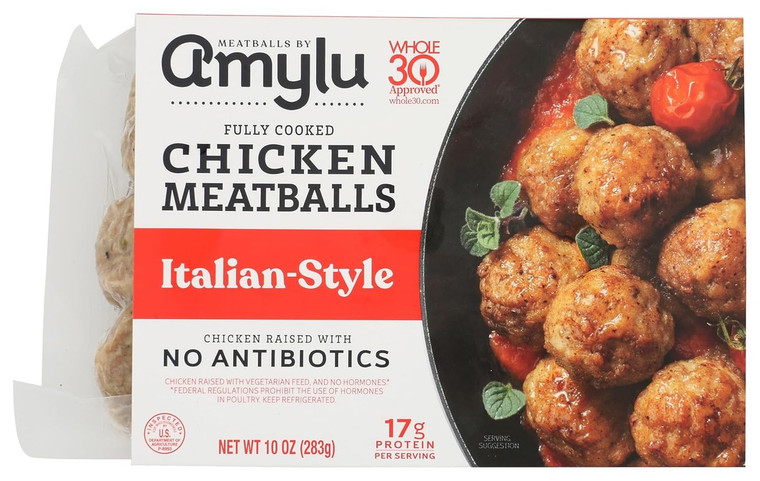
AmyLu Italian Style Chicken Meatballs are fully cooked, ready-to-heat meatballs made with chicken as the primary protein — no pork fillers, no beef extenders, and no artificial preservatives. They're seasoned in an Italian herb profile and designed to go from package to plate in minutes, making them a practical choice for weeknight dinners without sacrificing ingredient integrity.
- Use cases: Ideal over pasta, in a sub roll, sliced onto flatbread, simmered in marinara, or added to sheet-pan meals — the fully cooked format means no raw-meat prep and no guesswork on doneness.
- Key differentiator: Chicken-based rather than pork- or beef-based, giving a leaner meatball profile compared to traditional Italian-style options made with higher-fat ground meats.
- Diet suitability: A fit for shoppers reducing red meat or pork, including those following poultry-forward diets, and anyone looking for a convenient protein that pairs broadly across cuisines.
AmyLu Italian Style Chicken Meatballs deliver the satisfying texture and herb-forward flavor of a classic Italian meatball in a leaner, fully cooked format that requires no prep beyond reheating. Each 10 oz package contains chicken meatballs seasoned with Italian-style herbs and spices — no artificial colors, no artificial preservatives, and no pork or beef fillers muddying the ingredient story.
The fully cooked format is genuinely useful: reheat in a skillet, in the microwave, or directly in a simmering sauce, and they're table-ready in under 10 minutes. The 10 oz package is sized for a single-meal or meal-prep portion, making it easy to keep on hand in the refrigerated section for quick weeknight execution.
For shoppers who typically reach for conventional pork-and-beef meatballs at the grocery store, chicken meatballs represent a meaningfully different nutritional and culinary choice — lower in saturated fat and lighter in flavor, while still delivering the density and bite that makes meatballs satisfying. AmyLu has built their line specifically around poultry, so the formulation reflects that focus rather than a reformulated afterthought.
Keep refrigerated. Use by the date printed on the package. Once opened, consume within 3 days.
INGREDIENTS — Chicken Raised Without Antibiotics, Contains 2% Or Less Of: Salt, Spices, Vinegar, Garlic, Extract Of Rosemary.
Common Questions
How do chicken meatballs compare nutritionally to traditional pork-and-beef meatballs?
A typical pork-and-beef meatball contains roughly 6-9 grams of total fat and 2.5-4 grams of saturated fat per ounce, while chicken-based meatballs generally come in at 3-5 grams of total fat and 0.5-1.5 grams of saturated fat per ounce, depending on the ratio of dark to white meat used. Protein content is broadly comparable, hovering around 6-8 grams per ounce for both formats. The practical difference is in the saturated fat load over a full serving: a 4-5 meatball portion from a chicken product can deliver 30-50% less saturated fat than the equivalent beef-pork portion. The flavor profile also shifts — chicken meatballs are lighter and let herb and cheese seasonings come forward more clearly, while pork-beef blends carry a richer, more mineral-forward taste. If you're tracking total fat for caloric or cardiovascular reasons, the swap is meaningful across a week of meals.
What is the role of Parmesan cheese in the meatball formulation, and does it affect sodium levels?
Parmesan serves two functional purposes in a meatball recipe: it adds umami depth through its naturally occurring glutamates, and it contributes to binding alongside the egg component, improving texture and cohesion during cooking. Aged Parmesan is one of the higher-sodium cheeses available, containing roughly 330-450 mg of sodium per ounce, so even a small inclusion in the formulation adds measurably to the per-serving sodium count. Most commercially prepared meatballs land between 400-700 mg of sodium per serving — confirming the exact figure from the Nutrition Facts panel on the package is important if you're managing sodium intake. The breadcrumb component also typically contributes sodium, so the cumulative effect of both ingredients is worth checking. For low-sodium meal planning, the sauce you pair with these matters as much as the meatball itself.
Do these meatballs fit a keto, paleo, or low-carb diet?
The presence of breadcrumbs in the ingredient list means these meatballs are not strictly compliant with keto or paleo protocols, both of which exclude grain-derived binders. Breadcrumbs in a standard meatball formulation typically contribute 3-6 grams of carbohydrate per serving, which is modest but not negligible for someone targeting under 20 grams of net carbs daily. Paleo frameworks specifically exclude grain-based fillers, so even a small breadcrumb inclusion disqualifies the product under strict interpretation. For low-carb eating that isn't strictly keto — often called a moderate low-carb approach targeting 50-100 grams of carbs per day — the carb contribution from these meatballs is unlikely to be disruptive. Always confirm the carbohydrate count on the current Nutrition Facts panel, as formulations can change between production runs.
What dishes can I make with these chicken meatballs, and do I need to adjust cooking times compared to raw meatballs?
Because these meatballs are fully cooked, the goal in any recipe is reheating to an internal temperature of 165°F rather than cooking through from raw — this shortens active time considerably and reduces the risk of overcooking. Classic applications include spaghetti and meatballs, meatball subs, and baked ziti, where the meatballs can be added directly to simmering sauce and warmed through in 8-10 minutes. They also work well in non-Italian contexts: slice them in half for a grain bowl topping, add them to a vegetable soup in the last few minutes of cooking, or use them in a slider format with provolone and roasted peppers. One adaptation worth noting: because they won't release fat into your sauce the way raw beef-pork meatballs do, the sauce itself may taste slightly leaner — adding a drizzle of olive oil or a knob of butter to the sauce at the end can compensate for that. Skillet reheating with a splash of broth or sauce prevents them from drying out.
How can I verify the no-artificial-preservatives claim, and what does that actually mean?
The cleanest way to verify the claim is to read the ingredient list on the package directly — if synthetic preservatives like sodium benzoate, potassium sorbate, BHA, BHT, or sodium nitrite are absent from the list, the claim holds for that production batch. 'No artificial preservatives' does not mean the product is free of all preservation mechanisms: refrigeration itself is a preservative method, and ingredients like salt and Parmesan cheese contribute inherent antimicrobial and moisture-control properties that extend shelf life naturally. The FDA does not require brands to define 'artificial' with precision, so the phrase functions as a negative claim (these specific synthetic compounds are excluded) rather than a positive certification (this product meets a defined standard). If you want a higher-order verification, look for third-party certifications on the label such as Non-GMO Project Verified or a USDA Organic seal, which involve audited ingredient sourcing. In the absence of those certifications, the ingredient list remains your most reliable source of truth.
Why does AmyLu use chicken specifically, and what does that mean for the fat composition compared to red meat meatballs?
Chicken as a base protein is naturally lower in total fat and saturated fat than an equal weight of ground pork or beef, which is the primary nutritional rationale for poultry-focused product lines. The fat in chicken is also compositionally different: it carries a higher proportion of monounsaturated and polyunsaturated fatty acids relative to saturated fat compared to beef, though the absolute omega-3 content in a conventionally raised chicken product is generally modest — typically under 100 mg per 3-ounce serving versus 150-300 mg in grass-finished beef. The brand's focus on poultry means the formulation is built around chicken's specific binding and moisture characteristics rather than adapted from a red meat recipe, which tends to produce a better texture outcome. For shoppers avoiding red meat for religious, ethical, or health reasons, a dedicated poultry meatball line offers a structurally coherent alternative rather than a product that treats chicken as a secondary option.
What is the shelf life once the package is opened, and are there any food safety considerations specific to cooked poultry products?
Once opened, these meatballs should be consumed within 3 days when stored in the refrigerator at or below 40°F — this is consistent with USDA guidelines for cooked poultry products stored under refrigeration. The 3-day window is shorter than many consumers expect and reflects the fact that fully cooked poultry, while safe at purchase, has less antimicrobial headroom than cured or fermented products once the packaging seal is broken. If you won't use the full package within 3 days, freezing the remainder immediately after opening is the safest option; cooked meatballs maintain acceptable quality frozen for 1-3 months. When reheating, the USDA recommends reaching an internal temperature of 165°F for all poultry products, including those that were previously fully cooked. A quick-read thermometer inserted into the center of the meatball is the reliable check — visual cues like browning or steam are not sufficient indicators of reaching that temperature.
- __Owner:
- TCFarm
- __Storage_Location:
- Frozen
- __Volume:
- 300
- __badge:
- Gluten Free