


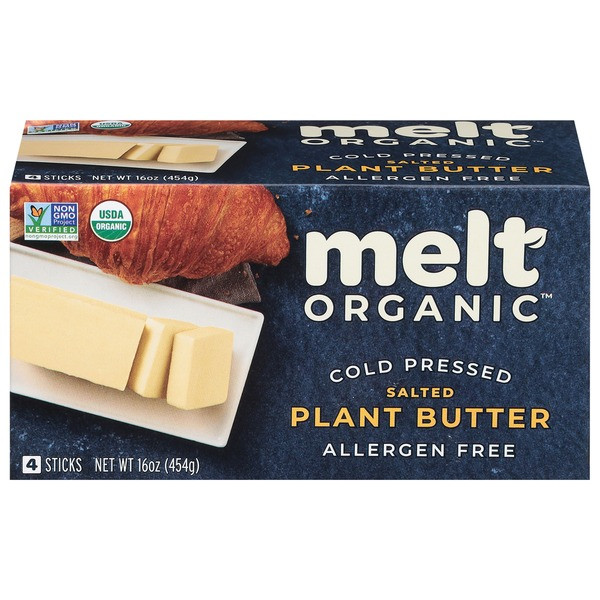
Organic Plant-Based Butter Sticks - 16 oz
MeltWrite a Review
Melt
Organic Plant-Based Butter Sticks - 16 oz
- Cut, measure, and bake straight from the stick — ideal for cookies, pie crusts, sautéing, and any recipe that calls for a measured tablespoon of butter
- Certified USDA Organic and free from dairy, making it one of the few plant-based butter sticks that earns both credentials simultaneously
- Verified dairy-free, vegan, and gluten-free — suitable for plant-based, lactose-intolerant, and allergy-conscious households
Melt Organic's plant-based butter sticks are built for bakers and cooks who need a dairy-free option that actually behaves like butter. Each stick is pre-portioned to the same dimensions as a standard quarter-pound dairy butter stick — meaning no guesswork when a recipe calls for half a cup or a tablespoon. The 4-count package delivers the same kitchen utility you'd expect from conventional sticks, without animal products or synthetic additives.
Certified USDA Organic, dairy-free, and vegan, these sticks occupy a narrow space in the plant-based butter category: most dairy-free spreads come in tubs, not sticks, which creates friction for anyone following a recipe precisely. Melt's stick format removes that friction entirely — score it into tablespoons, drop it into a roux, or grate it cold into pastry dough the way any trained baker would with conventional butter.
Each stick delivers 80 calories and 9g of fat per serving, with 0g sugar and 0g protein — a macronutrient profile consistent with a fat-only cooking ingredient. Suitable for vegan, dairy-free, and gluten-free diets. Store per package instructions; plant-based butter sticks are typically kept refrigerated and used within the recommended window after opening.
INGREDIENTS: Expeller-Pressed Organic Oil Blend (Coconut, Hi-Oleic Sunflower, Sustainable Ethical Palm Fruit) Water, Sunflower Lecithin, Organic Natural Flavor, Tocopherols (Plant-Based Preservative), Organic Annatto Extract (Color).
Common Questions
How does Melt Organic plant-based butter compare nutritionally to conventional dairy butter?
Conventional unsalted dairy butter delivers roughly 102 calories, 11.5g of total fat, and 7.2g of saturated fat per tablespoon, along with small amounts of fat-soluble vitamins A, D, E, and K2 that occur naturally in milk fat. Melt Organic plant-based sticks come in at 80 calories and 9g of fat per serving, with 0g sugar and 0g protein — a leaner fat profile per serving. The key structural difference is the fat source: dairy butter is predominantly animal-derived saturated fat, while plant-based butters like Melt rely on a blend of plant oils, which shifts the saturated-to-unsaturated fat ratio depending on the specific oils used. Neither version provides meaningful protein or carbohydrates, so both function as pure fat-delivery ingredients in cooking. Confirm the exact oil blend on the current package, as that determines the specific fatty acid profile you're consuming.
What gives plant-based butter its solid stick form, and does it behave the same as dairy butter in baking?
Dairy butter holds its stick shape because milk fat is solid at refrigerator temperatures, melting near 90–95°F. Plant-based stick butters achieve a similar solid-at-cold, soft-at-room-temperature behavior through a combination of higher-melting saturated plant fats — commonly coconut oil or palm oil — blended with liquid oils to approximate dairy butter's texture curve. Because Melt is formulated specifically in stick format rather than a tub spread, it is designed to perform in baking applications that require cold, firm fat: cutting into pie crust, creaming with sugar, or grating into scone dough. The 1:1 substitution ratio holds for most recipes — one stick equals half a cup or 8 tablespoons, the same as a standard quarter-pound dairy butter stick. Some high-fat pastries like croissants or laminated doughs may show minor differences in layering because plant fats have different plasticity ranges than butterfat, but for cookies, cakes, quick breads, and sautéing, the performance is functionally equivalent.
Is Melt Organic plant-based butter suitable for keto, paleo, or whole-food plant-based diets?
For keto, the critical metric is net carbs and fat density: Melt's 0g sugar and ~9g fat per serving make it compatible with ketogenic macro targets, provided the specific oil blend does not include any added starches or fillers — verify the current ingredient list to confirm. Paleo compatibility depends on interpretation: strict paleo excludes industrial seed oils like canola or sunflower, so the oil sources in Melt's blend matter; if the formula relies primarily on coconut oil it would pass most paleo frameworks, but seed-oil-heavy formulas would not. Whole-food plant-based (WFPB) diets as defined by researchers like Dr. Caldwell Esselstyn and the Physicians Committee for Responsible Medicine generally discourage added oils of any kind due to their caloric density and minimal micronutrient content, so Melt would not fit a strict WFPB protocol. Vegan and dairy-free diets are squarely in scope — the product carries certified vegan and dairy-free status. Gluten-free diets are also covered by the product's certified gluten-free status.
How do I substitute Melt Organic sticks for dairy butter in specific recipes like pie crust, buttercream frosting, or pan sauces?
For pie crust and biscuits, use Melt sticks straight from the refrigerator exactly as you would cold dairy butter — cube it, keep it cold, and work quickly; the goal of keeping fat solid until it hits the oven is the same regardless of fat source. For buttercream frosting, start with Melt at room temperature and beat it the same way you would dairy butter; plant-based fats can sometimes produce a slightly softer frosting at warm room temperatures, so chilling the finished frosting for 15 minutes before piping helps maintain structure. For pan sauces and beurre blanc-style emulsified sauces, Melt works for the initial emulsification, but plant-based butters are generally more prone to breaking at high heat than dairy butter, so finishing the sauce off direct heat and working quickly preserves the emulsion. For sautéing vegetables or making a roux for béchamel, the substitution is 1:1 with no adjustment needed. Cookie and cake recipes are the most forgiving — substitute 1:1 by volume or weight and expect results very close to the dairy original.
What do the USDA Organic, vegan, and gluten-free certifications actually verify on this product?
USDA Organic certification means every agricultural ingredient in the product was grown without synthetic pesticides, synthetic fertilizers, or genetic engineering, and that the operation passed a third-party audit by a USDA-accredited certifying agent — it is not a self-declared label. The vegan certification (typically through organizations like Vegan Action or the Vegan Society) verifies no animal-derived ingredients and, depending on the certifier, no animal testing of ingredients — it requires documentation review and periodic re-certification. Gluten-free certification from a body like GFFS (Gluten-Free Food Service) or NSF International requires the product to test below 10–20 parts per million of gluten, a stricter threshold than the FDA's 20 ppm labeling rule; Melt's certified gluten-free status means it has cleared that testing. Dairy-free certification confirms the absence of milk proteins and lactose at a verified threshold, which matters for people with casein allergies or lactose intolerance who need more than a manufacturer's claim. Taken together, these four certifications represent four separate third-party verification chains, not a single blanket claim.
Why does the stick format matter for recipe accuracy compared to tub plant-based butters?
Most plant-based butter alternatives are sold in tub or spread format, which creates a measurement problem for recipe-following: scooping a soft spread from a tub into a measuring cup introduces air and inconsistency, and most recipes written for dairy butter assume the cook is cutting tablespoons off a stick or using a stick's pre-marked wrapper as a guide. A standard American butter stick is 4 inches long, weighs 113 grams, and is equal to exactly 8 tablespoons or half a cup — dimensions that inform both the wrapper markings and the way recipe authors communicate quantity. Melt's sticks match those same dimensions, so the wrapper markings align with standard recipe calls. For baking, where butter quantity affects fat-to-flour ratios that determine texture and spread, that precision matters more than it does in general cooking. Tub spreads also often contain more water than stick butter to maintain spreadability, which can throw off moisture ratios in baked goods; stick-format plant butters are generally formulated to closer approximate the lower water content of conventional stick butter.
Are there any allergens or oil sources in Melt Organic sticks that consumers with specific sensitivities should watch for?
The ingredients field for this product was not readable at the time this page was written — the data source returned a placeholder rather than the actual ingredient list, so a complete allergen statement cannot be confirmed here. Based on Melt Organic's publicly documented formulations, the product has historically contained coconut oil, palm fruit oil, flaxseed oil, and sunflower lecithin, but formulations can change and the current version should be verified against the physical package. People with tree nut sensitivities should note that coconut is classified as a tree nut by the FDA even though it is botanically a fruit, and some individuals with tree nut allergies react to coconut. Flaxseed is not a top-9 FDA allergen but does cause reactions in some people. The safest course is to read the current allergen statement on the package before use, and to contact Melt Organic directly if you have a severe allergy, as manufacturing facility cross-contact information is not captured in retailer product data.
- __Owner:
- TCFarm
- __Storage_Location:
- Refrigerated
- __Volume:
- 400