
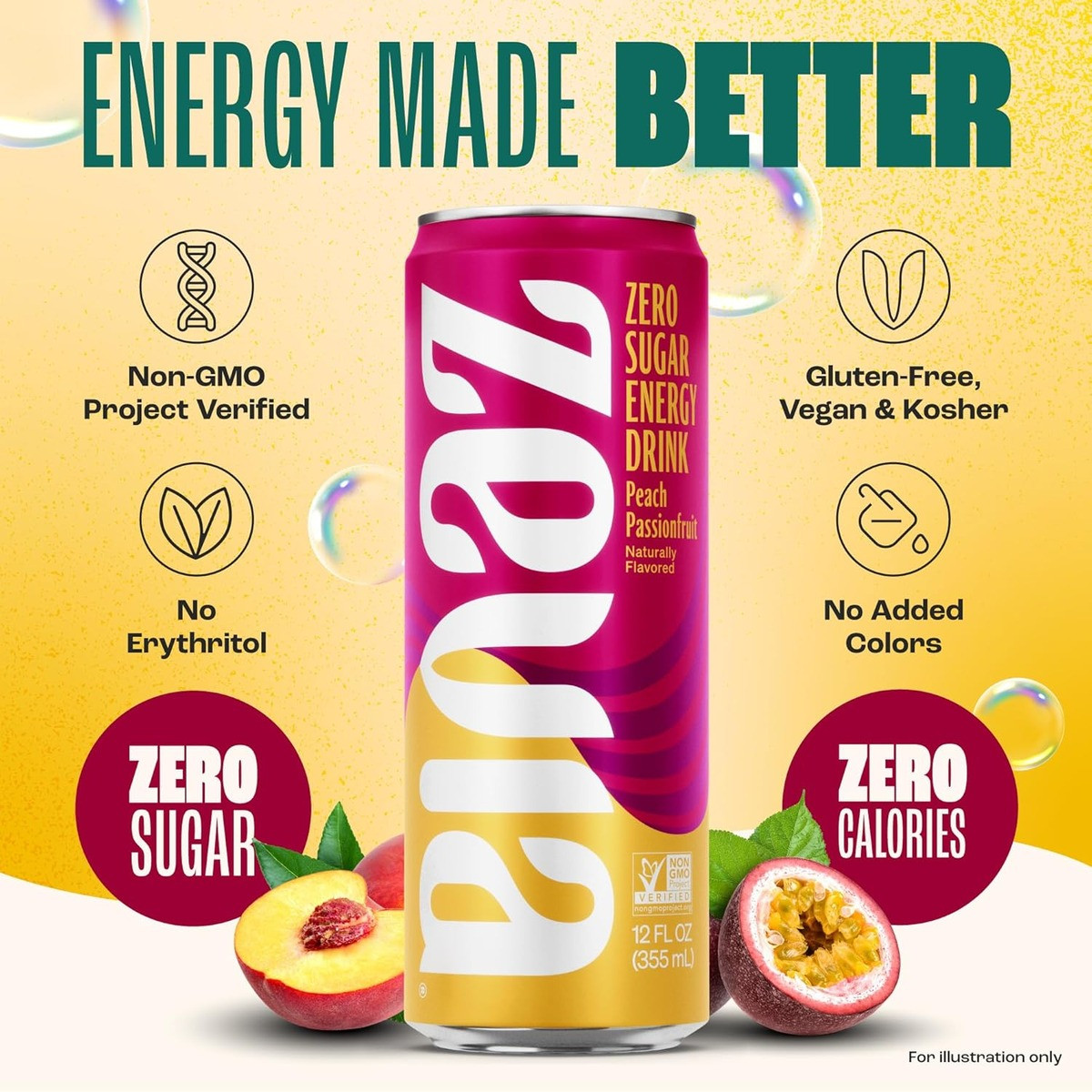


Peach Passionfruit Energy Drink - 12 fl oz
Zevia
$2.89
Below are the available bulk discount rates for each individual item when you purchase a certain amount
- Buy 2 - 5 and get 5% off
- Buy 6 - 11 and get 10% off
- Buy 12 or above and get 20% off
(No reviews yet)

Write a Review
Zevia
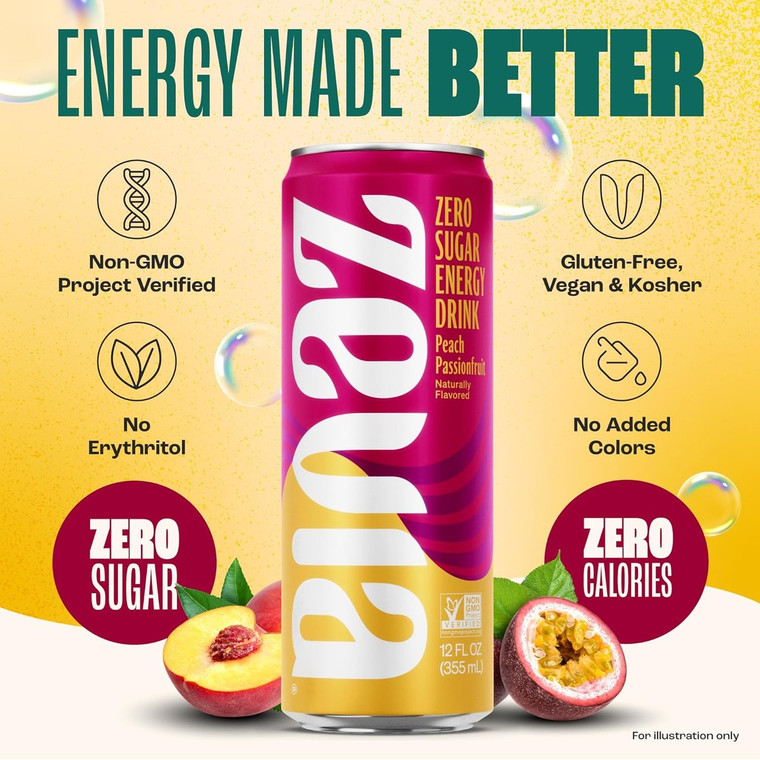
Peach Passionfruit Energy Drink - 12 fl oz
120mg of clean caffeine. Zero sugar. Five ingredients you can actually pronounce. Zevia's Peach Passion Energy Drink delivers a real caffeine kick — sourced from tea leaves, not synthetic stimulants — sweetened purely with stevia extract and nothing else. No sugar, no erythritol, no artificial sweeteners, no fake colors. Just carbonated water, natural flavors, citric acid, stevia extract, and caffeine. That's it.
- A tropical, tangy pick-me-up for mornings, workouts, or afternoon focus — zero calories means it fits any eating window without compromise
- Sweetened exclusively with stevia extract — unlike most zero-sugar energy drinks that hide erythritol or artificial sweeteners in the fine print, Zevia uses stevia alone with no bulking agents
- Non-GMO Project Verified, certified gluten-free, vegan, and kosher — fits keto, gluten-free, and plant-based lifestyles
Most zero-sugar energy drinks play a shell game: swap out cane sugar, add erythritol, toss in some artificial sweeteners, and call it clean. Zevia doesn't. The Peach Passion Energy Drink is sweetened with stevia extract — full stop. No erythritol, no sucralose, no acesulfame potassium, no mystery bulking agents. The ingredient list has five items, every one of them recognizable.
Each can delivers 120mg of caffeine sourced from tea leaves — roughly equivalent to a strong cup of coffee — with zero calories and zero sugar. The flavor profile leans tropical: sweet peach with a tangy passion fruit edge, carried by clean carbonation. It's a legitimate energy drink that doesn't ask you to trade off your label standards to get a boost.
Most mainstream energy drinks — even the ones marketed as "sugar-free" — rely on erythritol or a blend of artificial sweeteners to hit their sweetness target. Erythritol has come under increased scrutiny from researchers studying cardiovascular markers, and artificial sweeteners remain a polarizing choice for health-conscious shoppers. Zevia sidesteps both by using stevia extract as its sole sweetener, making it one of the few natural energy drinks genuinely compatible with a clean-label standard — and a standout option for anyone shopping for a keto-friendly energy drink with no artificial ingredients. While no specific geographic origin is disclosed for the ingredients, Zevia's Non-GMO Project Verified certification provides an additional layer of supply-chain transparency for shoppers who care about sourcing standards.
Nutritional snapshot: 0 calories, 0g sugar, 0g fat, 0g protein, 120mg caffeine (from tea leaves) per can. Fits keto, gluten-free, vegan, and kosher dietary frameworks — though it does not align with strict paleo or carnivore protocols that exclude stevia or carbonated beverages.
Store at room temperature. Chill before serving.
Ingredients: Carbonated Water, Natural Flavors, Citric Acid, Stevia Extract, And Caffeine.
Common Questions
How does 120mg of caffeine from tea leaves compare to coffee and other energy drinks?
A standard 8oz brewed coffee contains roughly 80-100mg of caffeine, while a 12oz strong drip coffee can reach 120-150mg, so one can of Zevia Energy sits squarely in strong-coffee territory. By comparison, a Red Bull 12oz delivers about 114mg, a Monster 16oz delivers 160mg, and a Celsius 12oz delivers 200mg — meaning Zevia's 120mg is a moderate, functional dose rather than a maximum-stimulation formula. The caffeine here is sourced from tea leaves rather than synthesized anhydrous caffeine, though functionally the caffeine molecule is identical regardless of source. For most adults, 120mg falls well within the 400mg daily safe intake ceiling established by the FDA.
What is stevia extract and how does it produce sweetness without calories or sugar?
Stevia extract is derived from the leaves of Stevia rebaudiana, a South American plant, through a water-based extraction process that isolates compounds called steviol glycosides — most commonly rebaudioside A (Reb A) and rebaudioside M (Reb M). These glycosides bind to sweet taste receptors on the tongue (specifically the T1R2/T1R3 receptor complex) with an intensity roughly 200-400 times greater than sucrose, which is why vanishingly small amounts produce noticeable sweetness. Because steviol glycosides are not metabolized for energy by the body, they contribute zero calories and have no effect on blood glucose or insulin response in controlled studies. The FDA classifies high-purity steviol glycosides as Generally Recognized As Safe (GRAS).
Why does the absence of erythritol matter, and what does the research say about it?
Erythritol is a sugar alcohol widely used as a bulking sweetener in zero-sugar products because it provides body and mouthfeel that pure high-intensity sweeteners lack. A 2023 study published in Nature Medicine found that elevated plasma erythritol levels were independently associated with increased risk of major adverse cardiovascular events (MACE), including heart attack and stroke, in a cohort of over 4,000 patients. The study also demonstrated that consuming a single erythritol-sweetened drink raised blood erythritol levels substantially for two or more days. Zevia Energy contains no erythritol — its five-ingredient list is Carbonated Water, Natural Flavors, Citric Acid, Stevia Extract, and Caffeine — so consumers concerned about erythritol exposure can drink it without that tradeoff. This is increasingly rare in the zero-sugar energy category, where erythritol or blends of erythritol plus sucralose are nearly universal.
Is Zevia Energy genuinely keto-compatible, and does stevia affect ketosis?
With 0 grams of sugar, 0 grams of net carbohydrates, and 0 calories, Zevia Energy presents no macronutrient barrier to ketosis. The relevant question for strict keto practitioners is whether stevia triggers an insulin response that could interrupt fat metabolism, and multiple controlled studies — including a 2018 review in the journal Nutrients — found that stevia consumption does not produce a meaningful insulin or blood glucose response in healthy adults. The caffeine content (120mg per can) may actually support keto goals, as caffeine has been shown to increase fat oxidation rates in some studies. There are no hidden carbohydrate sources like maltodextrin or dextrose in this formula, which are common fillers in flavored sparkling waters and energy drinks that undermine keto compatibility despite front-label claims.
How do I verify Zevia's Non-GMO and other certifications — what do those labels actually mean?
The Non-GMO Project Verified seal means Zevia's product and supply chain have been audited by the Non-GMO Project, a third-party nonprofit that requires ingredient traceability documentation and ongoing testing — it is not a self-declared label. The Gluten-Free certification is issued by the Gluten Intolerance Group (GIG), which requires products to test below 10 parts per million (ppm) of gluten, a stricter threshold than the FDA's 20ppm standard for gluten-free labeling. The Kosher certification comes from the Orthodox Union (OU), one of the most widely recognized kosher certifying agencies globally, whose mark requires ingredient review and facility inspection. The Zero Sugar and erythritol-free claims are verifiable against the published ingredient list, which contains no sugar-derived ingredients and no erythritol, xylitol, or other sugar alcohols.
How does Zevia Energy compare to mainstream sugar-free energy drinks like Monster Zero or Reign on ingredients?
Monster Zero Ultra uses a sweetener blend of erythritol, sucralose, and acesulfame potassium, plus added B vitamins, taurine, ginseng, and L-carnitine — its ingredient list runs to roughly 20+ items. Reign Total Body Fuel similarly uses sucralose as its primary sweetener and adds BCAAs, CoQ10, and electrolytes. Zevia Energy's entire ingredient list is five items: Carbonated Water, Natural Flavors, Citric Acid, Stevia Extract, and Caffeine. For consumers who want a single-sweetener, short-ingredient-list energy drink without erythritol or artificial sweeteners, Zevia is one of very few options in the mainstream market. The tradeoff is that Zevia does not include added B vitamins, taurine, or amino acids that some buyers look for in an energy drink.
Can people sensitive to artificial sweeteners or sugar alcohols drink Zevia Energy without digestive concerns?
Sugar alcohols like erythritol, xylitol, and sorbitol are known to cause gastrointestinal distress — including bloating, gas, and diarrhea — in sensitive individuals because they are incompletely absorbed in the small intestine and fermented by gut bacteria. Zevia Energy contains none of these compounds. Stevia extract, the only sweetener used here, is absorbed differently: steviol glycosides pass through the small intestine largely intact and are metabolized by gut bacteria into steviol before being excreted, a process that has not been linked to the osmotic laxative effect associated with sugar alcohols in the published literature. Citric acid, present in small amounts as an acidulant, can be a trigger for acid reflux in highly sensitive individuals, but at typical beverage concentrations it is well tolerated by most people. Those with rare stevia allergies (related to Asteraceae/Compositae plant family sensitivities) should consult a physician before consuming.
Each can delivers 120mg of caffeine sourced from tea leaves — roughly equivalent to a strong cup of coffee — with zero calories and zero sugar. The flavor profile leans tropical: sweet peach with a tangy passion fruit edge, carried by clean carbonation. It's a legitimate energy drink that doesn't ask you to trade off your label standards to get a boost.
Most mainstream energy drinks — even the ones marketed as "sugar-free" — rely on erythritol or a blend of artificial sweeteners to hit their sweetness target. Erythritol has come under increased scrutiny from researchers studying cardiovascular markers, and artificial sweeteners remain a polarizing choice for health-conscious shoppers. Zevia sidesteps both by using stevia extract as its sole sweetener, making it one of the few natural energy drinks genuinely compatible with a clean-label standard — and a standout option for anyone shopping for a keto-friendly energy drink with no artificial ingredients. While no specific geographic origin is disclosed for the ingredients, Zevia's Non-GMO Project Verified certification provides an additional layer of supply-chain transparency for shoppers who care about sourcing standards.
Nutritional snapshot: 0 calories, 0g sugar, 0g fat, 0g protein, 120mg caffeine (from tea leaves) per can. Fits keto, gluten-free, vegan, and kosher dietary frameworks — though it does not align with strict paleo or carnivore protocols that exclude stevia or carbonated beverages.
Store at room temperature. Chill before serving.
Ingredients: Carbonated Water, Natural Flavors, Citric Acid, Stevia Extract, And Caffeine.
Common Questions
How does 120mg of caffeine from tea leaves compare to coffee and other energy drinks?
A standard 8oz brewed coffee contains roughly 80-100mg of caffeine, while a 12oz strong drip coffee can reach 120-150mg, so one can of Zevia Energy sits squarely in strong-coffee territory. By comparison, a Red Bull 12oz delivers about 114mg, a Monster 16oz delivers 160mg, and a Celsius 12oz delivers 200mg — meaning Zevia's 120mg is a moderate, functional dose rather than a maximum-stimulation formula. The caffeine here is sourced from tea leaves rather than synthesized anhydrous caffeine, though functionally the caffeine molecule is identical regardless of source. For most adults, 120mg falls well within the 400mg daily safe intake ceiling established by the FDA.
What is stevia extract and how does it produce sweetness without calories or sugar?
Stevia extract is derived from the leaves of Stevia rebaudiana, a South American plant, through a water-based extraction process that isolates compounds called steviol glycosides — most commonly rebaudioside A (Reb A) and rebaudioside M (Reb M). These glycosides bind to sweet taste receptors on the tongue (specifically the T1R2/T1R3 receptor complex) with an intensity roughly 200-400 times greater than sucrose, which is why vanishingly small amounts produce noticeable sweetness. Because steviol glycosides are not metabolized for energy by the body, they contribute zero calories and have no effect on blood glucose or insulin response in controlled studies. The FDA classifies high-purity steviol glycosides as Generally Recognized As Safe (GRAS).
Why does the absence of erythritol matter, and what does the research say about it?
Erythritol is a sugar alcohol widely used as a bulking sweetener in zero-sugar products because it provides body and mouthfeel that pure high-intensity sweeteners lack. A 2023 study published in Nature Medicine found that elevated plasma erythritol levels were independently associated with increased risk of major adverse cardiovascular events (MACE), including heart attack and stroke, in a cohort of over 4,000 patients. The study also demonstrated that consuming a single erythritol-sweetened drink raised blood erythritol levels substantially for two or more days. Zevia Energy contains no erythritol — its five-ingredient list is Carbonated Water, Natural Flavors, Citric Acid, Stevia Extract, and Caffeine — so consumers concerned about erythritol exposure can drink it without that tradeoff. This is increasingly rare in the zero-sugar energy category, where erythritol or blends of erythritol plus sucralose are nearly universal.
Is Zevia Energy genuinely keto-compatible, and does stevia affect ketosis?
With 0 grams of sugar, 0 grams of net carbohydrates, and 0 calories, Zevia Energy presents no macronutrient barrier to ketosis. The relevant question for strict keto practitioners is whether stevia triggers an insulin response that could interrupt fat metabolism, and multiple controlled studies — including a 2018 review in the journal Nutrients — found that stevia consumption does not produce a meaningful insulin or blood glucose response in healthy adults. The caffeine content (120mg per can) may actually support keto goals, as caffeine has been shown to increase fat oxidation rates in some studies. There are no hidden carbohydrate sources like maltodextrin or dextrose in this formula, which are common fillers in flavored sparkling waters and energy drinks that undermine keto compatibility despite front-label claims.
How do I verify Zevia's Non-GMO and other certifications — what do those labels actually mean?
The Non-GMO Project Verified seal means Zevia's product and supply chain have been audited by the Non-GMO Project, a third-party nonprofit that requires ingredient traceability documentation and ongoing testing — it is not a self-declared label. The Gluten-Free certification is issued by the Gluten Intolerance Group (GIG), which requires products to test below 10 parts per million (ppm) of gluten, a stricter threshold than the FDA's 20ppm standard for gluten-free labeling. The Kosher certification comes from the Orthodox Union (OU), one of the most widely recognized kosher certifying agencies globally, whose mark requires ingredient review and facility inspection. The Zero Sugar and erythritol-free claims are verifiable against the published ingredient list, which contains no sugar-derived ingredients and no erythritol, xylitol, or other sugar alcohols.
How does Zevia Energy compare to mainstream sugar-free energy drinks like Monster Zero or Reign on ingredients?
Monster Zero Ultra uses a sweetener blend of erythritol, sucralose, and acesulfame potassium, plus added B vitamins, taurine, ginseng, and L-carnitine — its ingredient list runs to roughly 20+ items. Reign Total Body Fuel similarly uses sucralose as its primary sweetener and adds BCAAs, CoQ10, and electrolytes. Zevia Energy's entire ingredient list is five items: Carbonated Water, Natural Flavors, Citric Acid, Stevia Extract, and Caffeine. For consumers who want a single-sweetener, short-ingredient-list energy drink without erythritol or artificial sweeteners, Zevia is one of very few options in the mainstream market. The tradeoff is that Zevia does not include added B vitamins, taurine, or amino acids that some buyers look for in an energy drink.
Can people sensitive to artificial sweeteners or sugar alcohols drink Zevia Energy without digestive concerns?
Sugar alcohols like erythritol, xylitol, and sorbitol are known to cause gastrointestinal distress — including bloating, gas, and diarrhea — in sensitive individuals because they are incompletely absorbed in the small intestine and fermented by gut bacteria. Zevia Energy contains none of these compounds. Stevia extract, the only sweetener used here, is absorbed differently: steviol glycosides pass through the small intestine largely intact and are metabolized by gut bacteria into steviol before being excreted, a process that has not been linked to the osmotic laxative effect associated with sugar alcohols in the published literature. Citric acid, present in small amounts as an acidulant, can be a trigger for acid reflux in highly sensitive individuals, but at typical beverage concentrations it is well tolerated by most people. Those with rare stevia allergies (related to Asteraceae/Compositae plant family sensitivities) should consult a physician before consuming.
- __Storage_Location:
- Dry
- __Volume:
- 400
- __Owner:
- TCFarm
- __badge:
- Non-GMO