


Premium Cocktail Cherries - 16 oz
Traverse City Whiskey Co
$19.99
(No reviews yet)

Write a Review
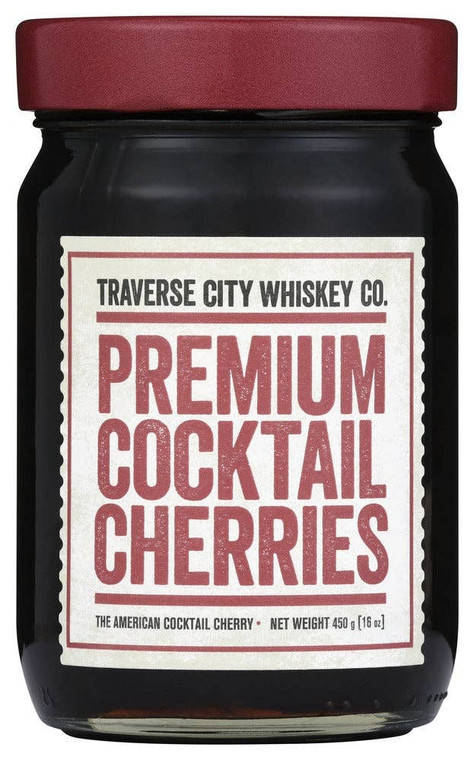
Traverse City Whiskey Co
Premium Cocktail Cherries - 16 oz
Grown in the cherry capital of the world, slow-cooked to a balance no maraschino can touch. Traverse City Whiskey Co. sources Balaton cherries — a tart Hungarian variety grown in Northern Michigan's ideal fruit belt — and slow-cooks them in-house in Traverse City. The result lands exactly between sweet and tart: complex enough to elevate a Manhattan or Old Fashioned, satisfying enough to eat straight from the jar. This is what cocktail cherries look like when a whiskey distillery makes them for their own bar first.
- Use cases: Drop one into a Manhattan, Old Fashioned, or Whiskey Sour; skewer over charcuterie; spoon over vanilla ice cream or a cheese board — the syrup is equally useful as a cocktail modifier.
- The real differentiator: Balaton cherries are a distinct tart variety (not commodity sweet cherries) grown in Michigan's Northern fruit belt — slow-cooked, not mass-brined in artificial dye and syrup the way conventional maraschino cherries are.
- Lifestyle fit: Shelf-stable pantry item; no refrigeration required before opening. A product of Michigan — made and grown in Traverse City and the surrounding Northern Michigan region.
Slow-cooked Balaton cherries from Northern Michigan's fruit belt, made by a whiskey distillery for its own bar first. Tart, complex, and a world apart from bleached, dyed maraschino cherries — equally at home in a cocktail glass or spooned straight from the jar.
Traverse City Whiskey Co. built their reputation on Northern Michigan-sourced spirits — and their cocktail cherries follow the same philosophy: start with a genuinely superior ingredient and don't overcomplicate it. Balaton cherries, a tart Hungarian variety that thrives in Northern Michigan's fruit belt, are slow-cooked in small batches in Traverse City to hit the precise balance between sweet and tart that commodity cocktail cherries routinely miss.
The standard cocktail cherry — the neon-red maraschino — is a bleached, artificially dyed sweet cherry brined in high-fructose corn syrup and red dye. It exists as a garnish, not a flavor. Traverse City's version is the opposite: a real fruit with its own acidity, depth, and color, slow-cooked to soften without collapsing, preserved in a syrup that works as a cocktail ingredient in its own right.
Each 16 oz jar is handmade in Traverse City, Michigan — the self-described cherry capital of the world — where the local Balaton cherry harvest drives both the distillery's fruit-forward spirits and these cocktail cherries. The syrup left in the jar carries the same flavor profile as the cherries and can be used as a sweetener in any cocktail recipe that calls for simple syrup or cherry liqueur.
Retailers and fellow distillers have made these a consistent bestseller. One buyer — a distillery owner in California — noted they stock Traverse City's cherries in their own bar because they're "THAT GOOD." Another retailer called them "one of our favorites and best sellers."
Customer Reviews: Wholesale buyers and bartenders consistently describe these as a standout product across the bar and specialty food categories.
Store at room temperature before opening; refrigerate after opening. 16 oz jar. Product of Michigan.
Ingredients: Cherries, water, sugar, black carrot extract, citric acid, cherry concentrate, natural flavoring, bourbon whiskey (contains no alcohol). May contain pits or pit fragments.
Common Questions
What exactly is a Balaton cherry, and how does it differ from the cherries used in standard maraschino cocktail cherries?
Balaton is a tart cherry variety originally developed in Hungary and brought to the United States in the 1980s by researchers at Michigan State University, who recognized that Northern Michigan's climate and soil closely matched the cherry's native growing conditions. Unlike the Rainier or Bing sweet cherries used in most commercial cocktail cherries, Balaton has a naturally high acidity and a deep burgundy color that comes from its own anthocyanin pigments — no dye required. Standard maraschino cherries are made from a different process entirely: sweet cherries are bleached in a sulfur dioxide brine to strip all color and flavor, then re-dyed with Red 40 and packed in high-fructose corn syrup. Balaton cherries retain their natural structure, flavor complexity, and color through the cooking process, which is why the finished product tastes like fruit rather than candy.
Can the syrup in the jar actually be used in cocktails, or is it just a packing liquid?
The syrup is a functional cocktail ingredient. Because it slow-cooks with the Balaton cherries, it absorbs the same tart-sweet flavor profile and carries residual cherry solids, making it a direct substitute for simple syrup anywhere you want cherry character — Old Fashioneds, Manhattans, Sours, or any recipe calling for cherry liqueur at a lower sugar intensity. Standard maraschino brine is corn syrup-forward with artificial cherry flavoring and is generally discarded or ignored by bartenders. The Traverse City syrup works as a sweetener and flavoring agent simultaneously, so a half-ounce added to a whiskey sour, for example, replaces both the simple syrup and any fruit modifier in the recipe.
How do these compare to other premium cocktail cherry brands like Luxardo or Fabbri Amarena?
Luxardo Maraschino cherries are made from Marasca cherries grown in Italy and preserved in a syrup made with Marasca cherry juice and sugar — no artificial colors or flavors. Fabbri Amarena cherries are also Italian, using Amarena wild cherries in a very sweet, dense syrup. Both are legitimate premium products with long histories. Traverse City's Balaton cherries are a distinctly American and specifically regional product — the variety was cultivated for Northern Michigan and is harvested there before processing in Traverse City. The flavor difference is meaningful: Balaton leans tarter and less candy-forward than Luxardo, and the syrup is less viscous than Fabbri's, making it easier to integrate into cocktails without over-sweetening. The choice between them is largely a matter of flavor preference and whether provenance matters to the buyer.
Are there any artificial ingredients, preservatives, or added colorings in these cherries?
The cherries are free of artificial dyes and high-fructose corn syrup, which are the two primary additives that define the commodity maraschino cherry. Traverse City has not published a complete ingredient list on their product pages, so the confirmed components are Balaton cherries, sugar, and water — citric acid and natural cherry juice may also be present as common ingredients in this style of preparation, but buyers who need a complete certified ingredient list for allergen or dietary reasons should confirm directly with the manufacturer before purchasing. The deep red color of the finished cherry is natural, coming from the Balaton variety's own anthocyanin pigments, not added coloring.
What cocktails are these cherries best suited for, and are there any drinks where they would not be the right choice?
These cherries work best in spirit-forward cocktails where the garnish contributes to flavor rather than just appearance — the Old Fashioned, Manhattan, Rob Roy, and Whiskey Sour are the most common applications, and the syrup can be incorporated directly into any of those builds. They also work well in a Singapore Sling or a Cherry Bounce-style punch where cherry flavor is structural. Where they may not be the right fit is in drinks that specifically call for the ultra-sweet, neutral sweetness of a traditional maraschino — some tiki recipes and retro garnishes use that flavor intentionally, and the Balaton's natural tartness would read differently. For a Shirley Temple or a classic ice cream sundae cherry, the visual and flavor profile is also not a match for the traditional presentation.
What does 'Product of Michigan' mean in practical terms, and how does that connect to Traverse City Whiskey Co.'s distillery operations?
The 'Product of Michigan' designation means the cherries are grown and processed within the state, specifically in the Northern Michigan fruit belt — the peninsula region between Lake Michigan and Grand Traverse Bay whose microclimate, moderated by lake effect weather patterns, produces conditions unusually well-suited to tart cherry cultivation. Michigan grows approximately 75 percent of the U.S. tart cherry crop in a typical harvest year, and the Traverse City area sits at the center of that production zone. Traverse City Whiskey Co. was founded in 2012 and has built its core spirits line around Northern Michigan fruit sourcing, so the cocktail cherries represent the same supply chain logic as their Cherry Whiskey and other fruit-forward expressions — local harvest processed locally rather than sourced from commodity brokers.
How should these cherries be stored, and what is the realistic shelf life once the jar is opened?
Unopened jars can be stored at room temperature, as the sugar concentration in the syrup acts as a preservative. Once opened, the jar should be refrigerated and the cherries kept submerged in the syrup, which continues to protect them from oxidation and microbial growth. A properly refrigerated, opened jar stored with cherries submerged in syrup will typically remain in good condition for two to three months, though the texture of the cherries will gradually soften over time. The syrup itself keeps longer and can be used after the cherries are gone. As with any fruit preserve, signs of fermentation (off smell, bubbling, cloudiness in a non-turbid syrup) are indicators to discard the product.
Traverse City Whiskey Co. built their reputation on Northern Michigan-sourced spirits — and their cocktail cherries follow the same philosophy: start with a genuinely superior ingredient and don't overcomplicate it. Balaton cherries, a tart Hungarian variety that thrives in Northern Michigan's fruit belt, are slow-cooked in small batches in Traverse City to hit the precise balance between sweet and tart that commodity cocktail cherries routinely miss.
The standard cocktail cherry — the neon-red maraschino — is a bleached, artificially dyed sweet cherry brined in high-fructose corn syrup and red dye. It exists as a garnish, not a flavor. Traverse City's version is the opposite: a real fruit with its own acidity, depth, and color, slow-cooked to soften without collapsing, preserved in a syrup that works as a cocktail ingredient in its own right.
Each 16 oz jar is handmade in Traverse City, Michigan — the self-described cherry capital of the world — where the local Balaton cherry harvest drives both the distillery's fruit-forward spirits and these cocktail cherries. The syrup left in the jar carries the same flavor profile as the cherries and can be used as a sweetener in any cocktail recipe that calls for simple syrup or cherry liqueur.
Retailers and fellow distillers have made these a consistent bestseller. One buyer — a distillery owner in California — noted they stock Traverse City's cherries in their own bar because they're "THAT GOOD." Another retailer called them "one of our favorites and best sellers."
Customer Reviews: Wholesale buyers and bartenders consistently describe these as a standout product across the bar and specialty food categories.
- "It may be a bit funny for one distillery to purchase cocktail cherries from another, but Traverse City Whiskey Co's cherries are THAT GOOD that I love stocking them for my own distillery's patrons and using them in our cocktails." — Bonnie, Verified Buyer
- "One of our favorites, and best sellers. Love these cherries! Love supporting small, especially when they make it this easy." — Geniece, Verified Buyer
- "These are amazing cherries. Order fulfillment was quick." — Jeremy, Verified Buyer
Store at room temperature before opening; refrigerate after opening. 16 oz jar. Product of Michigan.
Ingredients: Cherries, water, sugar, black carrot extract, citric acid, cherry concentrate, natural flavoring, bourbon whiskey (contains no alcohol). May contain pits or pit fragments.
Common Questions
What exactly is a Balaton cherry, and how does it differ from the cherries used in standard maraschino cocktail cherries?
Balaton is a tart cherry variety originally developed in Hungary and brought to the United States in the 1980s by researchers at Michigan State University, who recognized that Northern Michigan's climate and soil closely matched the cherry's native growing conditions. Unlike the Rainier or Bing sweet cherries used in most commercial cocktail cherries, Balaton has a naturally high acidity and a deep burgundy color that comes from its own anthocyanin pigments — no dye required. Standard maraschino cherries are made from a different process entirely: sweet cherries are bleached in a sulfur dioxide brine to strip all color and flavor, then re-dyed with Red 40 and packed in high-fructose corn syrup. Balaton cherries retain their natural structure, flavor complexity, and color through the cooking process, which is why the finished product tastes like fruit rather than candy.
Can the syrup in the jar actually be used in cocktails, or is it just a packing liquid?
The syrup is a functional cocktail ingredient. Because it slow-cooks with the Balaton cherries, it absorbs the same tart-sweet flavor profile and carries residual cherry solids, making it a direct substitute for simple syrup anywhere you want cherry character — Old Fashioneds, Manhattans, Sours, or any recipe calling for cherry liqueur at a lower sugar intensity. Standard maraschino brine is corn syrup-forward with artificial cherry flavoring and is generally discarded or ignored by bartenders. The Traverse City syrup works as a sweetener and flavoring agent simultaneously, so a half-ounce added to a whiskey sour, for example, replaces both the simple syrup and any fruit modifier in the recipe.
How do these compare to other premium cocktail cherry brands like Luxardo or Fabbri Amarena?
Luxardo Maraschino cherries are made from Marasca cherries grown in Italy and preserved in a syrup made with Marasca cherry juice and sugar — no artificial colors or flavors. Fabbri Amarena cherries are also Italian, using Amarena wild cherries in a very sweet, dense syrup. Both are legitimate premium products with long histories. Traverse City's Balaton cherries are a distinctly American and specifically regional product — the variety was cultivated for Northern Michigan and is harvested there before processing in Traverse City. The flavor difference is meaningful: Balaton leans tarter and less candy-forward than Luxardo, and the syrup is less viscous than Fabbri's, making it easier to integrate into cocktails without over-sweetening. The choice between them is largely a matter of flavor preference and whether provenance matters to the buyer.
Are there any artificial ingredients, preservatives, or added colorings in these cherries?
The cherries are free of artificial dyes and high-fructose corn syrup, which are the two primary additives that define the commodity maraschino cherry. Traverse City has not published a complete ingredient list on their product pages, so the confirmed components are Balaton cherries, sugar, and water — citric acid and natural cherry juice may also be present as common ingredients in this style of preparation, but buyers who need a complete certified ingredient list for allergen or dietary reasons should confirm directly with the manufacturer before purchasing. The deep red color of the finished cherry is natural, coming from the Balaton variety's own anthocyanin pigments, not added coloring.
What cocktails are these cherries best suited for, and are there any drinks where they would not be the right choice?
These cherries work best in spirit-forward cocktails where the garnish contributes to flavor rather than just appearance — the Old Fashioned, Manhattan, Rob Roy, and Whiskey Sour are the most common applications, and the syrup can be incorporated directly into any of those builds. They also work well in a Singapore Sling or a Cherry Bounce-style punch where cherry flavor is structural. Where they may not be the right fit is in drinks that specifically call for the ultra-sweet, neutral sweetness of a traditional maraschino — some tiki recipes and retro garnishes use that flavor intentionally, and the Balaton's natural tartness would read differently. For a Shirley Temple or a classic ice cream sundae cherry, the visual and flavor profile is also not a match for the traditional presentation.
What does 'Product of Michigan' mean in practical terms, and how does that connect to Traverse City Whiskey Co.'s distillery operations?
The 'Product of Michigan' designation means the cherries are grown and processed within the state, specifically in the Northern Michigan fruit belt — the peninsula region between Lake Michigan and Grand Traverse Bay whose microclimate, moderated by lake effect weather patterns, produces conditions unusually well-suited to tart cherry cultivation. Michigan grows approximately 75 percent of the U.S. tart cherry crop in a typical harvest year, and the Traverse City area sits at the center of that production zone. Traverse City Whiskey Co. was founded in 2012 and has built its core spirits line around Northern Michigan fruit sourcing, so the cocktail cherries represent the same supply chain logic as their Cherry Whiskey and other fruit-forward expressions — local harvest processed locally rather than sourced from commodity brokers.
How should these cherries be stored, and what is the realistic shelf life once the jar is opened?
Unopened jars can be stored at room temperature, as the sugar concentration in the syrup acts as a preservative. Once opened, the jar should be refrigerated and the cherries kept submerged in the syrup, which continues to protect them from oxidation and microbial growth. A properly refrigerated, opened jar stored with cherries submerged in syrup will typically remain in good condition for two to three months, though the texture of the cherries will gradually soften over time. The syrup itself keeps longer and can be used after the cherries are gone. As with any fruit preserve, signs of fermentation (off smell, bubbling, cloudiness in a non-turbid syrup) are indicators to discard the product.
- __Storage_Location:
- Dry
- __Volume:
- 400
- __Owner:
- TCFarm