

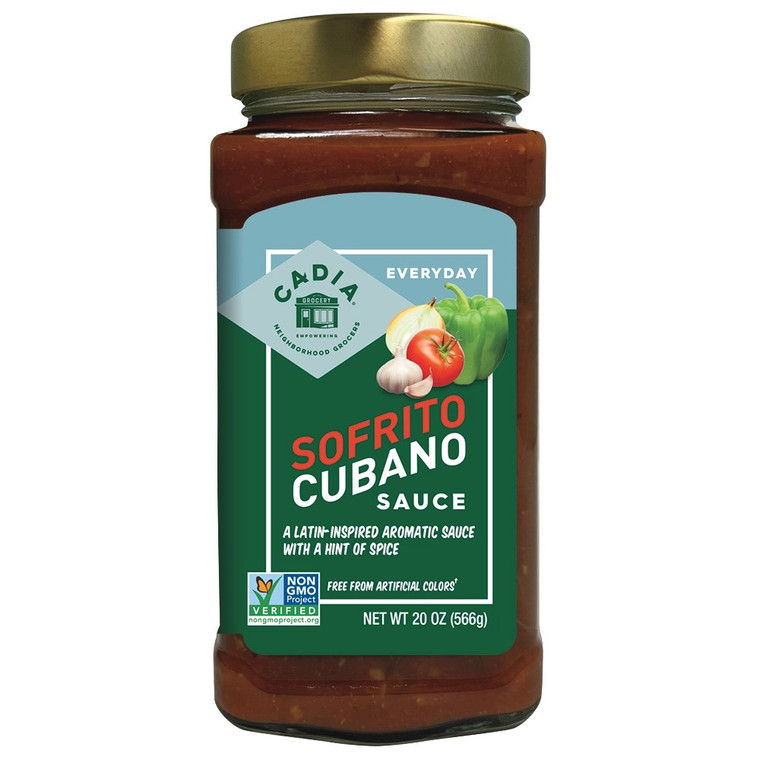
Sofrito Cubano Sauce - 20 oz
Cadia
$6.99
Below are the available bulk discount rates for each individual item when you purchase a certain amount
- Buy 2 - 2 and get 2% off
- Buy 3 - 5 and get 4% off
- Buy 6 or above and get 8% off
(No reviews yet)

Write a Review
Cadia
Sofrito Cubano Sauce - 20 oz
Built from fire-roasted tomatoes, sautéed onion, garlic, and green and red peppers, this Sofrito Cubano Sauce carries the same slow-built base Cuban cooks have simmered into rice, beans, and braised meats for generations — bright with lime juice, deep with fire-charred tomato. Cadia makes it with organic, non-GMO, sustainably sourced ingredients and sells it exclusively through independent neighborhood grocers, so every jar you bring home also keeps your local grocer's shelves stocked and competitive.
- Spoon it over rice and black beans, simmer with chicken or pork for a Cuban-style braise, or stir into ground beef for a quick picadillo
- Organic and Non-GMO Project Verified, built on fire-roasted tomatoes and fresh peppers with no artificial additives
- Vegan and gluten-free, fitting easily into plant-forward or allergen-conscious kitchens
Cadia Everyday's Sofrito Cubano Sauce brings the foundational flavor of authentic Cuban cooking into your kitchen - a rich saute of onion, garlic, and sweet bell peppers built on fire-roasted tomatoes and brightened with lime juice and warm spice. It's the sofrito base that gives Cuban rice, beans, and braised meats their signature depth.
Each 24 oz jar is organic, Non-GMO Project Verified, and made with sustainably sourced ingredients - fire-roasted tomatoes, onion, garlic, and red and green peppers - no artificial additives, fillers, or flavor enhancers. Cadia is sold exclusively through independently-owned neighborhood grocers, so choosing this jar also means choosing to keep your local grocer's shelves stocked with organic, non-GMO staples at accessible prices.
Spoon it straight over rice and black beans, simmer it with chicken thighs or pork shoulder for a Cuban-style braise, or stir it into ground beef for a quick picadillo. The tomato-forward, citrus-bright base adapts easily to weeknight cooking.
Vegan, gluten-free, and built for anyone reading every label on the shelf - though as a tomato- and onion-based sauce, it's not formulated as a keto, paleo, or carnivore-diet fit given its natural sugar content. Store in a cool, dry pantry before opening; refrigerate after opening.
Ingredients: Onion, Fire Roasted Tomatoes (Vine Ripened Fire Roasted Tomatoes, Tomato Juice, Salt, Calcium Chloride, Citric Acid), Water, Tomato Paste (Tomato Pulp, Citric Acid), Green Peppers, Red Peppers, Garlic, Lime Juice, Spices, Salt, Olive Oil, and Citric Acid.
Common Questions
How does this sofrito compare to conventional jarred sofrito or salsa bases?
Most conventional sofrito or Cuban-style cooking sauces list water or tomato concentrate as the first ingredient, then add sugar, modified starches, and preservatives like sodium benzoate or calcium disodium EDTA to extend shelf life. This jar lists onion first, followed by fire-roasted tomatoes, meaning the vegetable content itself carries the bulk of the volume rather than water or fillers. There's no added sugar, no starch thickeners, and no synthetic preservatives — the only stabilizing ingredients are citric acid and calcium chloride, both used in the tomato components for acidity balance and firmness, which are standard in canned tomato processing regardless of organic status. The tradeoff is a shorter shelf life after opening and a thinner, more rustic texture compared to gum-thickened commercial sauces.
Does fire-roasting the tomatoes actually change the nutrition, or is it just for flavor?
Fire-roasting is primarily a flavor step, but cooking tomatoes does have a documented nutritional effect on lycopene, the carotenoid responsible for their red color. Heat converts lycopene from its trans-isomer form into cis-isomers, which the body absorbs more efficiently, and this conversion is enhanced further when the tomatoes are cooked in the presence of oil, since lycopene is fat-soluble. This sauce includes olive oil in the ingredient list, which supports that absorption mechanism. So while fire-roasting itself is about char and depth of flavor, the combination of heat and oil in this formulation does make the lycopene more bioavailable than eating raw tomatoes alone.
Does this fit into a keto, paleo, or carnivore diet?
For paleo, this sauce fits cleanly — there's no grain, dairy, refined sugar, or legume-derived ingredient in the list, just vegetables, citrus, spices, and olive oil. For keto, it works in moderation but isn't a zero-carb condiment; tomatoes, onion, and peppers all carry natural sugars, so a typical 2-tablespoon serving will run in the low single digits of net carbs, meaning it's fine as a cooking base but shouldn't be poured on liberally if you're tracking strict daily carb limits. Carnivore is the one protocol this doesn't fit at all, since the entire product is plant-based with no animal-derived ingredients — it's meant to season meat, not replace it.
What dishes can I use this sofrito in beyond traditional Cuban recipes?
Beyond the classic Cuban rice and beans or ropa vieja, this sauce works as a one-to-one swap in any recipe that calls for a sautéed tomato-pepper-onion base — Spanish-style braised chicken, Dominican locrio, or a quick shakshuka where you crack eggs directly into the warmed sauce. It also holds up well stirred into ground beef or turkey for picadillo, or simmered with white beans and a bay leaf for a fast vegetarian stew. Because it's already cooked down, you can skip the step of sautéing your own onion and garlic in many recipes and add this straight to the pan, cutting active prep time without losing the aromatic base those dishes depend on.
What does the organic and Non-GMO Project Verified labeling actually guarantee here?
The USDA Organic seal means the vegetables — onion, tomatoes, peppers, garlic — were grown without synthetic pesticides or fertilizers and that the finished product contains no synthetic preservatives, colors, or flavor enhancers, verified through annual on-site inspections of growers and processors. Non-GMO Project Verification is a separate, more granular check specifically confirming that ingredients like the tomatoes and any derived components haven't been genetically engineered, tested through their standard for tracing high-risk crop inputs. Together these two marks cover different things: one governs farming and processing practices, the other governs genetic input sourcing, and both require third-party audits rather than self-declaration by the brand.
Why is the ingredient list on this sauce shorter than most shelf-stable sofritos?
Shelf-stable sofrito and sauce products typically need extra stabilizers because they're formulated to sit at room temperature for a year or more without separating or losing color. This version relies on citric acid for acidity control and calcium chloride to keep the tomato pieces firm during processing — both standard in canned tomato products, organic or not — rather than adding gums, starches, or chemical preservatives to extend shelf life further. That's also why the label specifies refrigeration after opening rather than claiming indefinite room-temperature storage once the jar is unsealed.
Each 24 oz jar is organic, Non-GMO Project Verified, and made with sustainably sourced ingredients - fire-roasted tomatoes, onion, garlic, and red and green peppers - no artificial additives, fillers, or flavor enhancers. Cadia is sold exclusively through independently-owned neighborhood grocers, so choosing this jar also means choosing to keep your local grocer's shelves stocked with organic, non-GMO staples at accessible prices.
Spoon it straight over rice and black beans, simmer it with chicken thighs or pork shoulder for a Cuban-style braise, or stir it into ground beef for a quick picadillo. The tomato-forward, citrus-bright base adapts easily to weeknight cooking.
Vegan, gluten-free, and built for anyone reading every label on the shelf - though as a tomato- and onion-based sauce, it's not formulated as a keto, paleo, or carnivore-diet fit given its natural sugar content. Store in a cool, dry pantry before opening; refrigerate after opening.
Ingredients: Onion, Fire Roasted Tomatoes (Vine Ripened Fire Roasted Tomatoes, Tomato Juice, Salt, Calcium Chloride, Citric Acid), Water, Tomato Paste (Tomato Pulp, Citric Acid), Green Peppers, Red Peppers, Garlic, Lime Juice, Spices, Salt, Olive Oil, and Citric Acid.
Common Questions
How does this sofrito compare to conventional jarred sofrito or salsa bases?
Most conventional sofrito or Cuban-style cooking sauces list water or tomato concentrate as the first ingredient, then add sugar, modified starches, and preservatives like sodium benzoate or calcium disodium EDTA to extend shelf life. This jar lists onion first, followed by fire-roasted tomatoes, meaning the vegetable content itself carries the bulk of the volume rather than water or fillers. There's no added sugar, no starch thickeners, and no synthetic preservatives — the only stabilizing ingredients are citric acid and calcium chloride, both used in the tomato components for acidity balance and firmness, which are standard in canned tomato processing regardless of organic status. The tradeoff is a shorter shelf life after opening and a thinner, more rustic texture compared to gum-thickened commercial sauces.
Does fire-roasting the tomatoes actually change the nutrition, or is it just for flavor?
Fire-roasting is primarily a flavor step, but cooking tomatoes does have a documented nutritional effect on lycopene, the carotenoid responsible for their red color. Heat converts lycopene from its trans-isomer form into cis-isomers, which the body absorbs more efficiently, and this conversion is enhanced further when the tomatoes are cooked in the presence of oil, since lycopene is fat-soluble. This sauce includes olive oil in the ingredient list, which supports that absorption mechanism. So while fire-roasting itself is about char and depth of flavor, the combination of heat and oil in this formulation does make the lycopene more bioavailable than eating raw tomatoes alone.
Does this fit into a keto, paleo, or carnivore diet?
For paleo, this sauce fits cleanly — there's no grain, dairy, refined sugar, or legume-derived ingredient in the list, just vegetables, citrus, spices, and olive oil. For keto, it works in moderation but isn't a zero-carb condiment; tomatoes, onion, and peppers all carry natural sugars, so a typical 2-tablespoon serving will run in the low single digits of net carbs, meaning it's fine as a cooking base but shouldn't be poured on liberally if you're tracking strict daily carb limits. Carnivore is the one protocol this doesn't fit at all, since the entire product is plant-based with no animal-derived ingredients — it's meant to season meat, not replace it.
What dishes can I use this sofrito in beyond traditional Cuban recipes?
Beyond the classic Cuban rice and beans or ropa vieja, this sauce works as a one-to-one swap in any recipe that calls for a sautéed tomato-pepper-onion base — Spanish-style braised chicken, Dominican locrio, or a quick shakshuka where you crack eggs directly into the warmed sauce. It also holds up well stirred into ground beef or turkey for picadillo, or simmered with white beans and a bay leaf for a fast vegetarian stew. Because it's already cooked down, you can skip the step of sautéing your own onion and garlic in many recipes and add this straight to the pan, cutting active prep time without losing the aromatic base those dishes depend on.
What does the organic and Non-GMO Project Verified labeling actually guarantee here?
The USDA Organic seal means the vegetables — onion, tomatoes, peppers, garlic — were grown without synthetic pesticides or fertilizers and that the finished product contains no synthetic preservatives, colors, or flavor enhancers, verified through annual on-site inspections of growers and processors. Non-GMO Project Verification is a separate, more granular check specifically confirming that ingredients like the tomatoes and any derived components haven't been genetically engineered, tested through their standard for tracing high-risk crop inputs. Together these two marks cover different things: one governs farming and processing practices, the other governs genetic input sourcing, and both require third-party audits rather than self-declaration by the brand.
Why is the ingredient list on this sauce shorter than most shelf-stable sofritos?
Shelf-stable sofrito and sauce products typically need extra stabilizers because they're formulated to sit at room temperature for a year or more without separating or losing color. This version relies on citric acid for acidity control and calcium chloride to keep the tomato pieces firm during processing — both standard in canned tomato products, organic or not — rather than adding gums, starches, or chemical preservatives to extend shelf life further. That's also why the label specifies refrigeration after opening rather than claiming indefinite room-temperature storage once the jar is unsealed.
- __Storage_Location:
- Dry
- __Volume:
- 662
- __Owner:
- TCFarm
- __badge:
- Organic