


Sunscreen Stick SPF 50
Babobotani
$13.79
(No reviews yet)

Write a Review
Babobotani
Sunscreen Stick SPF 50
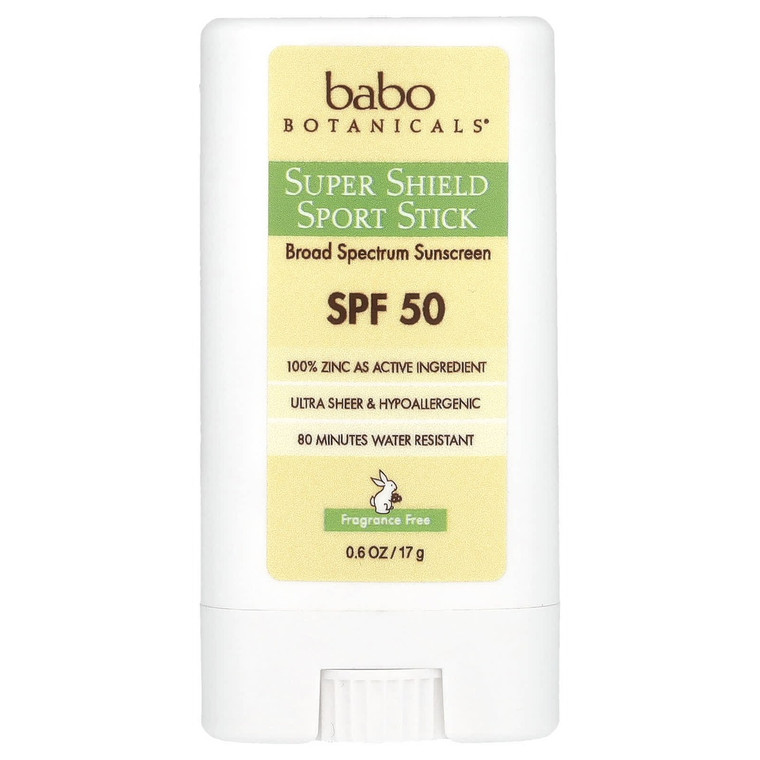
One of the first sunscreens ever to earn EWG Verified® status — babobotani's Super Shield Mineral Sunscreen Stick delivers broad spectrum SPF 50 protection through natural origin zinc oxide, backed by 17 plant-based ingredients including moisturizing sunflower oil and skin-calming calendula. Fragrance-free, dermatologist tested, and formulated for all ages, this pocket-sized stick goes on fast, stays on hard, and meets the most rigorous independent safety standards available in sunscreen today.
- Water-resistant up to 80 minutes — built for outdoor sport and active use; the compact stick format applies cleanly to face and body without mess or wasted product
- Triple-certified for safety: EWG Verified® (one of the first sunscreens ever), MADE SAFE® Certified, and NSF Certified with at least 70% organic ingredients — independently verified by three separate third-party bodies
- Suitable for the whole family — fragrance-free, cruelty-free, and featured in the EWG Sunscreen Guide for Best Recreational Sunscreens; appropriate for children and all skin types
babobotani's Super Shield Mineral Sunscreen Stick isn't just another zinc oxide stick — it's a convergence of three of the most rigorous independent safety certifications available in personal care: EWG Verified®, MADE SAFE® Certified, and NSF Certified (at least 70% organic ingredients). Most mineral sunscreens earn none of these. babobotani earned all three.
At SPF 50 broad spectrum, the active ingredient is natural origin zinc oxide — a physical UV blocker that sits on the skin's surface and deflects both UVA and UVB rays without synthetic chemical filters. The formula supports that block with 17 plant-based ingredients, including sunflower oil for skin conditioning and calendula, an herb used for centuries for its soothing properties on sensitive skin. The entire formula is fragrance-free — a meaningful choice, since synthetic fragrance is one of the most common allergens in topical products and is flagged by EWG as a concern ingredient in sunscreens that contain it.
The stick format is a deliberate design decision. Unlike lotions that require hands, spreading, and waiting, this mineral sunscreen stick applies directly to face and body in seconds — no rubbing, no mess, no bottle caps fumbled open at the trailhead. At 0.6 oz / 17g, it fits in a jersey pocket, a child's bag, or a first-aid kit. Water resistance is rated for up to 80 minutes, meeting the FDA's threshold for water-resistant sport sunscreen claims and making it suitable for swimming, sweating, and sustained outdoor activity.
Customers who use this product consistently highlight two things: the ease of on-the-go application and confidence from the EWG certification — especially for parents protecting children's skin. A minority of users with deeper skin tones note a visible white cast, which is typical of high-concentration mineral zinc oxide formulas.
Suitable for all ages, all skin types, and all-day outdoor activity. This is a shelf-stable topical product; store at room temperature and avoid leaving it in prolonged direct heat, such as a hot car, which can soften the stick. As a non-food topical, no specific geographic sourcing region is disclosed by the brand. Cruelty-free and dermatologist tested.
Common Questions
How does zinc oxide actually block UV rays, and why does babobotani use it instead of chemical filters like oxybenzone?
Zinc oxide is a physical (mineral) UV filter, meaning it sits on the surface of the skin and reflects or scatters both UVA and UVB radiation rather than absorbing it and converting it to heat the way chemical filters do. This makes it a true broad-spectrum blocker in a single ingredient. Oxybenzone, avobenzone, and similar chemical filters have been flagged by the EWG because they absorb into the bloodstream — the FDA reported in 2020 that oxybenzone reaches detectable plasma concentrations after a single day of use. Zinc oxide, by contrast, has a long safety record and minimal skin penetration, which is a primary reason it remains the only UV filter the FDA has proposed to classify as Generally Recognized as Safe and Effective (GRASE). The natural origin designation here refers to zinc oxide derived from zinc mineral sources rather than synthesized from petrochemical precursors.
What does EWG Verified actually require, and how does this sunscreen qualify as one of the first to earn it?
EWG Verified is a certification run by the Environmental Working Group, an independent nonprofit that maintains a database of over 90,000 personal care products. To earn the mark, a product must contain no ingredients flagged as EWG concerns, meet full transparency requirements for ingredient disclosure, and follow safe manufacturing practices — EWG estimates fewer than 2% of sunscreens in their database qualify. babobotani's Super Shield was among the earliest sunscreens to achieve this status, which is notable because most mineral sunscreens still fail EWG Verified due to the use of fragrance, preservatives like methylisothiazolinone, or nano-particle zinc oxide, which EWG flags separately from non-nano forms. The certification is publicly searchable on EWG's website under the product name, so buyers can independently verify the rating without relying on the brand's own claims.
What does the NSF Organic certification mean on a sunscreen, and what percentage of the formula does it cover?
NSF International's certification for personal care products (under NSF/ANSI 305) requires that at least 70% of the formula's ingredients meet organic standards — the same rigorous threshold that applies to organic food certification under the USDA National Organic Program. This is a meaningful bar because the personal care industry has no federally mandated definition of 'organic,' meaning brands can use the word loosely without third-party verification. NSF Certified on babobotani's stick confirms that the majority of inactive ingredients — including carriers like sunflower oil and botanical extracts like calendula — meet certified organic sourcing standards. The remaining ingredients up to 100% may include water, minerals like zinc oxide, or other components that are not certifiable as organic by their nature, not because they are synthetic or problematic.
The label says water resistant up to 80 minutes — what does that actually mean in practice, and when should I reapply?
The FDA defines two water resistance claims: 40 minutes and 80 minutes, both tested using a standardized swim test protocol where subjects spend alternating periods in water and are then tested for retained SPF. An 80-minute rating is the highest water resistance claim allowed under FDA sunscreen regulations and means the product maintained its labeled SPF through two 20-minute water immersion periods. In real-world use — swimming, sweating during a run, or playing in the ocean — the FDA and American Academy of Dermatology recommend reapplying every 80 minutes of water exposure or immediately after towel drying, regardless of the rated time. If you are not in water or sweating heavily, the standard guidance is reapplication every two hours of sun exposure, and always after drying off with a towel, which physically removes product from skin.
Some users mention a white cast — how significant is it, and which skin tones are most affected?
The white cast is a known tradeoff of non-nano zinc oxide at concentrations high enough to deliver SPF 50 protection. Zinc oxide particles that are not nano-sized (under 100 nm) remain visible on the skin surface rather than becoming optically transparent, which is precisely what gives mineral sunscreen its safety advantage but also its opacity. The effect is most visible on medium, olive, and deeper skin tones where the contrast between the white film and skin is greater — users with fair skin often find the cast barely noticeable. Some users reduce the cast by applying in thin, even layers and blending immediately after application rather than letting the product sit. No mineral-only formula at SPF 50 fully eliminates white cast, so for users with deeper skin tones, this is a real tradeoff to weigh against the safety profile of the ingredient.
Is this sunscreen appropriate for young children and babies, or is it formulated specifically for adults?
babobotani explicitly lists all ages as the target population, and the formulation choices — no fragrance, no chemical UV filters, no known common allergens — are consistent with guidelines for pediatric skin. The American Academy of Pediatrics recommends mineral sunscreens with zinc oxide or titanium dioxide as the preferred option for children, particularly those under two years of age, because the absorption profile of mineral filters is better characterized than chemical alternatives. The stick format is also practical for children: it allows direct, controlled application without requiring hands, which reduces the chance of product getting into eyes or mouth during application. The MADE SAFE certification adds an additional layer of assurance, as it screens for known neurotoxins, carcinogens, endocrine disruptors, and reproductive toxins — categories of particular concern when applying products to children's skin repeatedly over a season.
What is MADE SAFE certification, and how does it differ from EWG Verified on the same product?
MADE SAFE is a certification from the nonprofit Made Safe organization that screens every ingredient in a product against a database of known harmful chemicals including carcinogens, neurotoxins, endocrine disruptors, reproductive toxins, and environmental contaminants. Where EWG Verified focuses heavily on individual ingredient hazard scores within EWG's proprietary database and emphasizes consumer transparency, MADE SAFE evaluates the full ingredient list against multiple regulatory and scientific harm frameworks, including EPA lists, the National Toxicology Program, and peer-reviewed literature. Having both certifications means the formula has passed two independent, rigorous screening processes run by different organizations using different methodologies — a degree of redundant vetting that is rare in personal care. The NSF Organic certification is a third distinct credential focused on sourcing quality rather than toxicological safety, so the three certifications together cover safety screening, ingredient hazard profiling, and organic sourcing standards as separate dimensions of product quality.
At SPF 50 broad spectrum, the active ingredient is natural origin zinc oxide — a physical UV blocker that sits on the skin's surface and deflects both UVA and UVB rays without synthetic chemical filters. The formula supports that block with 17 plant-based ingredients, including sunflower oil for skin conditioning and calendula, an herb used for centuries for its soothing properties on sensitive skin. The entire formula is fragrance-free — a meaningful choice, since synthetic fragrance is one of the most common allergens in topical products and is flagged by EWG as a concern ingredient in sunscreens that contain it.
The stick format is a deliberate design decision. Unlike lotions that require hands, spreading, and waiting, this mineral sunscreen stick applies directly to face and body in seconds — no rubbing, no mess, no bottle caps fumbled open at the trailhead. At 0.6 oz / 17g, it fits in a jersey pocket, a child's bag, or a first-aid kit. Water resistance is rated for up to 80 minutes, meeting the FDA's threshold for water-resistant sport sunscreen claims and making it suitable for swimming, sweating, and sustained outdoor activity.
Customers who use this product consistently highlight two things: the ease of on-the-go application and confidence from the EWG certification — especially for parents protecting children's skin. A minority of users with deeper skin tones note a visible white cast, which is typical of high-concentration mineral zinc oxide formulas.
- "Love Babo and that it's EWG certified... Love that it's spf 50." — Elizabeth M, Verified Buyer
- "So convenient to have on the go. Makes application easy!" — Kimberly D, Verified Buyer
- "This is the only product that consistently works my kids... Great coverage and dry smooth texture." — Kaleena S, Verified Buyer
Suitable for all ages, all skin types, and all-day outdoor activity. This is a shelf-stable topical product; store at room temperature and avoid leaving it in prolonged direct heat, such as a hot car, which can soften the stick. As a non-food topical, no specific geographic sourcing region is disclosed by the brand. Cruelty-free and dermatologist tested.
Common Questions
How does zinc oxide actually block UV rays, and why does babobotani use it instead of chemical filters like oxybenzone?
Zinc oxide is a physical (mineral) UV filter, meaning it sits on the surface of the skin and reflects or scatters both UVA and UVB radiation rather than absorbing it and converting it to heat the way chemical filters do. This makes it a true broad-spectrum blocker in a single ingredient. Oxybenzone, avobenzone, and similar chemical filters have been flagged by the EWG because they absorb into the bloodstream — the FDA reported in 2020 that oxybenzone reaches detectable plasma concentrations after a single day of use. Zinc oxide, by contrast, has a long safety record and minimal skin penetration, which is a primary reason it remains the only UV filter the FDA has proposed to classify as Generally Recognized as Safe and Effective (GRASE). The natural origin designation here refers to zinc oxide derived from zinc mineral sources rather than synthesized from petrochemical precursors.
What does EWG Verified actually require, and how does this sunscreen qualify as one of the first to earn it?
EWG Verified is a certification run by the Environmental Working Group, an independent nonprofit that maintains a database of over 90,000 personal care products. To earn the mark, a product must contain no ingredients flagged as EWG concerns, meet full transparency requirements for ingredient disclosure, and follow safe manufacturing practices — EWG estimates fewer than 2% of sunscreens in their database qualify. babobotani's Super Shield was among the earliest sunscreens to achieve this status, which is notable because most mineral sunscreens still fail EWG Verified due to the use of fragrance, preservatives like methylisothiazolinone, or nano-particle zinc oxide, which EWG flags separately from non-nano forms. The certification is publicly searchable on EWG's website under the product name, so buyers can independently verify the rating without relying on the brand's own claims.
What does the NSF Organic certification mean on a sunscreen, and what percentage of the formula does it cover?
NSF International's certification for personal care products (under NSF/ANSI 305) requires that at least 70% of the formula's ingredients meet organic standards — the same rigorous threshold that applies to organic food certification under the USDA National Organic Program. This is a meaningful bar because the personal care industry has no federally mandated definition of 'organic,' meaning brands can use the word loosely without third-party verification. NSF Certified on babobotani's stick confirms that the majority of inactive ingredients — including carriers like sunflower oil and botanical extracts like calendula — meet certified organic sourcing standards. The remaining ingredients up to 100% may include water, minerals like zinc oxide, or other components that are not certifiable as organic by their nature, not because they are synthetic or problematic.
The label says water resistant up to 80 minutes — what does that actually mean in practice, and when should I reapply?
The FDA defines two water resistance claims: 40 minutes and 80 minutes, both tested using a standardized swim test protocol where subjects spend alternating periods in water and are then tested for retained SPF. An 80-minute rating is the highest water resistance claim allowed under FDA sunscreen regulations and means the product maintained its labeled SPF through two 20-minute water immersion periods. In real-world use — swimming, sweating during a run, or playing in the ocean — the FDA and American Academy of Dermatology recommend reapplying every 80 minutes of water exposure or immediately after towel drying, regardless of the rated time. If you are not in water or sweating heavily, the standard guidance is reapplication every two hours of sun exposure, and always after drying off with a towel, which physically removes product from skin.
Some users mention a white cast — how significant is it, and which skin tones are most affected?
The white cast is a known tradeoff of non-nano zinc oxide at concentrations high enough to deliver SPF 50 protection. Zinc oxide particles that are not nano-sized (under 100 nm) remain visible on the skin surface rather than becoming optically transparent, which is precisely what gives mineral sunscreen its safety advantage but also its opacity. The effect is most visible on medium, olive, and deeper skin tones where the contrast between the white film and skin is greater — users with fair skin often find the cast barely noticeable. Some users reduce the cast by applying in thin, even layers and blending immediately after application rather than letting the product sit. No mineral-only formula at SPF 50 fully eliminates white cast, so for users with deeper skin tones, this is a real tradeoff to weigh against the safety profile of the ingredient.
Is this sunscreen appropriate for young children and babies, or is it formulated specifically for adults?
babobotani explicitly lists all ages as the target population, and the formulation choices — no fragrance, no chemical UV filters, no known common allergens — are consistent with guidelines for pediatric skin. The American Academy of Pediatrics recommends mineral sunscreens with zinc oxide or titanium dioxide as the preferred option for children, particularly those under two years of age, because the absorption profile of mineral filters is better characterized than chemical alternatives. The stick format is also practical for children: it allows direct, controlled application without requiring hands, which reduces the chance of product getting into eyes or mouth during application. The MADE SAFE certification adds an additional layer of assurance, as it screens for known neurotoxins, carcinogens, endocrine disruptors, and reproductive toxins — categories of particular concern when applying products to children's skin repeatedly over a season.
What is MADE SAFE certification, and how does it differ from EWG Verified on the same product?
MADE SAFE is a certification from the nonprofit Made Safe organization that screens every ingredient in a product against a database of known harmful chemicals including carcinogens, neurotoxins, endocrine disruptors, reproductive toxins, and environmental contaminants. Where EWG Verified focuses heavily on individual ingredient hazard scores within EWG's proprietary database and emphasizes consumer transparency, MADE SAFE evaluates the full ingredient list against multiple regulatory and scientific harm frameworks, including EPA lists, the National Toxicology Program, and peer-reviewed literature. Having both certifications means the formula has passed two independent, rigorous screening processes run by different organizations using different methodologies — a degree of redundant vetting that is rare in personal care. The NSF Organic certification is a third distinct credential focused on sourcing quality rather than toxicological safety, so the three certifications together cover safety screening, ingredient hazard profiling, and organic sourcing standards as separate dimensions of product quality.
- __Storage_Location:
- Dry
- __Volume:
- 400
- __Owner:
- TCFarm
- __badge:
- EWG Certified