


Teriyaki Pineapple Chicken Meatballs - 10 oz
Amylu Foods
$8.99
(No reviews yet)

Write a Review
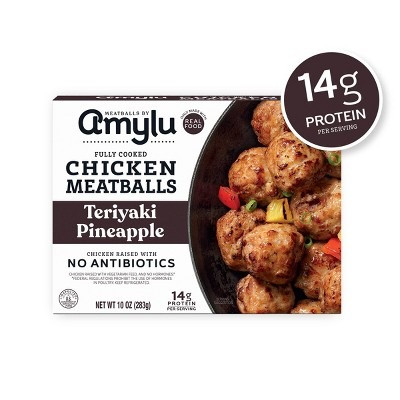
Amylu Foods
Teriyaki Pineapple Chicken Meatballs - 10 oz
Chicken meatballs built around a real teriyaki profile — antibiotic-free chicken, tamari soy sauce, mirin rice wine, caramelized onions, and dried pineapple in a single ready-to-heat format that skips the shortcuts most grab-and-go proteins take.
- Heat and serve versatility: works straight from the skillet over rice bowls, tucked into lettuce wraps, or added to noodle dishes — no prep beyond warming required.
- Antibiotic-free chicken + fermented soy: raised without antibiotics and seasoned with tamari (traditionally brewed soy sauce) rather than conventional soy flavoring, giving the savory notes a fermented depth that standard meatball seasonings don't carry.
- Gluten-conscious and dairy-free: tamari-based (wheat-minimal vs. conventional soy sauce) and free of dairy ingredients — check label for full allergen detail if gluten sensitivity is a concern.
Amylu's Teriyaki Pineapple Chicken Meatballs bring a complete flavor story to the refrigerated case: antibiotic-free chicken seasoned with tamari soy sauce powder, mirin sweet rice wine, caramelized onions, garlic, and dried pineapple — the kind of layered teriyaki profile that most convenience proteins gesture at with artificial flavoring and call it done.
Each 10 oz package contains fully cooked meatballs that need nothing more than a few minutes in a skillet or microwave. The ingredient list reflects that: tamari (soybeans, salt) rather than conventional soy sauce, mirin (water, sugar, rice, alcohol, salt, lactic acid) for a subtle sweetness that doesn't spike sugar content, and extract of rosemary as a natural preservative in place of synthetic stabilizers. Dried pineapple adds a mild tropical brightness that cuts the umami without tipping into candy-sweet.
For shoppers accustomed to reading labels on refrigerated meatballs: most shelf competitors in this category rely on pork or beef blends with fillers, synthetic flavor compounds, and preservatives like sodium erythorbate or sodium nitrite. These are chicken-only, with the savory character built from actual tamari fermentation and caramelized aromatics rather than flavor masking.
Serve over jasmine rice or cauliflower rice with steamed edamame, add to ramen or udon, or slice and use as a pizza topping with scallion and sesame. Internal temp of 165°F for reheating. Store refrigerated and use by the date on the package; not designed for long-term freezer storage (check package for freezing guidance).
Ingredients: Chicken Raised Without Antibiotics, Dried Pineapple (Pineapple, Sugar, Citric Acid, Sulfur Dioxide), Tamari Soy Sauce Powder (Tamari Soy Sauce [Soybeans, Salt], Maltodextrin, Salt), Contains 2% Or Less Of: Sea Salt, Spices, Pineapple Flavor, Garlic Powder, Sugar, Caramelized Onions, Mirin Sweet Cooking Rice Wine (Water, Sugar, Rice, Alcohol, Salt, Lactic Acid), Extract Of Rosemary, Vinegar.
Common Questions
How do these chicken meatballs compare nutritionally to conventional beef or pork meatballs?
Chicken meatballs typically run 140-170 calories and 14-18g protein per 3-4 oz serving, with total fat in the 6-10g range, compared to beef-pork blend meatballs that often land at 200-250 calories and 15-20g fat in the same serving size. The trade-off is saturated fat: chicken sits around 1.5-2.5g saturated fat per serving versus 6-9g for a 70/30 or 80/20 beef blend. Sodium levels in flavored chicken meatballs like these tend to be moderate — tamari-seasoned products typically fall between 400-600mg per serving, which is comparable to conventional Italian-style meatballs. For shoppers tracking fat grams or managing saturated fat intake, chicken-based meatballs offer a meaningful reduction without sacrificing protein density. The antibiotic-free designation here adds a label distinction that most standard grocery-brand meatballs, regardless of species, do not carry.
What does 'raised without antibiotics' actually mean on a chicken label, and how is it verified?
USDA regulations require that 'raised without antibiotics' claims be substantiated by producer documentation submitted to USDA's Food Safety and Inspection Service (FSIS) for approval — it is not a self-declared marketing term. The claim means no antibiotics of any class were administered at any point during the bird's life, from hatch to processing, which differs from 'no antibiotics added' language sometimes seen on beef, which is less rigorously defined. It does not, however, specify living conditions, feed composition, or outdoor access — those are governed by separate certifications like USDA Organic or Certified Humane. To verify, consumers can cross-reference the claim against USDA's FSIS label database or look for overlapping certifications (such as USDA Organic, which prohibits antibiotics by default) that provide independent corroboration. In this product, the antibiotic-free chicken claim stands on its own without a supporting organic or third-party animal welfare certification visible in the ingredient panel.
What role does tamari play compared to regular soy sauce, and does it affect the flavor or allergen profile?
Tamari is a Japanese-style soy sauce traditionally brewed with little to no wheat, making it the standard soy sauce choice for gluten-sensitive consumers — conventional soy sauce (like Kikkoman's standard variety) typically contains wheat as a secondary ingredient. The fermentation process for tamari generally produces a darker, richer, less sharp flavor than standard soy sauce due to a higher concentration of free glutamates and a lower ratio of wheat-derived sugars. In a powdered or dried application like this product, tamari contributes umami depth that holds up better through the drying process than thinner soy sauces would. However, because tamari does contain soybeans, it is still a soy allergen and is listed as such. Consumers with celiac disease or gluten sensitivity should note that while tamari itself is typically wheat-free, cross-contamination risk depends on the manufacturing facility, which is not specified here.
Are these meatballs suitable for keto, paleo, or gluten-free diets?
For keto, the key question is net carbs: dried pineapple, mirin (which contains sugar), tamari powder (which contains maltodextrin), and added sugar in the ingredient list all contribute carbohydrates. Based on the ingredient volumes noted as '2% or less' for several of these items, total carbs per serving are likely in the 4-8g range, which is workable within a moderate keto ceiling (20-50g net carbs per day) but not negligible — checking the nutrition facts panel for the exact figure is essential before including them in a strict keto protocol. For paleo, the product is borderline: paleo frameworks typically exclude soy-derived ingredients (tamari) and refined sugar, both of which appear here, so strict paleo followers would likely pass. Gluten-free suitability depends on tamari sourcing and facility cross-contamination disclosures not visible in the current ingredient list. These meatballs are not appropriate for carnivore diet protocols, which exclude all plant-derived seasonings and sugar sources.
What dishes can I substitute these into instead of traditional beef or pork meatballs, and do I need to adjust cooking?
Because these are fully cooked, the main adaptation is reheating rather than cooking through, which makes them faster and more forgiving than raw meatball substitutions. The teriyaki-pineapple flavor profile makes them a natural fit in ramen, udon, or soba bowls, where they replace chashu pork or plain chicken; fried rice with scrambled egg and edamame; or rice paper rolls with shredded cabbage and a hoisin dipping sauce. They also work well sliced thin as a pizza topping with mozzarella, scallion, and sesame seeds on a flatbread base. Where the substitution is less seamless is in Italian-American recipes like marinara-based pasta or stuffed peppers where the flavor profile would clash — the umami character is specifically East Asian. For skillet reheating, 2-3 minutes on medium with a splash of water or broth prevents drying; for microwave, 60-90 seconds covered at full power typically reaches the recommended 165°F internal temperature.
Why is sulfur dioxide listed in the dried pineapple, and is it a safety concern?
Sulfur dioxide (SO2) is a naturally occurring compound also used as a food-grade preservative and browning inhibitor in dried fruits — it is the same compound behind the sulfites used in wine preservation. In dried pineapple, it prevents enzymatic browning and extends shelf stability without requiring artificial preservatives. The FDA classifies sulfur dioxide as GRAS (Generally Recognized As Safe) at levels typically used in dried fruit, which are measured in parts per million. The primary safety concern is for individuals with sulfite sensitivity, particularly those with asthma, who can experience respiratory reactions; the FDA requires sulfite disclosure on labels when levels exceed 10 parts per million, which is why it appears explicitly in the ingredient list here. For the general population without sulfite sensitivity, the levels in dried fruit represent a very low exposure and are not considered a health risk.
What function does extract of rosemary serve here, and is it a preservative or a flavoring?
Extract of rosemary (also labeled as rosemary extract or carnosic acid extract) functions primarily as a natural antioxidant preservative in meat products — it inhibits lipid oxidation, which is the process that causes fats to go rancid and develop off-flavors. The active compounds, carnosic acid and carnosol, work by scavenging free radicals in the fat matrix, extending shelf life and maintaining flavor integrity without synthetic preservatives like BHA (butylated hydroxyanisole) or BHT (butylated hydroxytoluene), which are common in conventional refrigerated meat products. The concentration used in most meat applications is too low to contribute meaningful rosemary flavor, so it functions almost entirely as a preservative rather than a seasoning. It is widely accepted in clean-label and natural food formulations and does not require a 'contains preservatives' disclosure since it is derived from a botanical source. For consumers avoiding synthetic antioxidants, rosemary extract is the standard industry alternative.
Each 10 oz package contains fully cooked meatballs that need nothing more than a few minutes in a skillet or microwave. The ingredient list reflects that: tamari (soybeans, salt) rather than conventional soy sauce, mirin (water, sugar, rice, alcohol, salt, lactic acid) for a subtle sweetness that doesn't spike sugar content, and extract of rosemary as a natural preservative in place of synthetic stabilizers. Dried pineapple adds a mild tropical brightness that cuts the umami without tipping into candy-sweet.
For shoppers accustomed to reading labels on refrigerated meatballs: most shelf competitors in this category rely on pork or beef blends with fillers, synthetic flavor compounds, and preservatives like sodium erythorbate or sodium nitrite. These are chicken-only, with the savory character built from actual tamari fermentation and caramelized aromatics rather than flavor masking.
Serve over jasmine rice or cauliflower rice with steamed edamame, add to ramen or udon, or slice and use as a pizza topping with scallion and sesame. Internal temp of 165°F for reheating. Store refrigerated and use by the date on the package; not designed for long-term freezer storage (check package for freezing guidance).
Ingredients: Chicken Raised Without Antibiotics, Dried Pineapple (Pineapple, Sugar, Citric Acid, Sulfur Dioxide), Tamari Soy Sauce Powder (Tamari Soy Sauce [Soybeans, Salt], Maltodextrin, Salt), Contains 2% Or Less Of: Sea Salt, Spices, Pineapple Flavor, Garlic Powder, Sugar, Caramelized Onions, Mirin Sweet Cooking Rice Wine (Water, Sugar, Rice, Alcohol, Salt, Lactic Acid), Extract Of Rosemary, Vinegar.
Common Questions
How do these chicken meatballs compare nutritionally to conventional beef or pork meatballs?
Chicken meatballs typically run 140-170 calories and 14-18g protein per 3-4 oz serving, with total fat in the 6-10g range, compared to beef-pork blend meatballs that often land at 200-250 calories and 15-20g fat in the same serving size. The trade-off is saturated fat: chicken sits around 1.5-2.5g saturated fat per serving versus 6-9g for a 70/30 or 80/20 beef blend. Sodium levels in flavored chicken meatballs like these tend to be moderate — tamari-seasoned products typically fall between 400-600mg per serving, which is comparable to conventional Italian-style meatballs. For shoppers tracking fat grams or managing saturated fat intake, chicken-based meatballs offer a meaningful reduction without sacrificing protein density. The antibiotic-free designation here adds a label distinction that most standard grocery-brand meatballs, regardless of species, do not carry.
What does 'raised without antibiotics' actually mean on a chicken label, and how is it verified?
USDA regulations require that 'raised without antibiotics' claims be substantiated by producer documentation submitted to USDA's Food Safety and Inspection Service (FSIS) for approval — it is not a self-declared marketing term. The claim means no antibiotics of any class were administered at any point during the bird's life, from hatch to processing, which differs from 'no antibiotics added' language sometimes seen on beef, which is less rigorously defined. It does not, however, specify living conditions, feed composition, or outdoor access — those are governed by separate certifications like USDA Organic or Certified Humane. To verify, consumers can cross-reference the claim against USDA's FSIS label database or look for overlapping certifications (such as USDA Organic, which prohibits antibiotics by default) that provide independent corroboration. In this product, the antibiotic-free chicken claim stands on its own without a supporting organic or third-party animal welfare certification visible in the ingredient panel.
What role does tamari play compared to regular soy sauce, and does it affect the flavor or allergen profile?
Tamari is a Japanese-style soy sauce traditionally brewed with little to no wheat, making it the standard soy sauce choice for gluten-sensitive consumers — conventional soy sauce (like Kikkoman's standard variety) typically contains wheat as a secondary ingredient. The fermentation process for tamari generally produces a darker, richer, less sharp flavor than standard soy sauce due to a higher concentration of free glutamates and a lower ratio of wheat-derived sugars. In a powdered or dried application like this product, tamari contributes umami depth that holds up better through the drying process than thinner soy sauces would. However, because tamari does contain soybeans, it is still a soy allergen and is listed as such. Consumers with celiac disease or gluten sensitivity should note that while tamari itself is typically wheat-free, cross-contamination risk depends on the manufacturing facility, which is not specified here.
Are these meatballs suitable for keto, paleo, or gluten-free diets?
For keto, the key question is net carbs: dried pineapple, mirin (which contains sugar), tamari powder (which contains maltodextrin), and added sugar in the ingredient list all contribute carbohydrates. Based on the ingredient volumes noted as '2% or less' for several of these items, total carbs per serving are likely in the 4-8g range, which is workable within a moderate keto ceiling (20-50g net carbs per day) but not negligible — checking the nutrition facts panel for the exact figure is essential before including them in a strict keto protocol. For paleo, the product is borderline: paleo frameworks typically exclude soy-derived ingredients (tamari) and refined sugar, both of which appear here, so strict paleo followers would likely pass. Gluten-free suitability depends on tamari sourcing and facility cross-contamination disclosures not visible in the current ingredient list. These meatballs are not appropriate for carnivore diet protocols, which exclude all plant-derived seasonings and sugar sources.
What dishes can I substitute these into instead of traditional beef or pork meatballs, and do I need to adjust cooking?
Because these are fully cooked, the main adaptation is reheating rather than cooking through, which makes them faster and more forgiving than raw meatball substitutions. The teriyaki-pineapple flavor profile makes them a natural fit in ramen, udon, or soba bowls, where they replace chashu pork or plain chicken; fried rice with scrambled egg and edamame; or rice paper rolls with shredded cabbage and a hoisin dipping sauce. They also work well sliced thin as a pizza topping with mozzarella, scallion, and sesame seeds on a flatbread base. Where the substitution is less seamless is in Italian-American recipes like marinara-based pasta or stuffed peppers where the flavor profile would clash — the umami character is specifically East Asian. For skillet reheating, 2-3 minutes on medium with a splash of water or broth prevents drying; for microwave, 60-90 seconds covered at full power typically reaches the recommended 165°F internal temperature.
Why is sulfur dioxide listed in the dried pineapple, and is it a safety concern?
Sulfur dioxide (SO2) is a naturally occurring compound also used as a food-grade preservative and browning inhibitor in dried fruits — it is the same compound behind the sulfites used in wine preservation. In dried pineapple, it prevents enzymatic browning and extends shelf stability without requiring artificial preservatives. The FDA classifies sulfur dioxide as GRAS (Generally Recognized As Safe) at levels typically used in dried fruit, which are measured in parts per million. The primary safety concern is for individuals with sulfite sensitivity, particularly those with asthma, who can experience respiratory reactions; the FDA requires sulfite disclosure on labels when levels exceed 10 parts per million, which is why it appears explicitly in the ingredient list here. For the general population without sulfite sensitivity, the levels in dried fruit represent a very low exposure and are not considered a health risk.
What function does extract of rosemary serve here, and is it a preservative or a flavoring?
Extract of rosemary (also labeled as rosemary extract or carnosic acid extract) functions primarily as a natural antioxidant preservative in meat products — it inhibits lipid oxidation, which is the process that causes fats to go rancid and develop off-flavors. The active compounds, carnosic acid and carnosol, work by scavenging free radicals in the fat matrix, extending shelf life and maintaining flavor integrity without synthetic preservatives like BHA (butylated hydroxyanisole) or BHT (butylated hydroxytoluene), which are common in conventional refrigerated meat products. The concentration used in most meat applications is too low to contribute meaningful rosemary flavor, so it functions almost entirely as a preservative rather than a seasoning. It is widely accepted in clean-label and natural food formulations and does not require a 'contains preservatives' disclosure since it is derived from a botanical source. For consumers avoiding synthetic antioxidants, rosemary extract is the standard industry alternative.
- __Owner:
- TCFarm
- __Storage_Location:
- Frozen
- __Volume:
- 300
- __badge:
- Gluten Free