


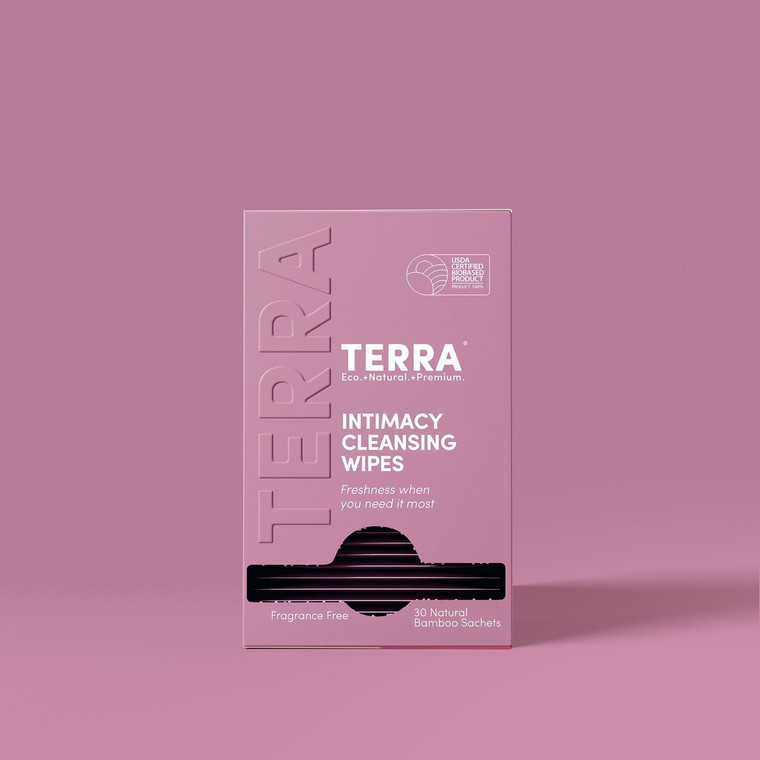
Terra Intimate Cleansing Wipes - 30 ct
Terra OrganicsWrite a Review
Terra Organics
Terra Intimate Cleansing Wipes - 30 ct
- On-the-go intimacy care: Individually packaged wipes deliver freshness and comfort at home, while traveling, postworkout, or anytime confidence matters — without disrupting the skin's natural pH balance.
- Triple-tested, OEKO-TEX certified fabric: Made from 100% FSC-certified, biodegradable bamboo fiber — independently verified to be free of harmful substances by OEKO-TEX, with additional RIPT and SGS safety testing on both wipes and raw materials.
- Thoughtfully plant-derived: Every ingredient serves a specific skin function — no synthetic fragrance masking, no parabens — suitable for sensitive intimate skin.
TERRA Intimate Cleansing Wipes are built on a clear premise: intimate skin deserves the same ingredient transparency and safety scrutiny applied to any skincare product. Where most conventional intimate wipes rely on synthetic preservatives, alcohol, and artificial fragrance, TERRA formulates around four functional botanicals — each chosen for a specific role in skin comfort and barrier health.
What's in each wipe: Sweet Almond Oil softens and conditions the delicate skin of intimate areas. Aloe Vera delivers calming hydration to reduce dryness and discomfort. Chamomile Extract actively works to reduce redness and irritation — particularly relevant for skin that reacts to conventional wipes. Vitamin E supports the lipid barrier, helping skin maintain its own natural defenses between uses. This combination works synergistically rather than relying on a single active ingredient.
The fabric is 100% plant-based FSC-certified biodegradable bamboo fiber — a material chosen both for its softness against sensitive skin and its environmental impact profile. Unlike conventional flushable or synthetic wipes, these break down without contributing to waterway or landfill accumulation.
TERRA's safety commitment is unusually transparent for a personal care brand: every wipe — and every raw material used to make them — undergoes RIPT testing (Repeat Insult Patch Testing, the gold standard for skin sensitization), SGS laboratory analysis, and OEKO-TEX certification, which verifies the fabric is free from over 100 categories of harmful substances. These are independent third-party audits, not self-reported claims.
Each wipe comes individually packaged for single-use hygiene and portability — compact enough for a gym bag, a travel kit, or an everyday bag without leaking or drying out. The 30-count format provides a month's supply for daily use.
Store at room temperature, away from direct sunlight and heat. Suitable for sensitive intimate skin; formulated without parabens, alcohol, or synthetic fragrance.
INGREDIENTS —
- Pure New Zealand Purified Water
- Biodegradable FSC® Certified Bamboo fiber
- Sweet Almond Oil (moisturizes and conditions delicate skin)
- Aloe Leaf Extract (hydrates, soothes, and supports skin comfort)
- Chamomilla Flower Extract (calms irritation, helps reduce redness)
- Vitamin E (antioxidant protection, supports skin barrier and softness)
Common Questions
How do these wipes differ from conventional drugstore intimate wipes in terms of ingredients?
Most conventional intimate wipes contain synthetic preservatives such as methylisothiazolinone or parabens, alcohol (which disrupts the skin's natural pH and strips moisture), and artificial fragrance — one of the leading causes of contact dermatitis in intimate skin. Terra's formula replaces that preservative-and-fragrance backbone with four functional botanicals: Sweet Almond Oil (emollient), Aloe Vera (hydration), Chamomile Extract (anti-inflammatory), and Vitamin E (barrier support). The fabric is also meaningfully different — 100% bamboo fiber versus the polyester or rayon blends common in mass-market wipes. That material difference matters because synthetic fibers can cause friction and trap heat against sensitive skin.
What is RIPT testing and why does it matter for a wipe used on intimate skin?
RIPT stands for Repeat Insult Patch Testing, and it is the dermatological gold standard for evaluating whether a product causes skin sensitization over repeated exposure — not just a single application. The protocol involves applying the product to the same skin site across multiple sessions, then re-introducing it after a rest period to detect whether the immune system has developed a sensitization response. For a product used daily on intimate skin — which has a thinner epidermal barrier and higher absorption rates than facial or body skin — this level of testing is considerably more relevant than a simple in-vitro safety screen. Terra states that both the finished wipes and the raw materials undergo RIPT, which means the ingredient supply chain is tested, not just the final product assembly.
What does OEKO-TEX certification actually verify about the bamboo fabric in these wipes?
OEKO-TEX STANDARD 100 is an independent certification administered by the OEKO-TEX Association that tests textiles against a list of over 100 harmful substance categories, including heavy metals, pesticide residues, formaldehyde, pH abnormalities, and colorfast dyes. Products that contact intimate skin are held to the most stringent tier of the standard (Product Class I), meaning permissible limits for potentially harmful substances are set lower than for outerwear or household textiles. Certification is issued by an accredited third-party laboratory — not self-declared by the brand — and must be renewed regularly. For bamboo specifically, this matters because the processing method used to convert raw bamboo into soft fiber can introduce chemical residues if not carefully controlled.
How does Chamomile Extract reduce irritation, and is there clinical evidence for this mechanism?
Chamomile's primary active compounds are bisabolol and apigenin-derived flavonoids, both of which inhibit the production of pro-inflammatory cytokines — specifically by suppressing cyclooxygenase and lipoxygenase pathways, the same enzymatic routes targeted by topical anti-inflammatory drugs. Bisabolol in particular has been studied for its ability to reduce erythema (redness) and accelerate skin repair in irritated tissue. Clinical research published in dermatology literature has shown chamomile extracts reduce inflammatory markers measurably compared to placebo in patch-test models. In the context of intimate wipes, this mechanism is especially relevant because the goal is to calm skin that may already be mildly reactive from conventional product use, friction, or hormonal fluctuations.
What role does Vitamin E (Tocopherol) play beyond basic moisturization?
Tocopherol functions primarily as an antioxidant that neutralizes reactive oxygen species (free radicals) at the skin surface — damage that can accumulate from UV exposure, environmental pollutants, and friction. In the context of a cleansing wipe, it also acts as a lipid-replenishing agent, helping to restore the intercellular lipid matrix that forms the stratum corneum's barrier. This is specifically valuable in intimate areas, where the skin barrier is thinner and more permeable than on most body surfaces, making it more susceptible to transepidermal water loss after cleansing. Vitamin E works synergistically with the Sweet Almond Oil in this formulation, as almond oil itself contains naturally occurring tocopherols, compounding the barrier-support effect.
Is the bamboo fiber truly biodegradable, and what does FSC certification confirm about it?
FSC (Forest Stewardship Council) certification confirms that the bamboo used in the fiber was sourced from responsibly managed forests — meaning harvesting practices met standards for ecosystem health, worker rights, and replanting. It does not, by itself, certify biodegradability; that claim relates to the fiber's material composition. Bamboo fiber, unlike the polyester or rayon-blend fabrics used in most conventional wipes, breaks down through natural microbial decomposition without leaving persistent microplastic residue. Standard synthetic wipe fabrics can persist in landfills for decades and are a documented contributor to sewer blockages even when labeled flushable. However, even biodegradable wipes should be disposed of in trash rather than flushed, as biodegradation timelines in sewage environments are not instantaneous.
Why are these wipes individually packaged rather than sold in a resealable tub or pouch?
Individual packaging solves two practical problems for intimate wipes specifically. First, it eliminates the moisture-loss issue common to tub or pouch formats, where frequent opening exposes remaining wipes to air and can cause them to dry out before use — particularly in dry climates or frequent-travel conditions. Second, single-unit packaging maintains hygiene integrity: each wipe is sealed in its own sterile environment until the moment of use, which matters more for intimate application than for, say, a hand wipe. The trade-off is slightly more per-unit packaging material, though the brand's use of biodegradable substrate addresses a portion of that concern. The format also makes the product genuinely portable without the bulk or leak risk of a multi-wipe container.
- __Owner:
- TCFarm
- __Storage_Location:
- Dry
- __Volume:
- 400
- __badge:
- for delivery by 11/4