


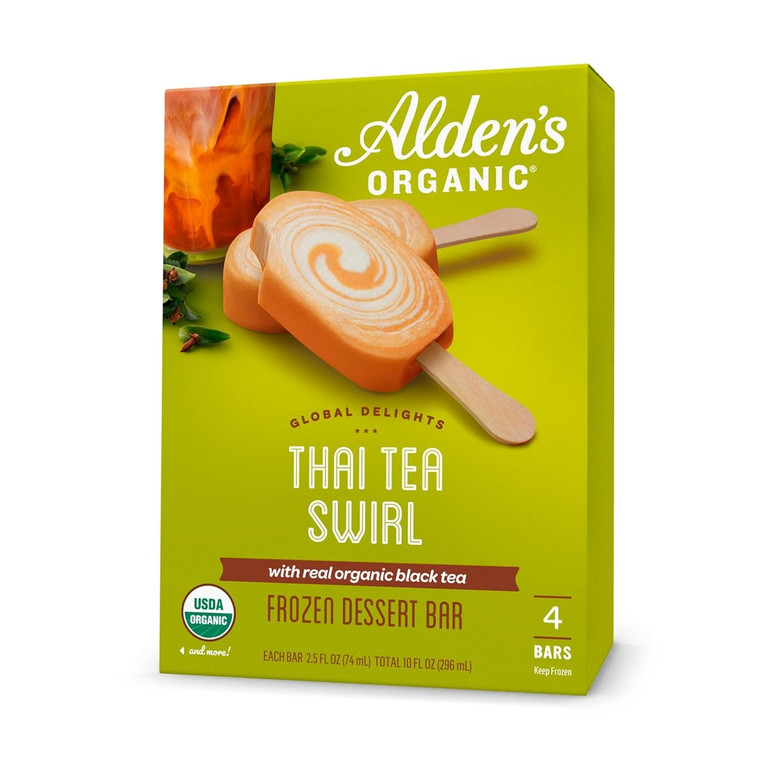
Thai Tea Swirl Ice Cream Bars - 10 oz
Aldens OrganicWrite a Review
Aldens Organic
Thai Tea Swirl Ice Cream Bars - 10 oz
- A freezer-case standout for fans of chai, spiced tea, and Southeast Asian-inspired flavors — rich enough to satisfy as a standalone dessert.
- Certified USDA Organic — made without synthetic pesticides, artificial colors, or artificial flavors at every stage of production, from dairy sourcing to final bar.
- A fit for organic-lifestyle households; check the label for dairy and allergen details before serving to guests with specific dietary needs.
Alden's Organic has been one of the most trusted names in certified organic frozen desserts in the U.S., and the Thai Tea Swirl Ice Cream Bar shows exactly why. While most novelty ice cream bars on grocery shelves rely on artificial colorings to mimic the amber-orange hue of Thai tea and artificial flavor compounds to approximate its spiced-milk-tea character, Alden's builds the same flavor profile from organic ingredients — no shortcuts.
Each bar features organic ice cream swirled with Thai tea flavor, delivering the warm, subtly spiced, creamy notes that have made Thai tea a cult favorite. The format — individually portioned bars — makes them easy to pull from the freezer without commitment to a full pint. The 10 oz package contains multiple bars (exact count on the package; confirm at purchase).
As a USDA Certified Organic product, every ingredient — including the dairy — must meet federal organic standards: no synthetic pesticides on feed crops, no synthetic hormones, no antibiotic use in the dairy herd. That certification is third-party audited, not self-declared. For shoppers who buy organic dairy specifically to avoid synthetic hormone residues and pesticide-exposed milk, the certification does the work for you.
Store frozen. Check the package label for complete allergen information, including dairy and any tree nut or soy cross-contact disclosures.
INGREDIENTS - Water, Milk*, Cane Sugar*, Cream*, Tapioca Syrup*, Thai Tea Base* (Water, Sugar*, Instant Black Tea*, Tapioca Starch*, Citric Acid, Cloves*, Natural Flavor*), Guar Gum*, Locust Bean Gum*, Annatto Extract* (Color).
Common Questions
What actually gives Thai tea its distinctive flavor, and how does Alden's recreate it without artificial ingredients?
Traditional Thai tea gets its character from strongly brewed black tea — typically Ceylon or Assam varieties — combined with spices like star anise, cardamom, and sometimes tamarind, then sweetened and cut with condensed or evaporated milk. The result is a warm, earthy, slightly floral flavor with a creamy richness. Alden's replicates this using organic black tea extract and organic spices, which capture the same aromatic compounds — primarily terpenes like linalool from cardamom and anethole from star anise — without synthetic flavor concentrates. The amber-orange color that makes Thai tea visually recognizable comes from organic annatto, a seed-derived pigment that produces the same hue conventionally achieved with artificial dyes like Yellow 6.
What does USDA Certified Organic actually require for dairy products, and how is it verified?
For a dairy product to carry the USDA Certified Organic seal, the cows must be raised on certified organic land, fed 100% organic feed with no synthetic pesticides or fertilizers on those crops, have year-round access to pasture (with at least 30% of their dry matter intake coming from pasture during the grazing season), and cannot be treated with synthetic hormones like rBST or preventive antibiotics. The certification is not self-declared — it requires annual third-party audits by a USDA-accredited certifying agent, with full supply chain traceability from farm to finished product. For consumers specifically trying to avoid synthetic hormone residues or pesticide-exposed milk, the organic seal is the only label backed by federal enforcement, unlike terms like 'natural' or 'hormone-free,' which have no mandatory third-party audit requirement.
How does organic ice cream compare nutritionally to conventional ice cream?
The macronutrient profile of organic ice cream — fat, protein, sugar, calories — is essentially identical to conventional ice cream made with the same formulation, because the organic certification governs farming inputs, not nutritional composition. Where organic dairy does show measurable differences is in fatty acid ratios: several peer-reviewed studies, including a 2016 meta-analysis published in the British Journal of Nutrition, found that organic whole milk contains roughly 56% more omega-3 fatty acids and about 18% more conjugated linoleic acid (CLA) than conventional milk, attributable to higher pasture intake in organic herds. However, ice cream is not a meaningful source of omega-3s in practice given the quantities consumed, so the nutritional distinction is more relevant for everyday dairy staples like whole milk or butter than for a frozen dessert.
Is this ice cream bar suitable for people avoiding gluten, and what allergens should buyers watch for?
Ice cream bars like this one are typically gluten-free by formulation — the core ingredients of milk, cream, sugar, tea, and spices do not contain gluten. However, Alden's produces multiple products, and shared production equipment can introduce cross-contact risk depending on the facility and production line. Dairy is a confirmed allergen present in this product. Depending on the exact formulation, soy lecithin is sometimes used in frozen desserts as an emulsifier, which would be relevant for soy-allergic consumers. The definitive allergen statement — including any 'may contain' cross-contact disclosures — is on the physical package label, and that is the authoritative source to check before consuming if you have a food allergy.
Does the 'swirl' in Thai Tea Swirl mean two distinct layers or flavors, or is it one flavor throughout?
In most swirl-format ice cream bars, the swirl refers to a visual and textural ribbon of a contrasting element — often a sauce, flavored ice, or differently colored ice cream — twisted through the primary base rather than two fully separate flavors in equal proportions. In the Thai Tea Swirl, the likely interpretation is an organic ice cream base with a Thai tea-flavored swirl running through it, creating pockets of more concentrated tea flavor against the cream base. The exact structure — whether it is a ribbon sauce, a flavored ice cream stripe, or a coating element — should be confirmed by examining the product description on the physical package, as swirl execution varies significantly by product.
How should these bars be stored, and is there a risk of texture degradation if they partially thaw and refreeze?
These bars should be stored continuously at 0°F (-18°C) or below, which is standard for hard frozen novelties. Partial thawing followed by refreezing is the primary enemy of ice cream texture: when ice cream warms above roughly 20°F (-7°C), ice crystals begin to melt and recrystallize into larger formations upon refreezing, producing a grainy or icy mouthfeel rather than the smooth, creamy texture of the original product. This is irreversible — no amount of re-freezing restores the original crystal structure once significant melt has occurred. A freezer that cycles or runs warm, or bars left out even for 10-15 minutes before being returned, can noticeably degrade quality. The bars are individually portioned specifically to minimize this risk, since you remove only what you intend to eat.
What is annatto, and is it a safe coloring for people who react to synthetic food dyes?
Annatto is a natural pigment extracted from the seeds of the achiote tree (Bixa orellana), native to tropical regions of the Americas. Its primary coloring compounds are bixin and norbixin, which produce yellow-to-orange hues depending on concentration — the same color range as Thai tea's characteristic amber tones. Because annatto is plant-derived and not a synthetic azo dye, it does not carry the FDA-required advisory warning that links synthetic dyes like Yellow 5 and Yellow 6 to hyperactivity in some children. However, annatto is not universally tolerated: a subset of individuals, particularly those with salicylate sensitivity, report reactions to annatto including hives or gastrointestinal symptoms, and it is one of the more common non-synthetic food coloring triggers in clinical allergy literature. People with known sensitivities to natural colorings should review the ingredient list before consuming.
- __Storage_Location:
- FrozenICE
- __Volume:
- 400
- __Owner:
- TCFarm
- __badge:
- Organic