


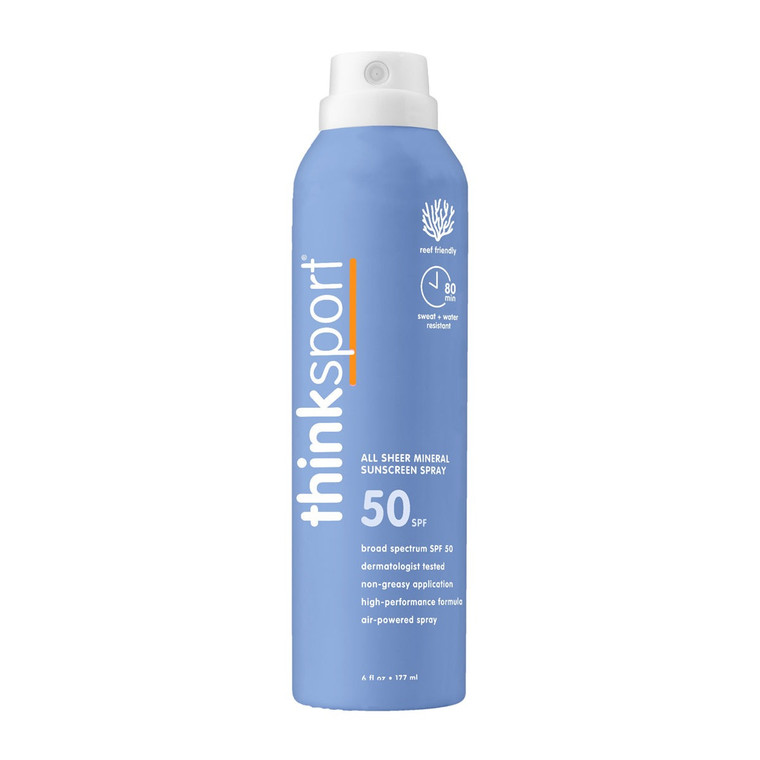
Thinksport All Sheer Mineral Sunscreen Spray SPF 50 - 6oz
Think
$17.79
Below are the available bulk discount rates for each individual item when you purchase a certain amount
- Buy 3 - 5 and get 3% off
- Buy 6 or above and get 8% off
(No reviews yet)

Write a Review
Think
Thinksport All Sheer Mineral Sunscreen Spray SPF 50 - 6oz
Broad-spectrum SPF 50 protection with nothing but mineral actives — Thinksport's All Sheer Spray uses non-nano Zinc Oxide (15.7%) and Titanium Dioxide (3.4%) as its only UV filters, delivering the kind of physical sun blocking that conscious shoppers trust. No oxybenzone, no avobenzone, no chemical UV absorbers that raise flags with EWG. The formula is rated by EWG and formulated to be free of the ingredients that give conventional sport sunscreens their reputation for endocrine disruption and reef toxicity — all in a spray that goes on clear and stays on through sweat.
- Built for active use: water-resistant, broad-spectrum SPF 50 coverage in a spray format designed for easy, even application on the go — face, body, or both
- Mineral-only actives with a clean supporting cast: non-nano zinc oxide and titanium dioxide carry the UV work; aloe barbadensis leaf juice, bisabolol, and vitamin E (tocopherol) support skin comfort — no oxybenzone, octinoxate, or synthetic fragrance
- Vegan-certified, EWG-rated: suitable for vegan lifestyles, free of animal-derived ingredients, and independently rated by the Environmental Working Group for ingredient safety
Thinksport built its reputation on a simple premise: sunscreen that actually protects you shouldn't come loaded with ingredients that compromise your health or the environment. The All Sheer Mineral Sunscreen Spray SPF 50 is the spray-format expression of that commitment — a broad-spectrum, water-resistant, mineral-only formula that goes on clear and relies exclusively on physical UV filters rather than chemical absorbers.
The active ingredients are Zinc Oxide at 15.7% and Titanium Dioxide at 3.4% — both non-nano, both physical blockers that sit on top of skin and deflect UV rather than absorbing it into the bloodstream the way chemical filters do. Non-nano particle size means the minerals cannot penetrate skin at the cellular level, addressing one of the primary concerns health researchers have raised about nano-particle mineral sunscreens. The inactive formula adds Aloe Barbadensis Leaf Juice, Banana Fruit Extract, Bisabolol, and Tocopherol (Vitamin E) for skin conditioning — alongside Bentonite for texture stability — and excludes oxybenzone, octinoxate, parabens, and synthetic fragrance.
Thinksport's full product line is EWG-rated, placing it in the top tier of independently reviewed sunscreens for ingredient safety. The EWG Skin Deep database evaluates formulas for hazard, data gaps, and overall risk — and Thinksport products consistently score among the lowest-hazard options on the market. That rating is not self-reported; it is assigned by EWG's database team based on the published ingredient list.
The spray format makes this practical for sport and outdoor use: no rubbing required, quick to apply over large surface areas, and the sheer finish means no white cast on skin. Certified Vegan, free of animal-derived ingredients, and appropriate for adults and older children. Store at room temperature; avoid prolonged exposure to extreme heat, which can degrade aerosol function.
Ingredients: Water, Butyloctyl Salicylate, Dicaprylyl Carbonate, Isononyl Isononanoate, Propanediol, Isocetyl Stearoyl Stearate, Methyl Dihydroabietate, Cetearyl Alcohol, Aloe Barbadensis Leaf Juice, Musa Sapientum (Banana) Fruit Extract, Bentonite, Glycerin, Tocopherol, Citric Acid, Alumina, Sodium Gluconate, Bisabolol, Caprylhydroxamic Acid, Cellulose Gum, Caprylyl Glycol, Coco-Glucoside, Microcrystalline Cellulose, Polyhydroxystearic Acid, Polyester-8, Silica, Sodium Stearoyl Glutamate, C18-21 Alkane. Active Ingredients: Titanium Dioxide 3.4%, Zinc Oxide 15.7%.
Common Questions
How does the zinc oxide percentage in this sunscreen compare to other mineral sunscreens on the market?
At 15.7% zinc oxide, this formula sits at the higher end of the consumer sunscreen range — most drugstore mineral sunscreens contain between 5% and 10% zinc oxide, and many SPF 50 mineral sprays use zinc oxide in the 10–12% range to balance protection with cosmetic feel. The additional 3.4% titanium dioxide brings the combined active concentration to 19.1%, which is how the formula achieves broad-spectrum SPF 50 coverage while remaining sheer. Zinc oxide is the only FDA-approved sunscreen ingredient that covers both UVA1 (340–400 nm) and UVA2 (320–340 nm) wavelengths, making a higher percentage meaningful rather than cosmetic. The tradeoff at this concentration is typically a heavier feel or white cast, which the formulation addresses through the sheer spray delivery system and suspension aids like Bentonite and Microcrystalline Cellulose.
What does non-nano mean for zinc oxide and titanium dioxide, and why does particle size matter?
Non-nano means the zinc oxide and titanium dioxide particles in this formula are larger than 100 nanometers in diameter. Nano-scale mineral particles — those under 100 nm — have been flagged in research because smaller particles can penetrate skin more deeply, and some in vitro studies have raised questions about cellular toxicity at nano scale, particularly with titanium dioxide. The FDA's own 2019 proposed rule specifically called out nano-particle zinc oxide and titanium dioxide as categories requiring additional safety data before they could be designated as generally recognized as safe. Non-nano particles sit on the surface of the skin and act as a physical shield, reflecting and scattering UV photons rather than being absorbed. The EWG Skin Deep database assigns lower hazard scores to non-nano mineral sunscreens compared to nano-formulated equivalents, which is part of why Thinksport's line consistently earns top EWG ratings.
Which chemical UV filters does this formula exclude, and what is the concern with those ingredients?
This formula excludes oxybenzone, octinoxate, octisalate, homosalate, avobenzone, and octocrylene — the six most commonly used chemical UV filters in conventional sunscreens. Oxybenzone has drawn the most regulatory attention: Hawaii banned it in sunscreens sold in the state starting in 2021 due to documented coral reef toxicity, and the FDA's 2019 proposed rule classified it as requiring more safety data because studies detected it in blood, urine, and breast milk after a single day of use at concentrations far exceeding FDA's threshold of concern. Octinoxate is also banned in Hawaii and the U.S. Virgin Islands for reef toxicity reasons. Homosalate and octocrylene have been flagged by the European Commission's Scientific Committee on Consumer Safety for potential endocrine activity. By using only zinc oxide and titanium dioxide as actives, this formula avoids all of those categories entirely.
Is this sunscreen safe to use on the face, and will it leave a white cast?
Yes, the formula is designed for face and body use. The sheer finish is achieved through the spray delivery system combined with suspension agents — Bentonite, Microcrystalline Cellulose, and Silica — that help distribute the mineral particles in a fine, even layer rather than a thick coat. At 15.7% zinc oxide, some formulas would leave a noticeable white residue, but the spray format and particle suspension chemistry are specifically engineered to minimize that effect. Bisabolol (derived from chamomile) and Aloe Barbadensis Leaf Juice are included to soothe skin, which makes it practical for sensitive facial skin as well. One practical note: spray sunscreens should be rubbed in after application on the face to ensure full, even coverage and to avoid inhalation of the mist.
What role do the botanical ingredients — aloe, banana extract, and bisabolol — actually play in this formula?
Aloe Barbadensis Leaf Juice is a well-documented humectant and skin soother; it contains polysaccharides that help retain moisture and has been studied for its ability to reduce UV-induced skin irritation, which makes it a functional pairing with a sunscreen rather than just a cosmetic addition. Musa Sapientum (Banana) Fruit Extract provides antioxidant compounds including dopamine, which acts as a free radical scavenger — relevant because UV exposure generates reactive oxygen species in the skin even when UV penetration is blocked. Bisabolol is a chamomile-derived compound with well-documented anti-inflammatory and skin-calming properties, and it has been shown in dermatological studies to reduce redness and sensitization. Tocopherol (Vitamin E) is a lipid-soluble antioxidant that protects cell membranes from oxidative damage. Together these four ingredients address the oxidative and inflammatory skin stress that occurs during sun exposure, not just the UV radiation itself.
How was the EWG rating earned, and what does it actually verify?
EWG's Skin Deep database assigns ratings based on a formula's full ingredient list, cross-referencing each ingredient against a database of toxicological studies, regulatory flags, and data gaps. The rating is not self-reported or purchased by the brand — EWG's team evaluates the published ingredient list independently and scores each component for hazard level and data availability, then generates an overall product score from 1 (lowest hazard) to 10 (highest hazard). Thinksport sunscreens consistently score in the 1–2 range, which places them in EWG's top verified category. The EWG Verified mark, which Thinksport products carry, adds a stricter layer: it requires brands to submit full formulation data and prohibits a specific list of ingredients EWG has flagged for health or environmental concerns. This is a meaningful distinction from brands that simply score well passively — Verified status involves active brand participation and ongoing transparency obligations.
Is this formula reef-safe, and what makes a sunscreen genuinely reef-safe versus one that just claims it?
This formula qualifies as reef-safe under the most commonly used scientific and regulatory definitions because it contains no oxybenzone or octinoxate — the two compounds most directly linked to coral bleaching and marine ecosystem disruption at measurable concentrations. Research published in the journal Archives of Environmental Contamination and Toxicology found that oxybenzone induces bleaching, DNA damage, and endocrine disruption in coral at concentrations as low as 62 parts per trillion. Hawaii, the U.S. Virgin Islands, Palau, and several other jurisdictions have enacted legislation banning these two ingredients specifically on this basis. The term reef-safe is not federally regulated in the U.S., which means brands can use it loosely, but the scientifically grounded version of the claim requires the absence of oxybenzone, octinoxate, and ideally octocrylene and homosalate as well. This formula excludes all of them, using only zinc oxide and titanium dioxide, both of which have not been shown to cause reef toxicity at environmentally relevant concentrations.
The active ingredients are Zinc Oxide at 15.7% and Titanium Dioxide at 3.4% — both non-nano, both physical blockers that sit on top of skin and deflect UV rather than absorbing it into the bloodstream the way chemical filters do. Non-nano particle size means the minerals cannot penetrate skin at the cellular level, addressing one of the primary concerns health researchers have raised about nano-particle mineral sunscreens. The inactive formula adds Aloe Barbadensis Leaf Juice, Banana Fruit Extract, Bisabolol, and Tocopherol (Vitamin E) for skin conditioning — alongside Bentonite for texture stability — and excludes oxybenzone, octinoxate, parabens, and synthetic fragrance.
Thinksport's full product line is EWG-rated, placing it in the top tier of independently reviewed sunscreens for ingredient safety. The EWG Skin Deep database evaluates formulas for hazard, data gaps, and overall risk — and Thinksport products consistently score among the lowest-hazard options on the market. That rating is not self-reported; it is assigned by EWG's database team based on the published ingredient list.
The spray format makes this practical for sport and outdoor use: no rubbing required, quick to apply over large surface areas, and the sheer finish means no white cast on skin. Certified Vegan, free of animal-derived ingredients, and appropriate for adults and older children. Store at room temperature; avoid prolonged exposure to extreme heat, which can degrade aerosol function.
Ingredients: Water, Butyloctyl Salicylate, Dicaprylyl Carbonate, Isononyl Isononanoate, Propanediol, Isocetyl Stearoyl Stearate, Methyl Dihydroabietate, Cetearyl Alcohol, Aloe Barbadensis Leaf Juice, Musa Sapientum (Banana) Fruit Extract, Bentonite, Glycerin, Tocopherol, Citric Acid, Alumina, Sodium Gluconate, Bisabolol, Caprylhydroxamic Acid, Cellulose Gum, Caprylyl Glycol, Coco-Glucoside, Microcrystalline Cellulose, Polyhydroxystearic Acid, Polyester-8, Silica, Sodium Stearoyl Glutamate, C18-21 Alkane. Active Ingredients: Titanium Dioxide 3.4%, Zinc Oxide 15.7%.
Common Questions
How does the zinc oxide percentage in this sunscreen compare to other mineral sunscreens on the market?
At 15.7% zinc oxide, this formula sits at the higher end of the consumer sunscreen range — most drugstore mineral sunscreens contain between 5% and 10% zinc oxide, and many SPF 50 mineral sprays use zinc oxide in the 10–12% range to balance protection with cosmetic feel. The additional 3.4% titanium dioxide brings the combined active concentration to 19.1%, which is how the formula achieves broad-spectrum SPF 50 coverage while remaining sheer. Zinc oxide is the only FDA-approved sunscreen ingredient that covers both UVA1 (340–400 nm) and UVA2 (320–340 nm) wavelengths, making a higher percentage meaningful rather than cosmetic. The tradeoff at this concentration is typically a heavier feel or white cast, which the formulation addresses through the sheer spray delivery system and suspension aids like Bentonite and Microcrystalline Cellulose.
What does non-nano mean for zinc oxide and titanium dioxide, and why does particle size matter?
Non-nano means the zinc oxide and titanium dioxide particles in this formula are larger than 100 nanometers in diameter. Nano-scale mineral particles — those under 100 nm — have been flagged in research because smaller particles can penetrate skin more deeply, and some in vitro studies have raised questions about cellular toxicity at nano scale, particularly with titanium dioxide. The FDA's own 2019 proposed rule specifically called out nano-particle zinc oxide and titanium dioxide as categories requiring additional safety data before they could be designated as generally recognized as safe. Non-nano particles sit on the surface of the skin and act as a physical shield, reflecting and scattering UV photons rather than being absorbed. The EWG Skin Deep database assigns lower hazard scores to non-nano mineral sunscreens compared to nano-formulated equivalents, which is part of why Thinksport's line consistently earns top EWG ratings.
Which chemical UV filters does this formula exclude, and what is the concern with those ingredients?
This formula excludes oxybenzone, octinoxate, octisalate, homosalate, avobenzone, and octocrylene — the six most commonly used chemical UV filters in conventional sunscreens. Oxybenzone has drawn the most regulatory attention: Hawaii banned it in sunscreens sold in the state starting in 2021 due to documented coral reef toxicity, and the FDA's 2019 proposed rule classified it as requiring more safety data because studies detected it in blood, urine, and breast milk after a single day of use at concentrations far exceeding FDA's threshold of concern. Octinoxate is also banned in Hawaii and the U.S. Virgin Islands for reef toxicity reasons. Homosalate and octocrylene have been flagged by the European Commission's Scientific Committee on Consumer Safety for potential endocrine activity. By using only zinc oxide and titanium dioxide as actives, this formula avoids all of those categories entirely.
Is this sunscreen safe to use on the face, and will it leave a white cast?
Yes, the formula is designed for face and body use. The sheer finish is achieved through the spray delivery system combined with suspension agents — Bentonite, Microcrystalline Cellulose, and Silica — that help distribute the mineral particles in a fine, even layer rather than a thick coat. At 15.7% zinc oxide, some formulas would leave a noticeable white residue, but the spray format and particle suspension chemistry are specifically engineered to minimize that effect. Bisabolol (derived from chamomile) and Aloe Barbadensis Leaf Juice are included to soothe skin, which makes it practical for sensitive facial skin as well. One practical note: spray sunscreens should be rubbed in after application on the face to ensure full, even coverage and to avoid inhalation of the mist.
What role do the botanical ingredients — aloe, banana extract, and bisabolol — actually play in this formula?
Aloe Barbadensis Leaf Juice is a well-documented humectant and skin soother; it contains polysaccharides that help retain moisture and has been studied for its ability to reduce UV-induced skin irritation, which makes it a functional pairing with a sunscreen rather than just a cosmetic addition. Musa Sapientum (Banana) Fruit Extract provides antioxidant compounds including dopamine, which acts as a free radical scavenger — relevant because UV exposure generates reactive oxygen species in the skin even when UV penetration is blocked. Bisabolol is a chamomile-derived compound with well-documented anti-inflammatory and skin-calming properties, and it has been shown in dermatological studies to reduce redness and sensitization. Tocopherol (Vitamin E) is a lipid-soluble antioxidant that protects cell membranes from oxidative damage. Together these four ingredients address the oxidative and inflammatory skin stress that occurs during sun exposure, not just the UV radiation itself.
How was the EWG rating earned, and what does it actually verify?
EWG's Skin Deep database assigns ratings based on a formula's full ingredient list, cross-referencing each ingredient against a database of toxicological studies, regulatory flags, and data gaps. The rating is not self-reported or purchased by the brand — EWG's team evaluates the published ingredient list independently and scores each component for hazard level and data availability, then generates an overall product score from 1 (lowest hazard) to 10 (highest hazard). Thinksport sunscreens consistently score in the 1–2 range, which places them in EWG's top verified category. The EWG Verified mark, which Thinksport products carry, adds a stricter layer: it requires brands to submit full formulation data and prohibits a specific list of ingredients EWG has flagged for health or environmental concerns. This is a meaningful distinction from brands that simply score well passively — Verified status involves active brand participation and ongoing transparency obligations.
Is this formula reef-safe, and what makes a sunscreen genuinely reef-safe versus one that just claims it?
This formula qualifies as reef-safe under the most commonly used scientific and regulatory definitions because it contains no oxybenzone or octinoxate — the two compounds most directly linked to coral bleaching and marine ecosystem disruption at measurable concentrations. Research published in the journal Archives of Environmental Contamination and Toxicology found that oxybenzone induces bleaching, DNA damage, and endocrine disruption in coral at concentrations as low as 62 parts per trillion. Hawaii, the U.S. Virgin Islands, Palau, and several other jurisdictions have enacted legislation banning these two ingredients specifically on this basis. The term reef-safe is not federally regulated in the U.S., which means brands can use it loosely, but the scientifically grounded version of the claim requires the absence of oxybenzone, octinoxate, and ideally octocrylene and homosalate as well. This formula excludes all of them, using only zinc oxide and titanium dioxide, both of which have not been shown to cause reef toxicity at environmentally relevant concentrations.
- __Storage_Location:
- Dry
- __Volume:
- 400
- __Owner:
- TCFarm
- __badge:
- EWG Verified