


Vanilla Bean Marshmallows - 10 oz
Good Mallow
$4.49
(No reviews yet)

Write a Review
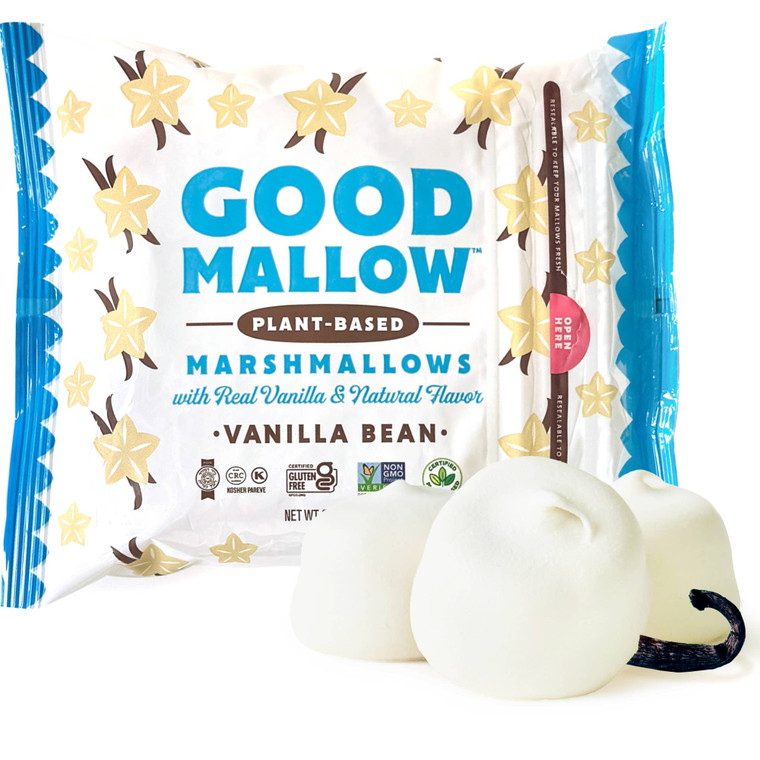
Good Mallow
Vanilla Bean Marshmallows - 10 oz
GoodMallow reimagines the campfire classic — gelatin-free, dairy-free, and gluten-free — without leaning on artificial anything. These large vanilla bean marshmallows are made with pea protein as the structural backbone instead of animal-derived gelatin, delivering the same pillowy pull you expect from a great marshmallow in a format that works for vegan, kosher, and gluten-free households alike.
- Built for the moments that matter: hot chocolate floaters, campfire s'mores, Rice Krispie treats, and holiday baking — these are large-format marshmallows sized to actually perform in all of them.
- Pea protein replaces gelatin: the structural leap that makes these fully vegan and kosher-certified without sacrificing the stretch and set that define a marshmallow worth eating.
- Certified Gluten-Free, Dairy-Free, Vegan, and Kosher — meeting four major dietary standards simultaneously makes these a go-to for mixed-household baking and entertaining.
GoodMallow was built around a single premise: the marshmallow — one of the most universally loved sweets — had never been done right for the vegan, kosher, or gluten-free household. Every mainstream marshmallow relies on animal-derived gelatin, locking out anyone who keeps kosher or avoids animal products. GoodMallow fixed that by engineering a pea protein–based structure that holds shape, toasts over a flame, and melts into hot chocolate the way a classic marshmallow should.
These are large marshmallows — not the mini baking variety — designed to perform in every marshmallow application: floating in mugs, stacking on s'more skewers, folding into fudge, and crusting the top of a sweet potato casserole. The vanilla bean flavor comes from natural flavor rather than synthetic vanillin, and vegetable juice provides the characteristic white color without artificial dyes.
GoodMallow carries four simultaneous certifications: Certified Gluten-Free, Dairy-Free, Vegan, and Kosher. For anyone navigating a mixed-dietary household — or baking for guests with multiple restrictions — that combination is genuinely rare in the confection aisle. Most gelatin-free marshmallow alternatives either skip kosher certification or are certified gluten-free but not vegan. GoodMallow clears all four bars at once.
Serve them over hot chocolate, use them in s'mores (they toast and char just like conventional marshmallows), fold them into homemade fudge, or use them anywhere a recipe calls for large marshmallows. Store in a cool, dry place away from humidity to maintain texture. Once opened, reseal tightly.
Certified Gluten-Free · Dairy-Free · Vegan · Kosher. Store in a cool, dry location.
Ingredients: Tapioca Syrup, Cane Sugar, Pea Protein, Carrageenan, Natural Flavor, Dextrose, And Vegetable Juice For Color.
Common Questions
What holds these marshmallows together if there's no gelatin?
GoodMallow uses a combination of pea protein and carrageenan to replace the structural role that animal-derived gelatin plays in conventional marshmallows. Gelatin works by forming a protein network that traps air bubbles and gives marshmallows their characteristic bounce and melt; pea protein provides a similar network-forming capacity, while carrageenan — a seaweed-derived polysaccharide — contributes gelling and stabilization. The tapioca syrup and cane sugar act as the sugar matrix that surrounds that structure, which is essentially the same role corn syrup plays in traditional recipes. The result is a marshmallow that holds its shape at room temperature, softens when heated, and toasts over an open flame rather than simply melting away.
How do these compare nutritionally to conventional gelatin-based marshmallows?
A conventional large marshmallow (roughly 7g) is essentially sugar, corn syrup, gelatin, and sometimes artificial vanilla — it provides virtually no protein. GoodMallow's pea protein inclusion means these marshmallows deliver a small but real protein contribution that standard marshmallows do not. Both products are fat-free and moderately high in simple sugars, so the caloric profile is broadly similar. The meaningful difference is ingredient quality: tapioca syrup instead of high-fructose corn syrup, natural flavor instead of synthetic vanillin, and vegetable juice for color instead of titanium dioxide or artificial dyes — all of which matter to buyers reading ingredient labels closely.
Do these actually toast and char over a flame the way regular marshmallows do?
Yes — the sugar matrix in GoodMallow behaves similarly to that in gelatin-based marshmallows when exposed to direct heat, so the exterior caramelizes and chars while the interior softens. The Maillard reaction between the sugars and the pea protein also contributes browning. That said, the interior texture when toasted is slightly denser than a gelatin marshmallow because the pea protein network doesn't expand under heat the same way collagen-derived gelatin does. For s'mores over a campfire or gas burner, the performance is close enough to conventional marshmallows that most people don't notice the difference.
What exactly does the Kosher certification cover, and which agency certifies these?
A Kosher certification for a marshmallow product primarily signals two things: the product contains no gelatin derived from non-kosher animals (pork-derived gelatin, which is used in most mainstream marshmallows, is not kosher), and all ingredients and processing steps have been inspected and approved by a recognized rabbinical authority. The specific certifying agency for GoodMallow should be verified by checking the certification symbol printed on the physical packaging, as different agencies (OU, OK, Star-K, CRC, etc.) have different scopes of inspection. For dairy-keeping households, it's worth confirming whether the product is certified Kosher Pareve — meaning it contains no meat or dairy — so it can be eaten with either a meat or dairy meal.
Can I substitute these in baking recipes that call for regular marshmallows, like Rice Krispie treats or fudge?
GoodMallow large marshmallows work in most baking applications that call for conventional large marshmallows, but a couple of practical adjustments help. In Rice Krispie-style treats, melt them over low heat with a small amount of vegan butter or coconut oil, stirring constantly — they can scorch slightly faster than gelatin marshmallows because the pea protein browns at lower temperatures than gelatin does. For fudge, fold them in after removing the mixture from heat rather than melting them directly into a boiling sugar syrup. In sweet potato casseroles, they perform very similarly to conventional marshmallows and develop a toasted crust under the broiler. The large size means you'll use roughly the same count as a standard large-marshmallow recipe calls for.
Is carrageenan safe to eat, and why is it used here?
Carrageenan is a polysaccharide extracted from red seaweed and has been used as a food thickener and gelling agent for decades; it is classified as GRAS (Generally Recognized as Safe) by the U.S. FDA and is approved for use in organic and vegan-certified products. In GoodMallow, it serves as the secondary structural agent alongside pea protein, helping the marshmallow hold a gel-like interior at room temperature. Some online sources conflate food-grade carrageenan with degraded carrageenan (poligeenan), which is a chemically distinct compound not used in food — the distinction is scientifically important and frequently misrepresented in consumer content. Food-grade carrageenan at the levels used in confections represents a very small total intake and is permitted under Certified Gluten-Free, Vegan, Kosher, and Dairy-Free standards simultaneously.
Are these appropriate for someone avoiding gluten due to celiac disease, not just a gluten preference?
GoodMallow carries a Certified Gluten-Free designation, which under most major certification bodies (including GFFS and GFCO) requires the product to test below 10-20 parts per million of gluten — the GFCO threshold is 10 ppm, which is stricter than the FDA's 20 ppm labeling standard. None of the listed ingredients — tapioca syrup, cane sugar, pea protein, carrageenan, natural flavor, dextrose, or vegetable juice — are inherently gluten-containing, so the primary concern for celiac-level sensitivity is cross-contact during manufacturing. The certification addresses that by requiring facility audits and periodic product testing. People with celiac disease should still check the most current packaging for the specific certifying body and any advisory statements, as formulations and manufacturing facilities can change.
These are large marshmallows — not the mini baking variety — designed to perform in every marshmallow application: floating in mugs, stacking on s'more skewers, folding into fudge, and crusting the top of a sweet potato casserole. The vanilla bean flavor comes from natural flavor rather than synthetic vanillin, and vegetable juice provides the characteristic white color without artificial dyes.
GoodMallow carries four simultaneous certifications: Certified Gluten-Free, Dairy-Free, Vegan, and Kosher. For anyone navigating a mixed-dietary household — or baking for guests with multiple restrictions — that combination is genuinely rare in the confection aisle. Most gelatin-free marshmallow alternatives either skip kosher certification or are certified gluten-free but not vegan. GoodMallow clears all four bars at once.
Serve them over hot chocolate, use them in s'mores (they toast and char just like conventional marshmallows), fold them into homemade fudge, or use them anywhere a recipe calls for large marshmallows. Store in a cool, dry place away from humidity to maintain texture. Once opened, reseal tightly.
Certified Gluten-Free · Dairy-Free · Vegan · Kosher. Store in a cool, dry location.
Ingredients: Tapioca Syrup, Cane Sugar, Pea Protein, Carrageenan, Natural Flavor, Dextrose, And Vegetable Juice For Color.
Common Questions
What holds these marshmallows together if there's no gelatin?
GoodMallow uses a combination of pea protein and carrageenan to replace the structural role that animal-derived gelatin plays in conventional marshmallows. Gelatin works by forming a protein network that traps air bubbles and gives marshmallows their characteristic bounce and melt; pea protein provides a similar network-forming capacity, while carrageenan — a seaweed-derived polysaccharide — contributes gelling and stabilization. The tapioca syrup and cane sugar act as the sugar matrix that surrounds that structure, which is essentially the same role corn syrup plays in traditional recipes. The result is a marshmallow that holds its shape at room temperature, softens when heated, and toasts over an open flame rather than simply melting away.
How do these compare nutritionally to conventional gelatin-based marshmallows?
A conventional large marshmallow (roughly 7g) is essentially sugar, corn syrup, gelatin, and sometimes artificial vanilla — it provides virtually no protein. GoodMallow's pea protein inclusion means these marshmallows deliver a small but real protein contribution that standard marshmallows do not. Both products are fat-free and moderately high in simple sugars, so the caloric profile is broadly similar. The meaningful difference is ingredient quality: tapioca syrup instead of high-fructose corn syrup, natural flavor instead of synthetic vanillin, and vegetable juice for color instead of titanium dioxide or artificial dyes — all of which matter to buyers reading ingredient labels closely.
Do these actually toast and char over a flame the way regular marshmallows do?
Yes — the sugar matrix in GoodMallow behaves similarly to that in gelatin-based marshmallows when exposed to direct heat, so the exterior caramelizes and chars while the interior softens. The Maillard reaction between the sugars and the pea protein also contributes browning. That said, the interior texture when toasted is slightly denser than a gelatin marshmallow because the pea protein network doesn't expand under heat the same way collagen-derived gelatin does. For s'mores over a campfire or gas burner, the performance is close enough to conventional marshmallows that most people don't notice the difference.
What exactly does the Kosher certification cover, and which agency certifies these?
A Kosher certification for a marshmallow product primarily signals two things: the product contains no gelatin derived from non-kosher animals (pork-derived gelatin, which is used in most mainstream marshmallows, is not kosher), and all ingredients and processing steps have been inspected and approved by a recognized rabbinical authority. The specific certifying agency for GoodMallow should be verified by checking the certification symbol printed on the physical packaging, as different agencies (OU, OK, Star-K, CRC, etc.) have different scopes of inspection. For dairy-keeping households, it's worth confirming whether the product is certified Kosher Pareve — meaning it contains no meat or dairy — so it can be eaten with either a meat or dairy meal.
Can I substitute these in baking recipes that call for regular marshmallows, like Rice Krispie treats or fudge?
GoodMallow large marshmallows work in most baking applications that call for conventional large marshmallows, but a couple of practical adjustments help. In Rice Krispie-style treats, melt them over low heat with a small amount of vegan butter or coconut oil, stirring constantly — they can scorch slightly faster than gelatin marshmallows because the pea protein browns at lower temperatures than gelatin does. For fudge, fold them in after removing the mixture from heat rather than melting them directly into a boiling sugar syrup. In sweet potato casseroles, they perform very similarly to conventional marshmallows and develop a toasted crust under the broiler. The large size means you'll use roughly the same count as a standard large-marshmallow recipe calls for.
Is carrageenan safe to eat, and why is it used here?
Carrageenan is a polysaccharide extracted from red seaweed and has been used as a food thickener and gelling agent for decades; it is classified as GRAS (Generally Recognized as Safe) by the U.S. FDA and is approved for use in organic and vegan-certified products. In GoodMallow, it serves as the secondary structural agent alongside pea protein, helping the marshmallow hold a gel-like interior at room temperature. Some online sources conflate food-grade carrageenan with degraded carrageenan (poligeenan), which is a chemically distinct compound not used in food — the distinction is scientifically important and frequently misrepresented in consumer content. Food-grade carrageenan at the levels used in confections represents a very small total intake and is permitted under Certified Gluten-Free, Vegan, Kosher, and Dairy-Free standards simultaneously.
Are these appropriate for someone avoiding gluten due to celiac disease, not just a gluten preference?
GoodMallow carries a Certified Gluten-Free designation, which under most major certification bodies (including GFFS and GFCO) requires the product to test below 10-20 parts per million of gluten — the GFCO threshold is 10 ppm, which is stricter than the FDA's 20 ppm labeling standard. None of the listed ingredients — tapioca syrup, cane sugar, pea protein, carrageenan, natural flavor, dextrose, or vegetable juice — are inherently gluten-containing, so the primary concern for celiac-level sensitivity is cross-contact during manufacturing. The certification addresses that by requiring facility audits and periodic product testing. People with celiac disease should still check the most current packaging for the specific certifying body and any advisory statements, as formulations and manufacturing facilities can change.
- __Storage_Location:
- Dry
- __Volume:
- 400
- __Owner:
- TCFarm